SISGAIN Technologies is a leading software development company specializing in Remote Patient Monitoring (RPM) software, healthcare app development, and restaurant POS systems.
If you run a business in Dubai or anywhere else in the UAE, you already know how mobile-obsessed your customers are. They browse on the metro, compare prices in-store, and expect a website to load instantly — or they bounce straight to a competitor. This is exactly why Progressive Web App development in Dubai has moved from “nice to have” to “must have” for companies that want to grow without burning through their budget on a separate native app for every platform.
A Progressive Web App, or PWA, sits in the sweet spot between a website and a mobile app. It loads through a browser like any webpage, but it behaves like an app — it can work offline, send push notifications, and even sit on a user’s home screen. For businesses across the UAE, this means Progressive Web Apps in UAE are quickly becoming the practical answer to a very real problem: how do you give customers an app-like experience without the cost and delay of building separate iOS and Android apps?
In this guide, we’ll break down exactly what PWAs are, how they work, where they fit into different industries, what they cost, and how they genuinely contribute to business growth with PWA in UAE — minus the marketing fluff you’ll find on most pages covering this topic.
Key Takeaways
Before we go deep into the details, here’s a quick map of what this guide covers and the core ideas you’ll walk away with:
What a PWA actually is a hybrid between a website and a native app that runs through any modern browser.
The real benefits of Progressive Web Apps in Dubai faster load speeds, offline access, lower development cost, and better customer retention.
How PWAs technically work through service workers, app shells, and a web app manifest, explained in plain language.
The features that make a PWA genuinely useful installability, push notifications, responsiveness, and automatic updates.
Where PWAs are already creating impact retail, real estate, hospitality, government services, and logistics across the UAE.
An honest look at the pros and cons because no technology is perfect for every business.
The common roadblocks teams face including iOS limitations and discoverability — and practical ways around them.
What it actually costs the real factors that influence app development cost in Dubai, including super app functionality.
Best practices and what’s coming next from AI-driven personalization to the rising demand for super apps in the region.
Why the right development partner matters and what to look for in a mobile application development company in Dubai.
What Is a Progressive Web App?
A Progressive Web App is a website built with modern web technologies that delivers an app-like experience — installable, fast, and capable of working offline — without requiring a download from an app store.
In simple terms, think of a PWA as a website that’s learned the best tricks from native apps. You open it once through a browser like Chrome or Safari, and from then on, it can behave almost exactly like an app you’d download from the App Store or Google Play. There’s no lengthy installation process, no waiting for app store approval, and no separate codebase for every operating system.
This is precisely why PWA development services in Dubai have become so popular among startups and enterprises alike — they solve a genuine business pain point: reaching customers quickly, on every device, without multiplying development costs.
Key Benefits of Progressive Web Apps for Business Growth
The reason PWAs keep coming up in growth conversations isn’t hype — it’s measurable impact. Here are the benefits of Progressive Web Apps in Dubai that actually move the needle for a business:
Faster load times. PWAs use caching and a lightweight app shell, so pages load in a fraction of the time compared to traditional websites — and speed directly affects conversion rates.
Works offline or on weak connections. This matters a lot in a market like the UAE, where users might be in basements, elevators, or areas with patchy connectivity. A PWA keeps functioning instead of showing a blank screen.
Lower development and maintenance cost. Instead of building and maintaining separate apps for iOS and Android, you maintain one responsive codebase that works everywhere.
No app store friction. Customers don’t need to search, download, and wait. They tap “Add to Home Screen” and they’re in — which removes a major drop-off point in the user journey.
Better engagement through push notifications. PWAs support push notifications even though they’re technically websites, helping you re-engage users the same way a native app would.
Improved SEO visibility. Because a PWA is still a website at its core, it can be indexed by search engines — something a native app simply cannot do on its own.
Higher conversion and retention rates. Several global retailers have reported meaningfully higher conversion rates and session times after switching to a PWA, largely because the friction of installation and load time disappears.
Together, these advantages explain why business growth with PWA in UAE isn’t just a buzzword — it’s a practical strategy for companies trying to do more with a leaner budget.
How Progressive Web Apps Work
PWAs rely on a handful of web technologies that, together, create that app-like feel:
Service Workers — These are background scripts that manage caching and offline functionality. They intercept network requests and decide whether to serve content from the cache or fetch it fresh, which is what allows the app to work without an internet connection.
Web App Manifest — A simple JSON file that tells the browser how the app should behave when installed: its name, icon, theme color, and how it should launch (full-screen, like a native app, rather than inside browser tabs).
App Shell Architecture — This is the minimal HTML, CSS, and JavaScript needed to power the user interface. It loads instantly because it’s cached locally, while the actual content loads dynamically.
HTTPS Requirement — PWAs must be served over a secure connection. This isn’t just a technical checkbox; it builds the trust layer that’s essential for any business handling customer data or payments.
Put simply, a PWA “wraps” your existing web experience in a layer of modern technology that makes it faster, installable, and far more resilient.
Major Features of a Well-Built PWA
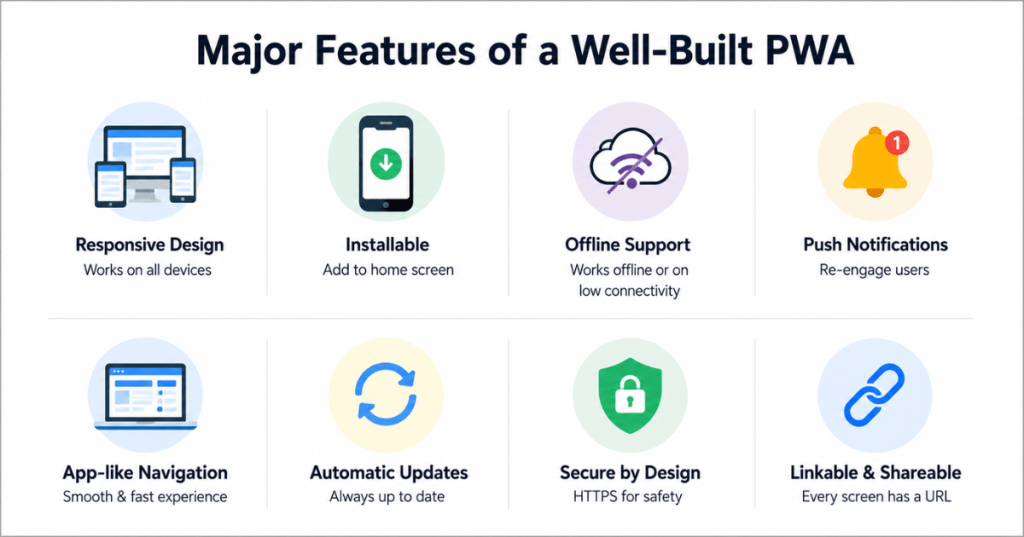
Not every website that calls itself a PWA actually delivers the full experience. Here’s what to look for — and what any credible PWA development services in Dubai provider should be building into your app:
Responsive design that adapts seamlessly across mobile, tablet, and desktop screens.
Installable on the home screen without going through an app store.
Offline and low-connectivity support through smart caching strategies.
Push notifications to bring users back without relying on email or SMS.
App-like navigation with smooth transitions and minimal reliance on full page reloads.
Automatic updates — users always get the latest version without manually updating anything.
Secure by design, since HTTPS is a non-negotiable requirement.
Linkable and shareable, meaning every screen has a URL that can be shared directly — something native apps can’t easily replicate.
Industry Applications: Where PWAs Are Making an Impact in the UAE
PWAs aren’t a one-size-fits-all solution, but their flexibility makes them relevant across a surprising number of sectors:
Retail and e-commerce. Online stores use PWAs to reduce cart abandonment by speeding up checkout and keeping the shopping experience alive even on flaky mobile networks — a real concern during high-traffic sale events.
Real estate. Property platforms benefit from instant-loading listings, offline browsing of saved properties, and push alerts for new listings matching a buyer’s criteria.
Hospitality and travel. Hotels and travel platforms use PWAs to let guests check booking details, boarding passes, or itineraries even without a stable connection at the airport.
Government and public services. As government bodies across the UAE push forward smart-city and digital-government initiatives, PWAs offer a low-friction way for citizens to access services without downloading a separate app for every department.
Logistics and delivery. Drivers and field staff rely on PWAs that keep working in low-signal areas, syncing data automatically once connectivity returns.
Healthcare. Clinics and healthcare platforms use PWAs for appointment booking and patient portals that load quickly even on older devices.
This breadth of use cases is exactly why many businesses now treat PWA development as a core part of their digital strategy, not just an experimental side project.
Advantages and Disadvantages of Progressive Web Apps
No technology decision should be made without weighing both sides. Here’s an honest comparison:
Advantages
Disadvantages
Lower development cost than building separate native apps
Limited access to certain native device features (e.g., advanced Bluetooth, some camera APIs)
Faster time-to-market
iOS support, while improved, still lags behind Android in some PWA capabilities
Works across all devices and operating systems
Discoverability can be harder since PWAs aren’t always listed in app stores
Easier to maintain — one codebase instead of several
Push notification support on iOS Safari has historically been more limited
Better SEO performance since content is crawlable
Heavy offline-first apps still require careful architecture to avoid performance issues
No app store approval delays or fees
Users unfamiliar with “Add to Home Screen” may not realize an app-like option exists
The takeaway here isn’t that PWAs are flawless — it’s that for most small and mid-sized businesses, the advantages significantly outweigh the limitations, especially when budget and speed-to-market matter.
Why Experienced Developers Make PWA Projects More Successful
Building a high-performing Progressive Web App requires more than technical knowledge—it demands strategic planning and extensive testing. Experienced app developers in UAE understand regional customer behavior, device preferences, browser compatibility, and local business requirements. They design scalable architectures, implement reliable offline functionality, optimize performance across multiple platforms, and address challenges such as iOS limitations before launch. By anticipating technical issues early, skilled developers reduce project risks, improve user experience, and ensure your PWA delivers consistent performance as your business expands across the UAE market.
Understanding the Cost of Building a Super App
If your long-term vision includes combining multiple services into one platform, understanding the cost of super app development UAE becomes essential. Unlike standard Progressive Web Apps, super apps integrate features such as payments, messaging, booking systems, loyalty programs, and real-time tracking within a single ecosystem. These advanced capabilities require stronger backend infrastructure, scalable architecture, API integrations, and ongoing maintenance. While the investment is significantly higher, businesses benefit from greater customer engagement, increased retention, and the flexibility to expand services without rebuilding their digital platform.
What Influences App Development Costs in Dubai?
Every business has unique requirements, which is why app development cost in Dubai varies based on project complexity, features, integrations, design quality, and scalability goals. A basic Progressive Web App typically requires a lower investment than enterprise-grade solutions with payment gateways, multilingual support, AI capabilities, or custom backend systems. Additional factors such as security requirements, cloud infrastructure, third-party APIs, and ongoing maintenance also influence the final budget. Understanding these variables helps businesses plan realistic investments while selecting features that deliver the highest long-term return.
Best Practices for Successful PWA Development
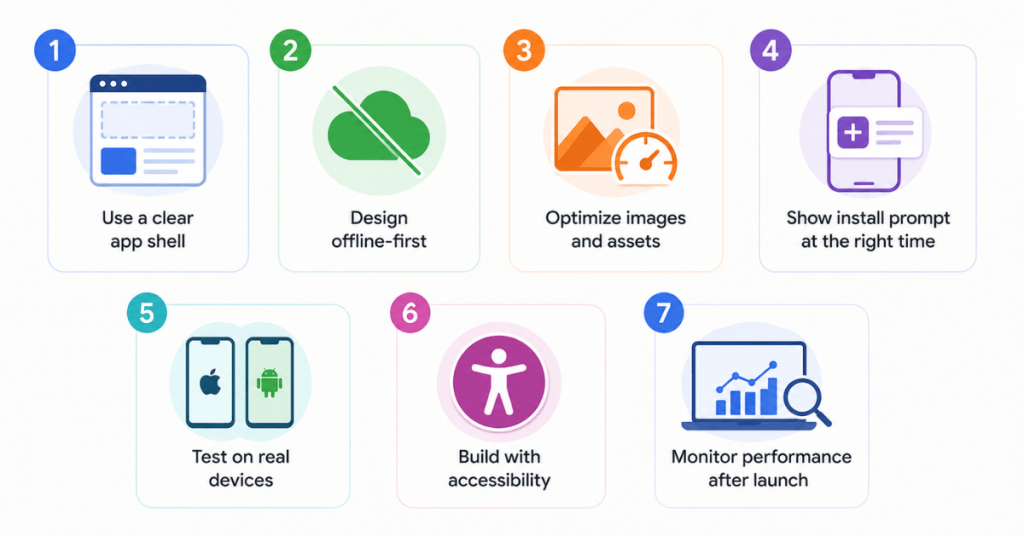
If you’re planning to invest in a PWA, these practices consistently separate the projects that succeed from the ones that quietly underperform:
Start with a clear app shell strategy so your interface loads instantly, even before content arrives.
Design offline-first, not offline-as-an-afterthought — plan what should still work without a connection from day one.
Optimize images and assets aggressively, since speed is the entire value proposition of a PWA.
Make the install prompt visible and well-timed, rather than burying the “Add to Home Screen” option.
Test across real devices, not just emulators, especially across the iOS and Android split common in the UAE market.
Build with accessibility in mind, ensuring the app works well for all users, including those using assistive technologies.
Monitor performance post-launch using tools like Lighthouse to catch regressions early.
Future Trends: What’s Next for PWAs in the UAE
The PWA landscape is evolving quickly, and a few trends are worth watching closely:
AI-driven personalization is becoming standard, with PWAs increasingly using behavioral data to tailor content and recommendations in real time.
Rising demand for super apps. The UAE’s appetite for all-in-one platforms — combining payments, bookings, and services — is pushing more businesses to explore super app architecture built on a PWA foundation.
Improved iOS support is gradually closing the gap with Android, making PWAs an even safer long-term bet.
5G adoption across the region is making even richer, more interactive PWA experiences viable without sacrificing speed.
Voice and conversational interfaces are starting to integrate into PWAs, particularly in retail and customer service contexts.
Businesses that invest in PWA infrastructure now are positioning themselves to adopt these trends faster than competitors still tied to slower, native-only development cycles.
Why SISGAIN Is Essential for These Services
Technology alone doesn’t guarantee results — the right development partner does. As a mobile application development company in Dubai, SISGAIN brings together technical depth and regional market understanding, which matters when you’re building for UAE-based customers with specific connectivity patterns, payment preferences, and bilingual content needs.
Working with experienced app developers in UAE means your PWA is architected correctly from the start — covering offline strategy, security, and scalability — rather than retrofitted after performance issues surface. SISGAIN‘s approach typically includes:
A discovery phase that maps your business goals to the right PWA features, instead of a one-size-fits-all template.
Transparent guidance on app development cost based on your actual scope, not inflated estimates.
Experience scaling from a focused PWA into broader super app development as your business grows.
Ongoing support post-launch, since a PWA’s performance depends on continuous monitoring and updates.
Choosing a partner who understands both the technical and commercial side of PWA development is often the single biggest factor in whether a project delivers real business growth with PWA in UAE or just becomes another underused digital asset.
Conclusion
Progressive Web Apps have moved well past the experimental stage. For businesses across Dubai and the wider UAE, Progressive Web App development in Dubai offers a genuinely practical path to reaching customers faster, cutting development costs, and staying competitive without the overhead of maintaining multiple native apps. From faster load times and offline functionality to easier maintenance and stronger SEO performance, the benefits compound quickly once a PWA is built thoughtfully and maintained properly.
That said, a PWA is only as good as the strategy and team behind it. Understanding the real costs, the genuine challenges, and the best practices outlined in this guide puts you in a far stronger position to make a decision that actually serves your business goals — rather than just following a trend.
Frequently Asked Questions ?
1. What is the difference between a PWA and a native app?
A PWA runs through a browser and works across all devices with a single codebase, while a native app is built separately for iOS and Android and must be downloaded from an app store. PWAs are generally faster to build and cheaper to maintain, though native apps still offer deeper access to certain device hardware.
2. Do Progressive Web Apps work on iPhones?
Yes, PWAs work on iPhones through Safari, though some features — particularly certain push notification capabilities — have historically been more limited on iOS compared to Android. Apple has been steadily improving this support in recent updates.
3. How much does Progressive Web App development cost in Dubai?
Cost depends entirely on scope — a simple PWA costs considerably less than a feature-rich app with payment integration, multi-language support, or super app functionality. A detailed discovery conversation with a development team is the most reliable way to get an accurate estimate.
4. Can a PWA replace my mobile app completely?
For many businesses, yes — especially those prioritizing speed-to-market and lower maintenance costs. However, businesses needing deep hardware integration (like advanced camera or sensor access) may still benefit from a native app alongside their PWA.
5. Which industries in the UAE benefit most from PWAs?
Retail, real estate, hospitality, logistics, healthcare, and government services have all seen strong results, largely because these sectors depend heavily on fast, reliable mobile experiences for a wide range of users.
Artificial intelligence is no longer a futuristic concept in e-commerce—it has become a powerful competitive advantage that separates high-growth brands from businesses struggling to keep pace. While many companies still rely on traditional strategies, leading e-commerce brands are using AI and machine learning to deliver personalized experiences, optimize operations, predict customer behavior, and increase profitability.
This growing gap between AI-driven organizations and conventional online stores is reshaping the future of digital commerce. From intelligent product recommendations and dynamic pricing to demand forecasting and automated customer support, AI-powered technologies are enabling businesses to operate smarter and scale faster.
The most successful brands understand that AI is not simply about automation; it is about creating better customer experiences and making data-driven decisions. By learning from these industry leaders, businesses can unlock new growth opportunities and build a stronger competitive position in an increasingly intelligent and customer-centric marketplace.
Key Takeaways
High-growth e-commerce companies are no longer relying solely on traditional marketing and operational strategies. They are leveraging artificial intelligence and machine learning to create smarter, more personalized, and highly scalable businesses.
AI in E-commerce has evolved from an emerging technology into a competitive necessity.
Machine learning enables businesses to predict customer behavior and improve decision-making.
Personalized recommendations and predictive analytics significantly increase revenue and customer loyalty.
AI-powered automation helps reduce operational costs and improve efficiency.
Demand forecasting and inventory optimization allow brands to minimize waste and maximize profitability.
Large Language Models (LLMs) are changing how customers discover products and interact with businesses.
Generative Engine Optimization (GEO) and Answer Engine Optimization (AEO) are becoming essential for visibility across AI-driven search experiences.
Companies that delay AI adoption risk losing market share to more agile competitors.
Successful AI implementation requires clear goals, quality data, and scalable technologies.
Partnering with experienced providers like SISGAIN can accelerate digital transformation and maximize return on investment.
AI-powered e-commerce will continue evolving through agentic AI, autonomous assistants, predictive commerce, and real-time personalization.
Why AI and Machine Learning Have Become Essential for E-commerce Growth
The Shift From Traditional E-commerce to Intelligent Commerce
Modern businesses across industries are embracing intelligent technologies to improve customer experiences and operational efficiency. While AI in e-commerce is transforming digital commerce, sectors such as AI and Machine Learning for healthcare are also demonstrating how predictive analytics and automation can deliver measurable outcomes. Organizations that invest in AI early gain stronger competitive advantages, improve decision-making, and build scalable systems that support long-term growth and innovation.
Rising Customer Expectations
Modern consumers expect seamless, personalized, and convenient shopping experiences across every touchpoint. They want relevant product recommendations, fast responses, and frictionless transactions. AI technologies help businesses understand customer preferences and deliver tailored experiences that improve satisfaction, strengthen loyalty, and increase conversion rates in an increasingly competitive digital marketplace.
Data-Driven Decision Making
Leading e-commerce brands no longer rely on assumptions when making business decisions. Machine learning models analyze customer behavior, sales patterns, and market trends to generate valuable insights. These data-driven strategies help companies improve forecasting, optimize inventory, refine marketing campaigns, and make informed decisions that contribute to sustainable growth.
Personalization as a Competitive Advantage
Personalization has become one of the strongest differentiators in modern commerce. AI-powered systems analyze browsing history, purchase behavior, and customer preferences to deliver customized recommendations and targeted experiences. Businesses that prioritize personalization can enhance customer engagement, increase average order value, and create stronger relationships that encourage repeat purchases.
Increasing Pressure on Margins and Customer Acquisition Costs
Rising advertising expenses and growing competition are making it increasingly difficult for businesses to maintain profitability. AI and machine learning help companies optimize marketing spending, improve customer retention, forecast demand, and automate repetitive processes. These capabilities reduce operational costs and enable brands to maximize revenue while maintaining healthy profit margins.
What High-Growth E-commerce Brands Understand That Others Overlook
AI Is Not Just Automation—It Is Business Intelligence
Many businesses still view artificial intelligence as a tool for automating repetitive tasks. However, high-growth companies understand that AI for E-commerce Businesses goes far beyond automation. Modern AI systems generate valuable insights, identify opportunities, predict trends, and support better decision-making. By leveraging Machine Learning Solutions for E-commerce, leading brands create intelligent ecosystems that improve efficiency, increase revenue, and deliver exceptional customer experiences.
AI Helps Predict Customer Behavior
Successful e-commerce brands use AI to understand how customers browse, shop, and interact with products. Predictive analytics allows businesses to anticipate future purchasing patterns, identify high-value customers, and recommend relevant products. These insights enable companies to improve engagement, increase conversions, and make proactive decisions that drive sustainable growth.
Machine Learning Improves Every Interaction
Machine learning continuously analyzes customer activities and refines digital experiences over time. From personalized emails and product suggestions to targeted advertisements and chatbots, intelligent systems ensure every interaction becomes more relevant. This continuous optimization helps businesses improve customer satisfaction and create stronger relationships with their audiences.
Data Creates Sustainable Competitive Advantages
Data has become one of the most valuable assets in modern commerce. High-growth brands use AI-driven insights to understand market trends, optimize inventory, and refine marketing strategies. Businesses that effectively utilize their data gain long-term advantages that competitors relying on traditional approaches often struggle to replicate.
Continuous Learning Enables Faster Growth
Unlike traditional software, machine learning models evolve with every new interaction and dataset. This ability to learn continuously allows businesses to adapt to changing customer preferences and market conditions. As a result, companies can innovate faster, improve operational efficiency, and maintain a strong competitive position in rapidly evolving markets.
How AI in E-commerce Improves Customer Experience
Creating Hyper-Personalized Shopping Journeys
Customer experience has become a defining factor for success in digital commerce. AI in E-commerce enables brands to create highly personalized shopping journeys that increase engagement and customer loyalty. Through intelligent recommendations, predictive analytics, and real-time personalization, AI-Powered E-commerce platforms provide seamless experiences that meet the expectations of today’s consumers while improving overall business performance.
Personalized Product Recommendations
AI algorithms analyze browsing history, purchase behavior, and customer preferences to suggest products that are most relevant to individual shoppers. Personalized recommendations improve product discovery, increase average order values, and enhance customer satisfaction. This capability has become one of the most effective E-commerce AI Solutions for driving revenue growth.
Dynamic Pricing Strategies
Modern AI systems can adjust pricing based on demand, competition, customer behavior, and market conditions. Dynamic pricing helps businesses maximize profitability while remaining competitive. By analyzing large volumes of data in real time, companies can make smarter pricing decisions that improve both sales performance and customer retention.
AI-Based Search and Navigation
Traditional search functions often struggle to understand customer intent. AI-powered search technologies provide more accurate results by interpreting natural language and user behavior. Intelligent navigation enhances product discovery, reduces friction, and enables customers to find desired products more quickly, resulting in higher conversion rates.
Voice Commerce and Conversational Shopping
The growing popularity of voice assistants and conversational AI is transforming online shopping experiences. Customers can search for products, ask questions, and complete purchases using natural language interactions. These technologies create more convenient and engaging experiences while opening new opportunities for businesses to connect with consumers.
AI-Powered Customer Support
AI chatbots and virtual assistants provide instant support and personalized assistance throughout the customer journey. They help answer questions, track orders, resolve issues, and offer recommendations around the clock. This level of responsiveness improves customer satisfaction while reducing operational costs and increasing service efficiency.
Machine Learning Applications That Are Driving Revenue Growth
Practical Use Cases Used by Fast-Growing Brands
Leading digital retailers are increasingly using Machine Learning in E-commerce to improve efficiency, enhance customer experiences, and increase profitability. Rather than relying on assumptions, successful brands leverage data-driven insights to optimize operations and make smarter decisions. These Machine Learning Solutions for E-commerce enable businesses to scale faster while creating sustainable competitive advantages in an increasingly demanding market.
Demand Forecasting
Machine learning models analyze historical sales data, customer trends, and seasonal patterns to accurately predict future demand. This enables businesses to prepare inventory levels, reduce waste, and avoid stock shortages. Better forecasting helps companies improve customer satisfaction and maximize revenue opportunities.
Inventory Optimization
Efficient inventory management is essential for profitability. Machine learning systems monitor stock levels and purchasing trends to ensure products are available when customers need them. This minimizes overstocking, reduces carrying costs, and helps businesses maintain healthy profit margins.
Customer Segmentation
Machine learning enables businesses to divide customers into meaningful groups based on behavior, preferences, and purchase history. These insights allow brands to create targeted campaigns and personalized experiences that improve engagement, increase conversions, and strengthen customer relationships.
Predictive Analytics
Predictive analytics helps businesses identify future trends and anticipate customer behavior. By analyzing large volumes of data, organizations can make proactive decisions regarding pricing, promotions, and product strategies. This approach improves operational efficiency and drives long-term growth.
Fraud Detection
Fraud prevention has become increasingly important in digital commerce. Machine learning algorithms can identify suspicious transactions and unusual patterns in real time. These intelligent systems reduce financial risks, protect customer information, and help maintain trust in online platforms.
Churn Prediction Models
Machine learning can identify customers who are likely to stop purchasing or switch to competitors. By recognizing early warning signs, businesses can implement retention strategies and personalized offers that improve loyalty and increase customer lifetime value.
Marketing Campaign Optimization
Machine learning helps businesses analyze campaign performance and customer responses across multiple channels. These insights allow marketers to optimize targeting, allocate budgets effectively, and improve return on investment while delivering more relevant experiences to customers.
The Hidden Costs of Ignoring AI and Machine Learning
Why Businesses That Delay Adoption Risk Falling Behind
As artificial intelligence becomes more deeply integrated into commerce, businesses that delay adoption face increasing challenges. Competitors using intelligent technologies are delivering better customer experiences and operating more efficiently. Companies that fail to embrace AI and machine learning may struggle to remain competitive in an evolving digital marketplace.
Higher Customer Acquisition Costs
Without AI-driven insights, businesses often rely on inefficient marketing strategies that increase advertising expenses. Intelligent systems optimize audience targeting and campaign performance, helping organizations acquire customers more efficiently and improve overall marketing returns.
Lower Conversion Rates
Traditional online experiences often fail to deliver the personalization modern consumers expect. AI-powered recommendations and behavioral analysis increase relevance and engagement, enabling businesses to convert more visitors into paying customers and maximize revenue opportunities.
Poor Inventory Management
Inaccurate forecasting and manual inventory processes can result in stock shortages or excess inventory. These issues negatively affect customer satisfaction and profitability. AI technologies help businesses maintain optimal inventory levels and improve operational efficiency.
Reduced Customer Retention
Customer loyalty is increasingly influenced by personalized experiences and timely interactions. Businesses that ignore AI may struggle to understand changing customer expectations, leading to lower retention rates and reduced lifetime value.
Inefficient Operations
Manual processes consume valuable resources and limit scalability. AI-driven automation streamlines workflows, reduces errors, and improves productivity. Companies that fail to modernize often experience slower growth and higher operational expenses.
Losing Market Share to AI-Enabled Competitors
High-growth brands are investing heavily in artificial intelligence to improve decision-making and customer experiences. Businesses that continue using outdated approaches risk losing customers and market share to competitors that are embracing digital innovation.
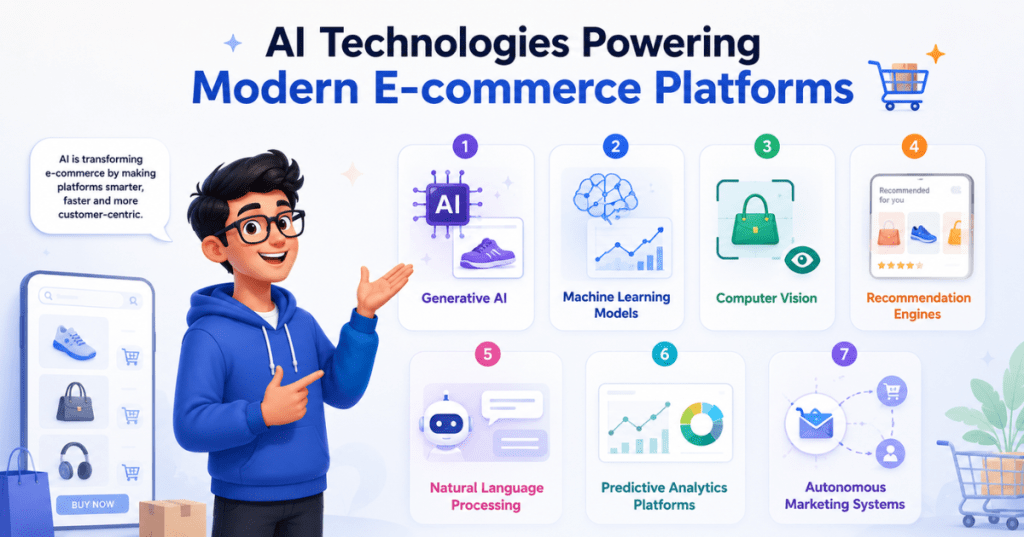
AI Technologies Powering Modern E-commerce Platforms
Modern online businesses rely on advanced technologies to deliver highly personalized and efficient shopping experiences. These E-commerce AI Solutions enable organizations to automate processes, understand customer behavior, and make data-driven decisions. As AI for E-commerce Businesses continues to evolve, these technologies are becoming essential for long-term growth and competitive differentiation.
Generative AI
Generative AI is transforming content creation, customer engagement, and personalization. Businesses use it to generate product descriptions, marketing campaigns, and conversational experiences. These capabilities improve efficiency while enabling brands to deliver more engaging customer interactions.
Machine Learning Models
Machine learning models continuously analyze customer behavior and operational data to uncover valuable insights. They support demand forecasting, recommendation engines, pricing optimization, and predictive decision-making, helping businesses improve performance and profitability.
Computer Vision
Computer vision technologies enable visual search, image recognition, and product identification. Customers can search for products using images, while businesses can automate quality control and enhance user experiences. These capabilities create more intuitive and convenient shopping journeys.
Recommendation Engines
Recommendation engines analyze browsing patterns and purchasing history to suggest relevant products to customers. Personalized recommendations increase average order values, improve engagement, and contribute significantly to revenue growth for modern e-commerce brands.
Natural Language Processing
Natural language processing enables AI systems to understand and respond to human language. This technology powers chatbots, virtual assistants, and intelligent search capabilities that improve customer interactions and provide faster support experiences.
Predictive Analytics Platforms
Predictive analytics platforms help businesses identify future trends and opportunities by analyzing large datasets. These systems improve strategic planning, optimize operations, and enable organizations to make proactive decisions that support sustainable growth.
Autonomous Marketing Systems
AI-driven marketing platforms automate campaign management, customer segmentation, and performance optimization. By continuously learning from user behavior, these systems improve targeting accuracy and help businesses maximize returns on their marketing investments.
Real-World AI Use Cases Across the E-commerce Customer Journey
Where AI Creates the Greatest Impact
Customer expectations continue to evolve, making seamless digital experiences more important than ever. AI-powered recommendations, intelligent search, and personalized engagement are helping brands increase conversions and customer loyalty. Businesses working with an experienced ECommerce App Development Company can build feature-rich and AI-enabled applications that deliver exceptional shopping experiences across web and mobile platforms while supporting long-term business growth.
Product Discovery
AI-powered search and recommendation systems make it easier for customers to discover products that match their interests and preferences. By analyzing browsing behavior and previous purchases, intelligent algorithms improve product visibility and help businesses increase conversions and customer engagement.
Personalized Recommendations
Personalized recommendations are among the most successful AI applications in digital commerce. By studying customer preferences and purchasing patterns, AI systems suggest relevant products that enhance the shopping experience, increase average order value, and encourage repeat purchases.
Smart Checkout Experiences
Artificial intelligence helps simplify checkout processes through intelligent payment methods, fraud prevention, and personalized offers. These capabilities reduce cart abandonment rates and create a faster, more convenient experience that contributes to higher conversion rates.
AI Chatbots and Customer Service
AI-driven chatbots and virtual assistants provide instant support and answer customer queries around the clock. These technologies improve response times, reduce operational costs, and ensure customers receive timely assistance throughout their shopping journey.
Inventory and Supply Chain Optimization
AI systems analyze demand patterns, supplier performance, and inventory levels to improve supply chain efficiency. These insights help businesses reduce stock shortages, minimize waste, and ensure products remain available when customers need them.
Post-Purchase Engagement
Customer relationships do not end after a transaction. AI enables businesses to deliver personalized follow-ups, loyalty rewards, and relevant recommendations that improve customer retention and increase lifetime value.
Customer Lifetime Value Prediction
Predictive AI models help businesses identify high-value customers and estimate future revenue potential. These insights enable organizations to create targeted retention strategies and maximize profitability over the long term.
AI Models and Technologies Businesses Should Understand
The AI Models Behind Intelligent E-commerce Systems
Understanding modern AI models is essential for businesses looking to create intelligent and scalable platforms. Large language models, predictive analytics, recommendation engines, and computer vision technologies are driving digital transformation across industries. Partnering with an experienced machine learning services company enables organizations to implement advanced solutions, optimize business processes, and leverage data-driven insights that improve customer experiences and support sustainable growth.
Large Language Models
Large Language Models have transformed how businesses interact with customers and optimize digital experiences. These models understand natural language, generate content, and provide intelligent responses that enhance customer engagement and support.
GPT Models
GPT models are widely used for conversational AI, content generation, product descriptions, and personalized customer interactions. They help businesses automate communication and improve user experiences across multiple channels.
Gemini
Gemini models offer advanced reasoning capabilities and multimodal understanding, enabling businesses to create intelligent search experiences, automate workflows, and deliver highly relevant customer interactions.
Claude
Claude models are designed to provide reliable and context-aware responses. Businesses use these systems to improve customer support, content generation, and knowledge management processes.
DeepSeek
DeepSeek models are gaining popularity for their cost efficiency and strong performance in coding, reasoning, and AI-assisted automation. These capabilities support intelligent business processes and scalable AI implementations.
Llama Models
Llama models provide flexible and open-source AI capabilities that enable organizations to develop customized applications while maintaining greater control over their technology ecosystems.
Recommendation Models
Recommendation engines analyze user behavior and purchasing patterns to deliver personalized product suggestions. These models enhance customer experiences and significantly increase engagement and revenue.
Predictive Machine Learning Models
Predictive models analyze historical data to forecast customer behavior, sales trends, and inventory requirements. Businesses use these insights to make proactive decisions and optimize operations.
Reinforcement Learning
Reinforcement learning enables AI systems to continuously improve through experience and feedback. This approach supports pricing optimization, recommendation engines, and intelligent automation strategies.
Computer Vision Models
Computer vision technologies enable image recognition, visual search, and product classification capabilities. These models create more interactive shopping experiences and improve operational efficiency.
Natural Language Processing Models
Natural language processing models enable AI systems to understand human language and intent. They power chatbots, intelligent search systems, and automated customer support solutions.
Generative AI Models
Generative AI models are transforming content creation and personalization. Businesses use these technologies to create product descriptions, advertisements, emails, and conversational experiences more efficiently.
Why These AI Models Matter for E-commerce Businesses
AI models enable organizations to deliver personalized experiences, automate repetitive processes, and make better decisions based on real-time insights. Businesses that invest in intelligent technologies gain competitive advantages, improve operational efficiency, and create scalable systems that support long-term growth.
Large Language Model Optimization: Preparing for AI Search
As AI-powered search platforms become increasingly popular, businesses must optimize their content for large language models and answer engines. This approach improves visibility across conversational search experiences and ensures brands remain discoverable in AI-generated responses.
How Brands Can Appear in AI-Generated Answers
Brands can improve their visibility by publishing authoritative content, answering user questions clearly, and creating structured information that AI systems can easily understand and reference.
Generative Engine Optimization
Generative Engine Optimization focuses on making content discoverable by AI platforms such as ChatGPT, Gemini, Claude, and Perplexity. GEO emphasizes context, expertise, and semantic relevance rather than traditional keyword density.
Answer Engine Optimization
Answer Engine Optimization helps businesses appear in featured snippets and AI-generated responses. Structured headings, FAQ sections, and concise explanations improve visibility across modern search experiences.
Conversational Search Optimization
Consumers increasingly interact with search engines using natural language. Businesses should create content that answers questions conversationally and addresses user intent to remain relevant in AI-driven ecosystems.
Structured Content for AI Visibility
Well-organized content with clear headings, schema markup, FAQs, and topic clusters enables AI models to understand information more effectively. Structured content improves discoverability and strengthens authority across search platforms.
Emerging Trends Shaping the Future of AI-Powered E-commerce
Innovations High-Growth Brands Are Already Exploring
Forward-thinking organizations are investing in emerging technologies that promise to redefine digital commerce. These innovations are enabling businesses to deliver smarter experiences, increase efficiency, and create new opportunities for growth.
Agentic AI
Agentic AI systems are capable of making autonomous decisions and performing complex tasks with minimal human intervention. These technologies represent the next stage in intelligent automation and business optimization.
Autonomous Shopping Assistants
AI-powered assistants are evolving into digital shopping companions that guide customers, recommend products, and simplify purchasing decisions. These experiences improve convenience and customer engagement.
Voice Commerce
Voice-enabled technologies are changing how consumers search for and purchase products. Voice commerce creates more natural interactions and offers businesses additional opportunities to engage with customers.
Visual Search
Visual search technologies allow users to discover products using images instead of text. These capabilities improve product discovery and enhance the overall shopping experience.
AI-Generated Product Descriptions
Generative AI enables businesses to create consistent and optimized product descriptions at scale. This improves efficiency while maintaining content quality across large catalogs.
Real-Time Personalization
AI systems continuously analyze customer behavior to deliver highly personalized experiences in real time. This capability strengthens customer relationships and increases conversion rates.
Predictive Commerce
Predictive commerce uses AI and machine learning to anticipate customer needs and buying behavior. Businesses can proactively recommend products and optimize marketing strategies based on future trends.
How to Successfully Implement AI in E-commerce
A Strategic Roadmap
Successful AI adoption requires a clear strategy, reliable data infrastructure, and technologies aligned with business goals. Rather than relying on generic platforms, organizations increasingly invest in custom ai software development solutions to create scalable systems tailored to their requirements. Customized AI implementations help businesses maximize ROI, improve operational efficiency, and build intelligent ecosystems capable of supporting future innovation and sustainable competitive advantages.
Identify High-Impact Areas
Organizations should begin by identifying business processes where AI can deliver the greatest value. Focusing on high-impact opportunities ensures faster results and stronger returns.
Build Data Infrastructure
Reliable data is the foundation of successful AI initiatives. Businesses should establish secure and scalable infrastructures capable of supporting advanced analytics and machine learning models.
Choose the Right AI Technologies
Selecting technologies aligned with business goals is essential for long-term success. Organizations should evaluate solutions based on scalability, flexibility, and expected outcomes.
Start With Pilot Projects
Pilot projects allow businesses to validate AI capabilities before large-scale implementation. These initiatives reduce risk and provide valuable insights for future expansion.
Measure ROI and Performance
Continuous measurement enables organizations to evaluate the effectiveness of AI initiatives. Performance metrics help businesses refine strategies and maximize returns on investment.
Scale Across Departments
After demonstrating success, businesses can expand AI capabilities across marketing, customer service, supply chain management, and other operational areas. Enterprise-wide adoption enables organizations to unlock the full potential of artificial intelligence.
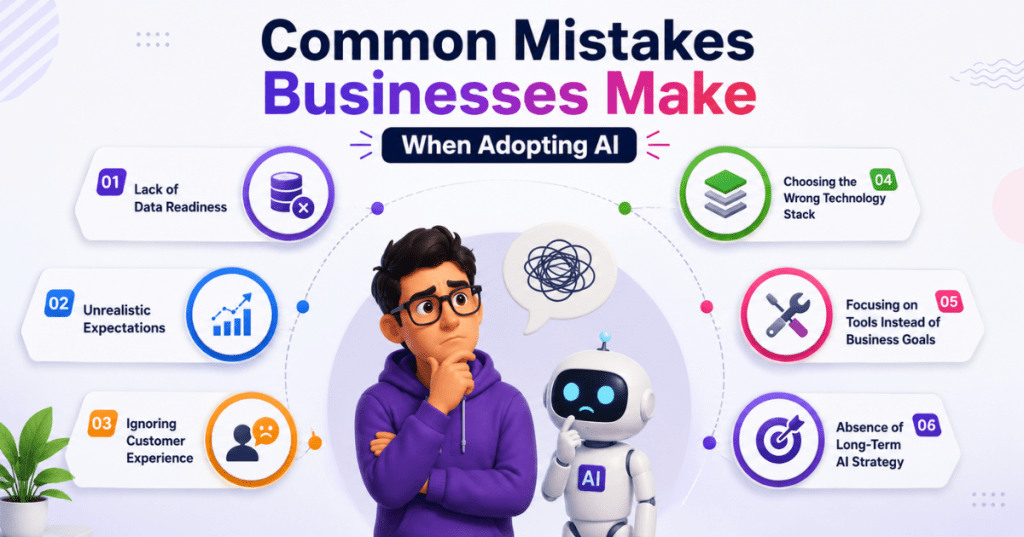
Common Mistakes Businesses Make When Adopting AI
Challenges That Slow Down AI Success
While artificial intelligence offers tremendous opportunities for growth and innovation, successful implementation requires more than simply investing in new technologies. Many businesses struggle to achieve meaningful results because they overlook fundamental requirements and strategic considerations. Understanding these common mistakes can help organizations maximize the value of AI investments, avoid costly setbacks, and build sustainable competitive advantages in an increasingly AI-driven marketplace.
Lack of Data Readiness
Artificial intelligence relies heavily on high-quality and well-structured data. Many businesses attempt to implement AI without establishing a reliable data foundation, resulting in inaccurate predictions and poor outcomes. Organizations should prioritize data quality, integration, and governance to ensure their AI systems can generate meaningful insights and support informed decision-making.
Unrealistic Expectations
Some organizations expect artificial intelligence to deliver immediate results or solve every business challenge overnight. In reality, successful AI adoption requires continuous improvement, experimentation, and long-term commitment. Setting realistic goals and focusing on measurable outcomes helps businesses achieve sustainable growth while maximizing the return on their AI investments.
Ignoring Customer Experience
Technology should enhance customer experiences rather than complicate them. Businesses that focus exclusively on automation without considering customer needs often create frustrating interactions and reduced engagement. AI initiatives should always prioritize personalization, convenience, and responsiveness to deliver experiences that strengthen customer relationships and increase loyalty.
Choosing the Wrong Technology Stack
Selecting inappropriate tools and platforms can limit scalability and increase implementation costs. Businesses should carefully evaluate AI technologies based on their objectives, infrastructure requirements, and long-term growth plans. Choosing the right technology stack enables organizations to build flexible and future-ready systems that support evolving business needs.
Focusing on Tools Instead of Business Goals
Many companies become overly focused on adopting the latest AI technologies without clearly defining the problems they want to solve. Successful organizations align AI initiatives with strategic objectives and measurable business outcomes. A goal-oriented approach ensures that investments deliver tangible value and contribute directly to growth and profitability.
Absence of Long-Term AI Strategy
Artificial intelligence should be viewed as an ongoing transformation rather than a one-time project. Businesses that lack a clear roadmap often struggle to scale their initiatives and maintain competitive advantages. Developing a long-term AI strategy enables organizations to adapt to changing market conditions, continuously innovate, and unlock the full potential of intelligent technologies.
Why SISGAIN Is the Right Technology Partner for AI and Machine Learning Solutions
Businesses looking to accelerate their AI-driven growth need a technology partner with proven expertise, scalability, and a strong focus on business outcomes. SISGAIN delivers comprehensive custom ai software development solutions tailored to specific business objectives, customer behavior, and long-term growth strategies. As an experienced machine learning services company, SISGAIN helps organizations leverage predictive analytics, recommendation engines, intelligent automation, and data-driven decision-making to improve efficiency and customer experiences. With extensive capabilities as an ECommerce Mobile App Development Company, the company enables brands to create seamless and intelligent shopping experiences across web and mobile platforms. SISGAIN’s expertise also extends to other domains, including AI and Machine Learning for healthcare, demonstrating its ability to deliver enterprise-grade solutions across industries. Supported by dedicated AI engineers and data scientists, the company focuses on secure, scalable, and customized development while ensuring measurable ROI, helping businesses build future-ready platforms that support sustainable growth and long-term competitive advantages.
Conclusion
The most successful e-commerce brands are not winning simply because they spend more on marketing—they are succeeding because they leverage artificial intelligence and machine learning to make smarter decisions, deliver highly personalized experiences, and operate more efficiently. What many businesses still consider a future investment has already become a competitive advantage for high-growth companies. From predictive analytics and intelligent automation to AI-powered customer engagement, these technologies are redefining the way digital commerce operates.
As AI models, machine learning systems, and large language models continue to evolve, businesses that embrace innovation early will be better positioned to increase revenue, improve customer loyalty, and build sustainable long-term growth. In an increasingly data-driven and AI-powered marketplace, organizations that invest in intelligent technologies today will be the ones leading the future of e-commerce tomorrow, while those that delay adoption risk falling behind more agile and digitally mature competitors.
Frequently Asked Questions ?
What is AI in E-commerce?
AI in E-commerce refers to the use of artificial intelligence technologies to improve customer experiences, automate operations, personalize recommendations, optimize pricing, and increase business efficiency.
How is machine learning used in e-commerce?
Machine learning in e-commerce helps businesses analyze customer behavior, forecast demand, optimize inventory, detect fraud, and deliver personalized shopping experiences.
What are the benefits of AI-powered e-commerce?
AI-powered e-commerce improves customer satisfaction, increases conversions, enhances personalization, automates repetitive tasks, and helps businesses make data-driven decisions.
Why are high-growth brands investing in AI?
High-growth brands use AI to gain competitive advantages, improve operational efficiency, increase customer retention, and generate higher revenue.
Which AI models are used in e-commerce?
Popular AI models used in e-commerce include GPT, Gemini, Claude, Llama, recommendation engines, predictive analytics models, natural language processing models, and computer vision systems.
What should businesses consider before implementing AI?
Businesses should evaluate their data quality, identify high-value use cases, select the right technologies, define KPIs, and work with experienced AI development partners.
The logistics industry is undergoing a rapid digital transformation driven by rising customer expectations, increasingly complex supply chains, and the growing need for real-time operational visibility. As logistics companies manage larger volumes of data across transportation, warehousing, inventory, and fleet operations, traditional IT infrastructure is often unable to deliver the scalability, agility, and security required to support modern business demands.
This is why organizations are increasingly investing in Cloud Migration Services for Logistics and advanced Cloud Security Services for Logistics Companies. Cloud technologies enable logistics providers to streamline operations, improve collaboration across distributed networks, reduce infrastructure costs, and enhance business continuity. At the same time, robust cloud security measures help protect sensitive shipment data, customer information, and mission-critical systems from evolving cyber threats.
In this comprehensive guide, you’ll learn how cloud migration and security work together, the benefits they offer logistics businesses, key implementation strategies, emerging industry trends, and how to choose the right technology partner for long-term success.
Legacy infrastructure creates risks that limit growth and digital transformation.
Cloud security is essential for protecting logistics networks, customer data, and business operations.
Successful cloud adoption requires strategic planning, governance, and ongoing monitoring.
AI, IoT, and advanced analytics are increasing the value of cloud-based logistics ecosystems.
Cloud migration and cloud security should be implemented together to maximize ROI and reduce risk.
Choosing an experienced cloud migration service provider can significantly improve project outcomes.
Partnering with a trusted cloud security services company helps maintain compliance and strengthen cyber resilience.
SISGAIN provides secure, scalable, and logistics-focused cloud solutions designed for long-term growth.
What Are Cloud Migration Services for Logistics?
As logistics operations become more data-driven and interconnected, businesses need technology infrastructures that can support real-time decision-making, seamless collaboration, and continuous growth. Cloud Migration Services for Logistics help organizations move applications, databases, workloads, and operational systems from traditional on-premises environments to secure cloud platforms. This transition enables logistics companies to modernize their IT ecosystems, improve operational efficiency, enhance scalability, and strengthen security while reducing the limitations associated with legacy infrastructure.
Understanding Cloud Migration in the Logistics Industry
Cloud migration is the process of transferring logistics applications, operational data, and business-critical systems from physical servers or legacy environments to cloud-based platforms. The goal is to create a more flexible, scalable, and resilient infrastructure capable of supporting modern supply chain demands. By leveraging cloud technology, logistics organizations can improve system performance, streamline operations, and gain better visibility across transportation, warehousing, inventory management, and distribution networks.
Cloud-Based Logistics Infrastructure
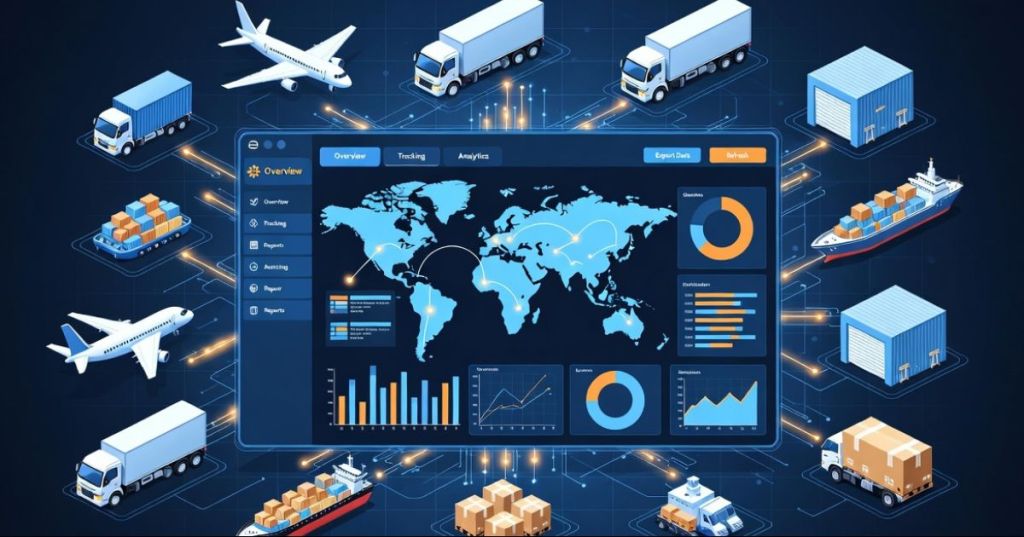
A cloud-based logistics infrastructure centralizes applications, data, and operational processes within a secure digital environment. This approach enables teams across multiple locations to access information in real time, improving coordination, decision-making, and operational efficiency throughout the supply chain ecosystem.
Modern cloud environments support seamless integration between transportation management systems, warehouse management platforms, IoT devices, and analytics tools. This interconnected infrastructure helps logistics providers create a more agile, data-driven, and scalable operational framework.
Why Logistics Companies Are Moving to the Cloud
The logistics industry is experiencing increasing pressure to deliver faster services, maintain operational transparency, and manage growing volumes of data. Traditional infrastructure often struggles to keep pace with these evolving demands. Cloud Computing Services for Logistics Industry organizations provide the flexibility and performance needed to support modern logistics operations while enabling businesses to remain competitive in a rapidly changing marketplace.
Real-Time Visibility
Cloud platforms provide centralized access to operational data across transportation, warehousing, inventory, and fleet management systems. This real-time visibility allows logistics teams to monitor shipments, identify disruptions quickly, and make informed decisions that improve service quality and customer satisfaction.
Scalability
Logistics businesses often experience fluctuations in shipment volumes, seasonal demand, and operational requirements. Cloud infrastructure allows organizations to scale computing resources up or down based on business needs, ensuring consistent performance without investing in costly physical hardware.
Cost Optimization
Cloud adoption reduces the need for expensive on-premises servers, infrastructure maintenance, and hardware upgrades. By shifting to a consumption-based model, logistics companies can optimize technology spending, improve resource utilization, and allocate budgets more effectively toward growth initiatives.
Improved Collaboration
Cloud-based platforms enable employees, partners, suppliers, and customers to access critical information from any location. Improved connectivity and data sharing enhance coordination across supply chain networks, resulting in faster responses, better communication, and more efficient operations.
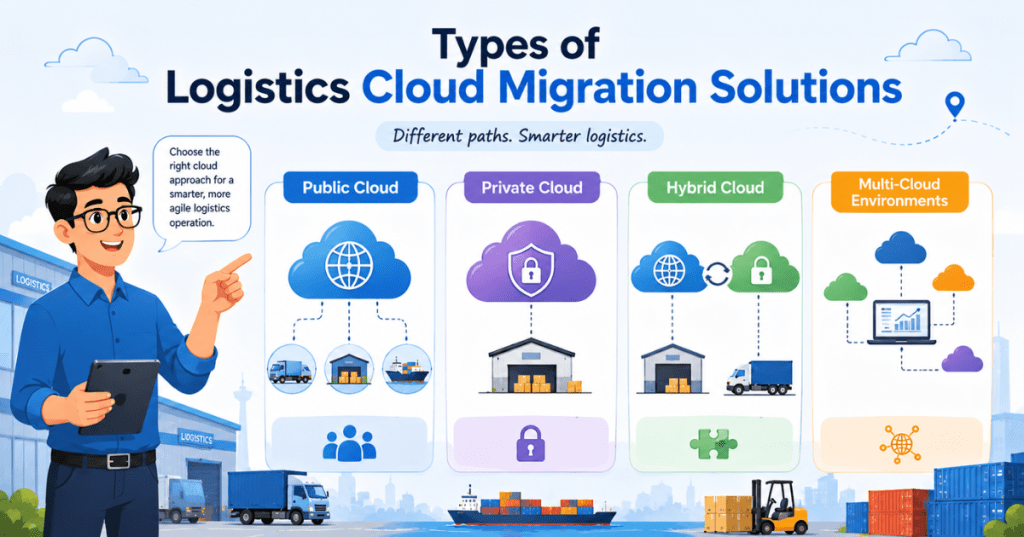
Types of Logistics Cloud Migration Solutions
Not all cloud environments are designed for the same operational requirements. Selecting the right Logistics Cloud Migration Solutions strategy depends on factors such as security requirements, regulatory obligations, scalability goals, and budget considerations. Understanding the available deployment models helps logistics companies choose the most suitable approach for their digital transformation journey.
Public Cloud
Public cloud environments provide scalable computing resources through third-party cloud providers. This model offers rapid deployment, flexible resource allocation, and lower infrastructure costs, making it an attractive option for logistics companies seeking operational agility and faster innovation.
Private Cloud
A private cloud is dedicated exclusively to a single organization, offering greater control, customization, and security. Logistics companies handling sensitive operational data or operating under strict compliance requirements often choose private cloud environments to strengthen governance and data protection.
Hybrid Cloud
Hybrid cloud combines public and private cloud environments, allowing organizations to distribute workloads based on business and security requirements. This approach provides flexibility while enabling logistics companies to maintain critical systems in secure environments and leverage public cloud scalability when needed.
Multi-Cloud Environments
Multi-cloud strategies involve using services from multiple cloud providers to improve redundancy, performance, and vendor flexibility. This approach helps logistics organizations reduce dependency on a single provider while optimizing workloads across different platforms for enhanced reliability and business continuity.
Why Traditional Logistics Infrastructure Is No Longer Enough
The logistics industry is evolving rapidly as businesses face increasing shipment volumes, rising customer expectations, and more complex supply chain operations. Traditional IT infrastructure, once sufficient for managing logistics workflows, is now struggling to support modern operational requirements. Legacy systems often lack the flexibility, scalability, and integration capabilities needed to handle real-time data, connected technologies, and growing business demands. As a result, many logistics organizations are turning to cloud-based solutions to modernize their infrastructure and remain competitive in an increasingly digital marketplace.
Challenges of Legacy Logistics Systems
Legacy infrastructure can create significant barriers to operational efficiency and business growth. Many logistics companies continue to rely on outdated systems that were not designed to support modern supply chain technologies, data-intensive processes, or rapidly changing market conditions.
Limited Scalability
Traditional infrastructure often requires additional hardware investments whenever business demands increase. This makes it difficult for logistics companies to quickly adapt to seasonal fluctuations, expanding customer requirements, or new operational initiatives without significant delays and capital expenditures.
High Maintenance Costs
Maintaining on-premises servers, storage systems, and network infrastructure requires continuous investments in hardware upgrades, software updates, and technical support. These ongoing expenses can consume valuable resources that could otherwise be directed toward innovation and business growth.
Poor System Integration
Many legacy logistics platforms operate independently, making it difficult to connect transportation, warehouse, inventory, and customer management systems. This lack of integration creates inefficiencies, limits visibility, and slows decision-making across the supply chain.
Data Silos
When critical business information is stored across disconnected systems, teams struggle to access accurate and consistent data. Data silos reduce operational transparency, increase reporting challenges, and make it harder to gain actionable insights for strategic planning.
Operational Risks Caused by Outdated Infrastructure
Outdated IT environments not only reduce efficiency but also expose logistics organizations to operational risks that can directly impact profitability, customer experience, and long-term business performance.
Downtime
Aging infrastructure is more vulnerable to hardware failures, software issues, and unexpected disruptions. Even short periods of downtime can interrupt logistics operations, delay shipments, and create significant financial losses while damaging customer trust.
Delayed Deliveries
Logistics companies depend on accurate, real-time information to coordinate transportation and distribution activities. Outdated systems often struggle to process data efficiently, increasing the likelihood of delays, scheduling errors, and disruptions across the supply chain.
Inefficient Warehouse Management
Legacy warehouse systems may lack automation capabilities and real-time inventory visibility. This can lead to inventory inaccuracies, slower order processing, reduced productivity, and operational inefficiencies that affect overall supply chain performance.
Reduced Customer Satisfaction
Customers expect accurate tracking information, reliable deliveries, and responsive service. Infrastructure limitations that cause delays, system outages, or communication gaps can negatively impact customer experiences and reduce long-term loyalty.
Growing Demand for Cloud Computing Services for Logistics Industry
The need for greater operational agility, real-time visibility, and technology-driven decision-making is accelerating cloud adoption throughout the logistics sector. Modern logistics organizations require infrastructure capable of supporting evolving business models and emerging technologies.
Increasing Shipment Volumes
The growth of eCommerce, global trade, and customer demand for faster deliveries has significantly increased shipment volumes. Cloud-based infrastructure provides the scalability needed to process larger workloads without compromising performance or reliability.
Connected Supply Chains
Modern supply chains rely on continuous communication between manufacturers, suppliers, logistics providers, and customers. Cloud platforms enable seamless information sharing and collaboration, improving visibility and coordination across the entire logistics ecosystem.
IoT Integration
Logistics organizations increasingly use IoT devices to monitor vehicles, track shipments, manage assets, and optimize operations. Cloud environments provide the processing power and connectivity required to collect, analyze, and act on large volumes of real-time IoT data.
AI-Powered Logistics Operations
Artificial intelligence is transforming logistics through predictive analytics, route optimization, demand forecasting, and automated decision-making. Cloud infrastructure supports these advanced technologies by providing scalable computing resources and access to centralized operational data.
Key Benefits of Cloud Migration Services for Logistics
Cloud Migration Services for Logistics provide more than infrastructure modernization. They create a foundation for greater operational efficiency, business agility, and long-term scalability. By moving critical systems and workloads to the cloud, logistics organizations can improve performance, strengthen resilience, and better support evolving customer expectations.
Enhanced Supply Chain Visibility
Cloud-based platforms centralize operational data from transportation, warehousing, inventory management, and customer-facing systems. This unified visibility enables logistics companies to track activities in real time, identify disruptions quickly, and make data-driven decisions that improve supply chain performance.
Faster Data Access Across Locations
Cloud environments allow employees, partners, and stakeholders to securely access information from virtually any location. This improves collaboration across distributed logistics networks while ensuring teams can make timely decisions using accurate and up-to-date information.
Improved Business Continuity and Disaster Recovery
Cloud platforms provide built-in redundancy, automated backups, and disaster recovery capabilities that help minimize operational disruptions. In the event of a system failure, cyberattack, or natural disaster, logistics companies can restore critical services more quickly and maintain business continuity.
Reduced IT Infrastructure Costs
Cloud adoption eliminates many of the expenses associated with purchasing, maintaining, and upgrading physical hardware. Organizations can optimize technology spending through flexible pricing models that align infrastructure costs with actual business usage.
Better Scalability During Seasonal Demand Peaks
Logistics businesses frequently experience demand fluctuations driven by holidays, promotional events, and market changes. Cloud infrastructure enables organizations to scale resources dynamically, ensuring consistent performance during peak periods without overinvesting in permanent capacity.
Improved Integration with Transportation and Warehouse Management Systems
Modern cloud platforms simplify integration between transportation management systems, warehouse management software, inventory tools, analytics platforms, and third-party applications. This connected ecosystem improves operational efficiency and supports a more streamlined supply chain operation.
What Are Cloud Security Services for Logistics Companies?
As logistics companies increasingly adopt cloud technologies, securing digital infrastructure has become a critical business priority. Modern logistics operations rely on interconnected systems, real-time data sharing, and cloud-based applications to manage transportation, warehousing, inventory, and customer communications. While cloud adoption offers significant operational advantages, it also introduces new cybersecurity risks. Cloud Security Services for Logistics Companies help protect sensitive business data, prevent unauthorized access, maintain regulatory compliance, and ensure uninterrupted operations across the supply chain ecosystem.
Understanding Cloud Security in Logistics Operations
Cloud security refers to the technologies, policies, controls, and practices used to protect cloud-based applications, data, networks, and infrastructure from cyber threats. In logistics environments, cloud security plays a vital role in safeguarding shipment information, customer records, operational systems, and business-critical processes. Effective security strategies help organizations maintain visibility, resilience, and trust while supporting digital transformation initiatives.
Why Cloud Security Is Critical for Logistics Companies
The logistics industry handles large volumes of sensitive information, including customer data, shipment details, inventory records, and supplier communications. A successful cyberattack can disrupt operations, cause financial losses, and damage customer relationships. Implementing Cloud Security Solutions for Logistics Companies helps organizations strengthen cyber resilience, reduce operational risks, and maintain business continuity in an increasingly connected environment.
Common Threats Facing Logistics Organizations
Ransomware Attacks
Ransomware remains one of the most disruptive cybersecurity threats facing logistics businesses. Attackers can encrypt operational systems and critical data, bringing transportation, warehousing, and distribution activities to a halt. Strong cloud security controls help minimize exposure and accelerate recovery efforts.
Data Breaches
Logistics companies manage valuable operational and customer information that can become a target for cybercriminals. Data breaches may result in financial penalties, reputational damage, and compliance violations. Cloud security measures help protect sensitive information through encryption, access controls, and continuous monitoring.
Insider Threats
Not all security risks originate from external attackers. Employees, contractors, or third-party users with excessive access privileges can unintentionally or deliberately expose critical information. Proper identity management and access governance reduce the likelihood of insider-related incidents.
Third-Party Vendor Vulnerabilities
Logistics operations often depend on external technology providers, suppliers, and business partners. Weak security practices within third-party environments can create entry points for attackers. Effective cloud security strategies help monitor and manage risks across connected vendor ecosystems.
Supply Chain Cyberattacks
Cybercriminals increasingly target supply chain networks because a single compromised system can affect multiple organizations. Cloud security frameworks help organizations strengthen defenses, improve visibility, and respond quickly to threats that could disrupt critical logistics operations.
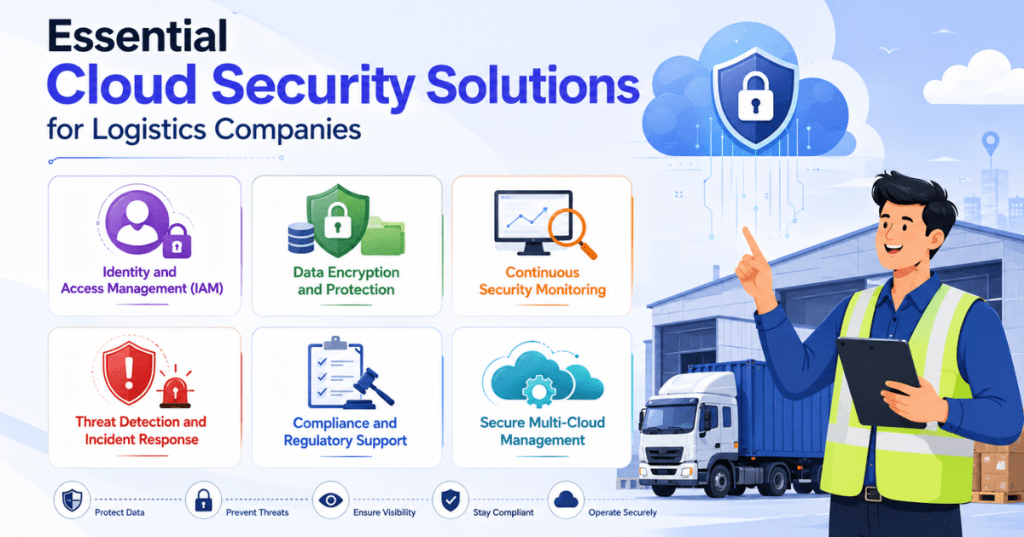
Essential Cloud Security Solutions for Logistics Companies
Protecting modern logistics infrastructure requires a comprehensive security strategy that addresses people, processes, and technology. The following security capabilities form the foundation of a resilient cloud environment.
Identity and Access Management (IAM)
Identity and Access Management solutions ensure that only authorized users can access specific systems, applications, and data. By implementing role-based access controls, multi-factor authentication, and user governance policies, logistics organizations can significantly reduce the risk of unauthorized access and credential-based attacks.
Data Encryption and Protection
Encryption protects sensitive information both during transmission and while stored within cloud environments. Strong encryption practices help safeguard shipment records, financial information, customer data, and operational intelligence from unauthorized access, ensuring greater confidentiality and regulatory compliance.
Continuous Security Monitoring
Modern cyber threats evolve rapidly, making continuous monitoring essential for cloud environments. Security monitoring solutions provide real-time visibility into network activity, user behavior, and system performance, enabling organizations to identify suspicious activities before they escalate into major incidents.
Threat Detection and Incident Response
Advanced threat detection technologies use automation, analytics, and artificial intelligence to identify potential security threats quickly. Combined with incident response planning, these capabilities help logistics companies contain attacks faster, minimize operational disruption, and reduce business impact.
Compliance and Regulatory Support
Logistics companies must often comply with industry regulations, data protection requirements, and customer security standards. Cloud security solutions help organizations implement governance frameworks, maintain audit readiness, and demonstrate compliance across cloud-based operations.
Secure Multi-Cloud Management
Many organizations operate across multiple cloud platforms to improve flexibility and resilience. Secure multi-cloud management ensures consistent security policies, centralized visibility, and effective governance across different cloud providers while reducing operational complexity and risk.
How Cloud Migration and Cloud Security Work Together
Cloud migration and cloud security should never be treated as separate initiatives. Successful digital transformation requires organizations to integrate security throughout every stage of the migration journey. A security-first approach helps logistics companies maximize cloud benefits while minimizing operational and cybersecurity risks.
Building a Secure Cloud Foundation
Security should be incorporated from the earliest stages of cloud planning and architecture design. Establishing strong governance policies, access controls, encryption standards, and security frameworks creates a reliable foundation that supports long-term operational growth and resilience.
Security Considerations During Migration
During migration, organizations must evaluate data sensitivity, application dependencies, access requirements, and compliance obligations. Addressing these security considerations early helps prevent vulnerabilities from being introduced into the new cloud environment while ensuring a smoother migration process.
Reducing Risk While Modernizing Infrastructure
Migrating to the cloud provides an opportunity to replace outdated security practices with modern protection mechanisms. By integrating advanced security technologies during migration, logistics companies can reduce cyber risks while improving operational efficiency and infrastructure performance.
Ensuring Business Continuity Throughout Migration
Business continuity is a critical concern for logistics organizations where even minor disruptions can impact supply chain performance. Combining cloud migration with proactive security planning helps minimize downtime, protect critical workloads, and ensure uninterrupted operations throughout the transition process.
How to Choose the Right Cloud Migration Strategy for Logistics Operations
A successful cloud transformation begins with selecting the right migration strategy that aligns with business objectives, operational requirements, and long-term scalability goals. Logistics companies should assess their existing infrastructure, application dependencies, data workflows, and security requirements before moving to the cloud. Partnering with an experienced cloud migration service provider can simplify this process by helping organizations develop a structured migration roadmap, reduce implementation risks, and ensure business continuity throughout the transition. A well-planned migration strategy enables logistics businesses to improve operational efficiency, optimize costs, enhance
Assessing Current Infrastructure
Before beginning any migration initiative, organizations should evaluate their existing IT environment, applications, databases, and operational workflows. Understanding current infrastructure limitations, performance challenges, and system dependencies helps identify migration priorities and potential risks. A thorough assessment also provides a clear roadmap for modernization efforts and future scalability requirements.
Defining Business Objectives
Cloud migration should support measurable business outcomes rather than serving solely as a technology upgrade. Logistics organizations should establish clear objectives such as improving operational efficiency, enhancing supply chain visibility, reducing infrastructure costs, strengthening security, or enabling future innovation. Well-defined goals help guide decision-making throughout the migration process.
Selecting the Right Cloud Environment
Choosing the appropriate cloud model depends on an organization’s security requirements, compliance obligations, workload characteristics, and operational priorities. Public, private, hybrid, and multi-cloud environments each offer unique advantages. Selecting the right environment ensures logistics companies achieve the ideal balance between flexibility, performance, security, and cost efficiency.
Planning Data Migration and Security Controls
Data is one of the most valuable assets within any logistics operation. Organizations must develop detailed migration plans that address data classification, transfer methods, access management, encryption requirements, and regulatory compliance. Integrating security controls into migration planning helps protect sensitive information while minimizing operational and cybersecurity risks.
Measuring Success and ROI
The success of a cloud migration initiative should be measured using predefined performance indicators. Metrics such as infrastructure cost savings, system availability, operational efficiency, application performance, scalability improvements, and security enhancements help organizations evaluate return on investment and identify opportunities for continuous optimization.
Best Practices for Successful Logistics Cloud Migration
Migrating logistics infrastructure to the cloud is a complex process that requires careful planning, execution, and governance. Following proven best practices helps organizations reduce risks, improve project outcomes, and maximize the benefits of their cloud transformation initiatives.
Conduct a Cloud Readiness Assessment
A cloud readiness assessment helps organizations evaluate their technical environment, operational processes, security posture, and migration preparedness. This assessment identifies potential challenges, uncovers infrastructure gaps, and provides valuable insights that support more informed planning and decision-making throughout the migration journey.
Prioritize Mission-Critical Applications
Not all applications require migration at the same time. Logistics companies should prioritize systems that have the greatest impact on business operations, customer service, and supply chain performance. A structured migration approach allows organizations to reduce complexity, minimize disruption, and validate success before expanding migration efforts.
Implement Security by Design
Security should be integrated into every phase of the migration process rather than added after deployment. A security-by-design approach incorporates identity management, encryption, access controls, monitoring capabilities, and compliance requirements from the outset, helping organizations build a stronger and more resilient cloud environment.
Create a Phased Migration Roadmap
Attempting to migrate all systems simultaneously can increase operational risk and complexity. A phased migration roadmap allows logistics organizations to transition workloads in manageable stages, monitor performance, address challenges proactively, and maintain business continuity throughout the transformation process.
Train Teams and Stakeholders
Technology adoption is most successful when employees understand how to use and manage new systems effectively. Providing training for IT teams, operational staff, and business stakeholders helps improve cloud adoption, reduce resistance to change, and ensure organizations maximize the value of their cloud investments.
Establish Ongoing Monitoring and Governance
Cloud migration is not a one-time project but an ongoing operational responsibility. Continuous monitoring, performance management, security oversight, and governance practices help organizations maintain efficiency, control costs, identify risks, and ensure cloud environments continue to align with evolving business objectives.
Emerging Trends Shaping the Future of Logistics Cloud Infrastructure
The logistics industry continues to evolve as organizations adopt new technologies to improve efficiency, visibility, and decision-making. Cloud infrastructure serves as the foundation for many of these innovations, enabling businesses to leverage advanced capabilities that support digital transformation and long-term competitiveness.
AI-Powered Logistics Operations
Artificial intelligence is helping logistics companies automate routine processes, optimize transportation routes, improve demand forecasting, and enhance operational decision-making. Cloud-based environments provide the computing power and scalability required to support AI-driven applications across complex logistics networks.
Predictive Analytics and Real-Time Intelligence
Modern logistics operations generate vast amounts of operational data every day. Cloud platforms enable organizations to analyze this information in real time, uncover trends, predict disruptions, and make proactive decisions that improve efficiency, reduce costs, and strengthen customer service performance.
Edge Computing for Logistics Networks
Edge computing brings data processing closer to operational environments such as warehouses, distribution centers, and transportation assets. When combined with cloud infrastructure, edge computing reduces latency, accelerates decision-making, and supports real-time operational visibility across geographically distributed logistics networks.
IoT-Enabled Supply Chain Visibility
Internet of Things (IoT) devices are transforming supply chain management by providing continuous visibility into asset locations, shipment conditions, vehicle performance, and inventory status. Cloud platforms collect and analyze IoT-generated data, enabling organizations to improve monitoring, efficiency, and operational responsiveness.
Autonomous and Data-Driven Logistics Ecosystems
The future of logistics is increasingly focused on automation, intelligent decision-making, and connected digital ecosystems. Cloud infrastructure supports autonomous technologies, advanced analytics, and integrated operational platforms that help logistics organizations improve agility, reduce manual processes, and create more resilient supply chain networks.
Why SISGAIN Is the Right Technology Partner for Logistics Cloud Transformation
Choosing the right technology partner is essential for maximizing the benefits of cloud transformation. SISGAIN combines deep logistics industry expertise with advanced cloud technologies to deliver secure, scalable, and high-performance solutions tailored to modern supply chain operations. As a trusted cloud security services company, SISGAIN helps organizations strengthen cybersecurity, protect sensitive logistics data, maintain compliance, and reduce operational risks through proactive security frameworks and continuous monitoring. Along with comprehensive cloud migration capabilities, SISGAIN enables logistics businesses to accelerate digital transformation, improve resilience, and create a secure foundation for long-term operational success and sustainable growth.
Logistics-Focused Industry Expertise
SISGAIN understands the unique challenges facing logistics organizations, including supply chain complexity, real-time visibility requirements, operational scalability, and cybersecurity risks. By combining industry knowledge with modern cloud technologies, SISGAIN delivers customized solutions that align with logistics workflows, regulatory requirements, and long-term business objectives.
End-to-End Cloud Migration Planning and Execution
From initial infrastructure assessments to migration planning, deployment, and post-migration optimization, SISGAIN provides comprehensive cloud migration support. This end-to-end approach helps logistics companies minimize disruptions, accelerate implementation timelines, and achieve a smooth transition to cloud-based environments.
Advanced Security-First Architecture
Security is integrated into every stage of SISGAIN’s cloud transformation strategy. Through robust access controls, encryption frameworks, continuous monitoring, and proactive risk management practices, SISGAIN helps organizations protect critical business data and strengthen their overall cybersecurity posture.
Scalable and Future-Ready Cloud Solutions
SISGAIN designs cloud environments that can evolve alongside changing business needs. Whether supporting growing shipment volumes, expanding operational networks, or adopting emerging technologies, these scalable solutions provide the flexibility needed to support sustainable business growth.
Continuous Monitoring, Optimization, and Support
Cloud success extends beyond migration. SISGAIN provides ongoing monitoring, performance optimization, and technical support to help logistics organizations maintain system reliability, improve efficiency, address emerging challenges, and maximize the long-term value of their cloud investments.
Proven Approach to Business Continuity and Risk Reduction
SISGAIN follows a structured methodology focused on minimizing operational risks and ensuring business continuity throughout cloud transformation initiatives. By implementing resilient architectures, disaster recovery strategies, and proactive security controls, organizations can maintain uninterrupted operations while navigating digital modernization efforts.
Conclusion
Cloud migration and cloud security have become essential for modern logistics companies aiming to improve efficiency, scalability, and resilience. By adopting Cloud Migration Services for Logistics along with robust security frameworks, businesses can enhance supply chain visibility, reduce operational costs, and protect critical data from evolving cyber threats. A well-planned strategy ensures smooth transformation, minimal disruption, and long-term business growth. Ultimately, combining cloud migration with strong security enables logistics organizations to stay competitive in a fast-changing, technology-driven industry.
Frequently Asked Questions
What are Cloud Migration Services for Logistics?
Cloud Migration Services for Logistics help businesses move applications, data, and operational systems from on-premises infrastructure to cloud environments. This improves scalability, operational efficiency, flexibility, and real-time visibility across logistics and supply chain operations.
Why do logistics companies need cloud security services?
Cloud security services help logistics companies protect sensitive shipment data, customer information, and business-critical systems from cyber threats. They also support compliance, reduce security risks, and ensure uninterrupted operations.
What are the benefits of logistics cloud migration solutions?
Logistics cloud migration solutions improve supply chain visibility, reduce infrastructure costs, enhance scalability, support remote access, strengthen disaster recovery capabilities, and enable faster integration with modern logistics technologies.
How long does a logistics cloud migration project typically take?
The timeline depends on infrastructure complexity, data volume, application requirements, and migration scope. Small projects may take a few weeks, while enterprise-scale cloud migrations can require several months for successful implementation.
What security measures should logistics companies implement in the cloud?
Logistics companies should implement identity and access management, multi-factor authentication, data encryption, continuous monitoring, threat detection, backup strategies, and compliance controls to secure cloud-based operations effectively.
Smart pregnancy apps are transforming maternal healthcare experiences in the UAE.
AI-powered healthcare solutions improve pregnancy monitoring and patient engagement.
Digital pregnancy platforms support remote healthcare accessibility and telemedicine.
UAE healthcare digitalization is increasing demand for personalized maternity apps.
Security, compliance, and data privacy are critical in healthcare app development.
Advanced features like AI insights, wearable integration, and virtual consultations are becoming essential.
Healthcare startups are investing heavily in scalable women-focused healthcare platforms.
Choosing the right technology partner significantly impacts healthcare app success.
The healthcare industry in the UAE is rapidly transforming through digital innovation, and pregnancy care is becoming one of the biggest beneficiaries of this shift. Modern women no longer rely only on traditional clinic visits and paper-based medical tracking. Instead, they are turning toward intelligent mobile platforms that provide real-time healthcare support, personalized pregnancy guidance, virtual consultations, AI-powered monitoring, and wellness tracking from anywhere.
This is where smart pregnancy apps UAE are changing the future of maternal healthcare.
From prenatal health tracking and appointment scheduling to AI-driven risk alerts and nutrition monitoring, digital pregnancy solutions are helping women experience safer, smarter, and more connected healthcare journeys. As the UAE continues investing in smart hospitals, telemedicine, and patient-centric healthcare systems, pregnancy applications are becoming a critical part of the country’s digital healthcare ecosystem.
Today, startups, healthcare providers, hospitals, and entrepreneurs are increasingly investing in pregnancy app development UAE to meet the growing demand for personalized maternity care solutions. These platforms are not only improving healthcare accessibility but are also supporting the broader vision of digital transformation across the UAE healthcare sector.
In this blog, we will explore how smart pregnancy apps are revolutionizing women’s healthcare in the UAE, the technologies behind these applications, must-have features, development costs, AI innovations, compliance requirements, and why businesses are investing heavily in this growing market.
What Are Smart Pregnancy Apps?
Smart pregnancy apps are next-generation digital healthcare solutions designed to help women manage their pregnancy journey with greater convenience, accuracy, and personalized medical support. Unlike traditional pregnancy tracking applications that only provide basic calendars or baby growth updates, modern smart pregnancy platforms use advanced technologies such as Artificial Intelligence (AI), cloud computing, real-time analytics, wearable integrations, and telemedicine services to create a more connected healthcare experience.
These intelligent applications act as virtual pregnancy companions that support women from early pregnancy planning to postnatal care. They provide real-time health insights, personalized wellness recommendations, appointment reminders, emotional support, and direct communication with healthcare professionals — all through a single mobile platform.
Today, advanced smart pregnancy apps UAE are transforming how women access maternal healthcare by making healthcare services more accessible, data-driven, and patient-centric. These platforms are especially important in fast-growing digital healthcare ecosystems like the UAE, where users expect smart, secure, and highly personalized healthcare experiences.
Modern women’s healthcare apps UAE commonly include features such as:
Pregnancy week-by-week tracking
AI-powered health and risk assessments
Personalized nutrition and hydration guidance
Fetal growth and development monitoring
Medication and vitamin reminders
Virtual doctor consultations and telemedicine support
Mental wellness and stress management tools
Emergency healthcare assistance
Integration with smartwatches and wearable devices
Secure digital medical record management
Many advanced AI pregnancy apps UAE also use predictive analytics to identify potential health risks early, helping healthcare providers deliver proactive maternal care. This improves both patient safety and healthcare efficiency.
As the demand for digital pregnancy healthcare UAE continues to grow, smart pregnancy applications are becoming an essential part of the modern healthcare ecosystem. They not only improve patient engagement and accessibility but also help hospitals, clinics, and healthcare startups deliver more personalized and technology-driven maternity care solutions.
Why Smart Pregnancy Apps Are Growing Rapidly in the UAE
The UAE is rapidly emerging as one of the most advanced digital healthcare markets in the Middle East. With strong government support, smart city initiatives, rising healthcare investments, and growing adoption of AI-powered medical technologies, the country is creating a highly innovation-driven healthcare ecosystem. As a result, the demand for smart pregnancy apps UAE is increasing significantly among hospitals, healthcare startups, clinics, and modern consumers.
Today’s users expect healthcare services to be fast, accessible, personalized, and digitally connected. Traditional pregnancy care models that rely only on in-person consultations are no longer enough for modern patients. Women now prefer healthcare solutions that provide real-time support, remote access to doctors, personalized health insights, and continuous pregnancy monitoring directly from their smartphones.
This shift is driving the rapid growth of digital pregnancy healthcare UAE platforms across the region.
Several important factors are contributing to the growing popularity of smart pregnancy applications in the UAE.
Increasing Smartphone and Internet Penetration
The UAE has one of the world’s highest smartphone penetration rates, making mobile healthcare services easily accessible to a large population. Women across different age groups are becoming increasingly comfortable using digital platforms for healthcare management, appointment scheduling, wellness tracking, and virtual consultations.
This strong digital infrastructure creates the perfect environment for the growth of women’s healthcare apps UAE and mobile-first healthcare experiences.
Additionally, high-speed internet connectivity and widespread adoption of smart devices are enabling healthcare providers to offer more advanced app-based healthcare services without major accessibility barriers.
Rising Demand for Personalized Healthcare Experiences
Modern healthcare consumers expect highly personalized experiences rather than generic healthcare advice. Smart pregnancy applications powered by AI and analytics can deliver customized recommendations based on:
Pregnancy stage
Medical history
Lifestyle habits
Nutritional needs
Sleep patterns
Health conditions
Physical activity levels
This level of personalization improves patient engagement and allows women to receive more relevant healthcare support throughout their pregnancy journey.
As AI technologies continue evolving, AI pregnancy apps UAE are becoming more intelligent in providing predictive insights, wellness recommendations, and proactive healthcare alerts tailored to individual users.
Rapid Growth of Telemedicine and Virtual Healthcare
Telemedicine has transformed the healthcare industry in the UAE. Patients increasingly prefer remote healthcare services for convenience, accessibility, and faster medical support.
Modern smart pregnancy apps now integrate telehealth functionalities such as:
Video consultations
Virtual prenatal checkups
In-app doctor messaging
Online prescription management
Digital health assessments
These features reduce the need for frequent hospital visits while improving healthcare accessibility for pregnant women.
The rise of telemedicine is also encouraging healthcare startups and businesses to invest heavily in pregnancy app development UAE solutions that combine virtual healthcare services with AI-powered patient engagement.
Strong Focus on Preventive and Proactive Healthcare
The UAE healthcare sector is shifting from reactive treatment models toward preventive and proactive healthcare systems. Healthcare providers are increasingly focusing on early detection, continuous monitoring, and personalized wellness management.
Smart pregnancy apps play a major role in this transformation by enabling:
Early symptom tracking
Pregnancy risk identification
Health monitoring
Medication reminders
Nutrition management
Lifestyle improvement recommendations
Advanced analytics and AI-driven monitoring systems help healthcare professionals identify potential complications earlier, improving both maternal and fetal health outcomes.
This preventive healthcare approach is one of the biggest reasons behind the growing adoption of digital pregnancy healthcare UAE solutions.
Government Support for Digital Healthcare Innovation
The UAE government is heavily investing in healthcare digitalization, AI integration, and smart healthcare ecosystems as part of its long-term national development strategies.
Initiatives connected to Digital Healthcare Goals in UAE are encouraging hospitals, startups, and healthcare technology providers to adopt innovative digital healthcare solutions that improve patient experiences and healthcare efficiency.
This includes investments in:
AI-powered healthcare systems
Smart hospitals
Electronic medical records
Telemedicine infrastructure
Mobile healthcare platforms
Data-driven patient care systems
These national digital transformation efforts are creating major opportunities for businesses developing advanced smart pregnancy apps UAE and intelligent maternal healthcare platforms.
Growing Awareness of Women’s Digital Health Solutions
Women in the UAE are becoming increasingly health-conscious and digitally connected. There is growing awareness around maternal wellness, prenatal care, mental health support, and pregnancy monitoring.
Modern pregnancy applications are helping women take greater control of their healthcare journey by offering:
Real-time pregnancy education
Personalized healthcare insights
Mental wellness resources
Community support features
Daily health tracking tools
This growing demand for convenient and intelligent healthcare experiences is accelerating the popularity of women’s healthcare apps UAE among modern users.
Increasing Investment in Healthcare Startups and Innovation
The UAE startup ecosystem is experiencing rapid growth in healthcare technology investments. Investors and entrepreneurs are recognizing the strong market demand for AI-powered healthcare platforms and women-focused digital health solutions.
As a result, many healthcare businesses are collaborating with experienced Healthcare App Development Company in Dubai providers and skilled app developers in UAE to build scalable and compliant maternal healthcare applications.
This innovation-driven ecosystem is helping accelerate the development of smarter, more secure, and more advanced pregnancy healthcare solutions across the region.
How AI Is Transforming Pregnancy Healthcare Apps
Artificial Intelligence is becoming one of the most powerful technologies revolutionizing modern maternal healthcare. Traditional pregnancy applications were once limited to simple tools like due date calculators and baby growth tracking. However, modern AI pregnancy apps UAE are far more advanced and intelligent. They now offer real-time healthcare support, predictive monitoring, personalized wellness guidance, and smart automation that improves both patient experiences and healthcare outcomes.
As digital healthcare adoption continues growing across the UAE, AI-powered pregnancy applications are helping healthcare providers deliver more connected, proactive, and patient-centric maternity care solutions. These intelligent systems are transforming how women monitor their pregnancy journey, communicate with healthcare professionals, and manage their overall wellness.
Personalized Pregnancy Insights and Recommendations
One of the biggest ways AI is transforming pregnancy healthcare apps is through personalized healthcare experiences. Every woman’s pregnancy journey is different, and AI technology helps applications provide customized recommendations instead of generic advice.
AI systems analyze various types of user data, including medical history, pregnancy stage, sleep quality, nutrition habits, physical activity, stress levels, and symptom patterns. Based on this information, the app generates tailored healthcare suggestions that match the user’s individual needs.
For example, if a pregnant woman is not maintaining proper hydration or nutritional balance, the application may recommend healthier meal plans, hydration reminders, and vitamin schedules. Similarly, if the system detects high stress levels or poor sleep quality, it can suggest meditation exercises, relaxation activities, or wellness tips to improve emotional health.
Some common AI-powered personalized features include:
Customized meal and nutrition guidance
Pregnancy-safe workout suggestions
Daily wellness recommendations
Sleep improvement advice
Emotional wellness support
Personalized pregnancy risk alerts
This personalized healthcare approach improves patient engagement and helps women feel more connected to their healthcare journey. It is also one of the key reasons why smart pregnancy apps UAE are becoming increasingly popular among modern healthcare users.
Predictive Health Monitoring and Early Risk Detection
AI is also transforming pregnancy healthcare through predictive health monitoring. Traditional healthcare systems usually depend on periodic hospital visits and manual health observations. In contrast, AI-powered systems can continuously monitor health data in real time and identify potential complications much earlier.
Advanced machine learning algorithms analyze patient behavior, wearable device data, medical records, and symptom patterns to detect abnormal health trends. These intelligent systems can help identify risks related to:
High blood pressure
Gestational diabetes
Sleep irregularities
Stress-related complications
Unusual fetal movement patterns
Heart rate fluctuations
Nutritional deficiencies
By detecting warning signs at an early stage, healthcare providers can take preventive actions before conditions become severe. This proactive healthcare approach significantly improves maternal safety and reduces emergency healthcare situations.
For healthcare businesses investing in pregnancy app development UAE, predictive analytics has become one of the most valuable AI features because it improves both patient outcomes and healthcare efficiency.
AI Chatbots and Virtual Healthcare Assistants
Modern women’s healthcare apps UAE are increasingly integrating AI-powered chatbots and virtual healthcare assistants to improve communication and healthcare accessibility.
These conversational AI systems use Natural Language Processing (NLP) to understand user questions and provide instant responses related to pregnancy healthcare. Instead of waiting for doctor appointments to address small concerns, users can receive immediate support directly through the app.
AI virtual assistants can help users with topics such as:
Pregnancy symptoms
Baby development information
Medication reminders
Prenatal care guidance
Nutrition advice
Exercise recommendations
Mental wellness support
Emergency healthcare instructions
This 24/7 healthcare assistance improves patient engagement and makes healthcare support more accessible. AI chatbots also help reduce the workload on hospitals and healthcare providers by handling basic patient queries automatically.
As telemedicine adoption continues increasing across the UAE, AI-powered communication systems are becoming an essential feature in digital pregnancy healthcare UAE platforms.
Smart Reminder Systems and Intelligent Automation
Pregnancy care involves managing multiple daily healthcare activities, including doctor appointments, supplements, hydration tracking, medications, exercise routines, and wellness monitoring. AI-powered automation systems help simplify this process through intelligent reminders and personalized scheduling.
Unlike traditional reminder systems, AI-driven healthcare automation adapts based on user behavior and health patterns. The application learns user habits and sends reminders at the most effective times to improve healthcare consistency.
For example, if a user regularly misses hydration goals during certain hours of the day, the app can automatically adjust reminder timings to encourage better habits. Similarly, medication reminders can become more personalized based on the user’s healthcare routine and pregnancy stage.
Smart automation commonly helps users manage:
Prenatal appointment schedules
Medication and supplement reminders
Hydration tracking
Daily wellness activities
Exercise schedules
Sleep monitoring
Health checkup notifications
This intelligent automation improves healthcare management while helping users maintain healthier pregnancy routines.
Wearable Device Integration and Real-Time Monitoring
Wearable healthcare technology is becoming an important part of modern AI pregnancy apps UAE. Many advanced pregnancy applications can now connect with wearable devices such as smartwatches, fitness bands, sleep trackers, and heart rate monitors.
These integrations allow healthcare applications to collect continuous real-time health data from users. AI systems then analyze this information to generate personalized healthcare insights and alerts.
Real-time monitoring can help track:
Physical activity levels
Heart rate changes
Sleep quality
Stress indicators
Daily movement patterns
Overall wellness trends
If the system detects unusual activity or abnormal health behavior, it can notify the user or healthcare provider immediately. This connected healthcare ecosystem improves preventive care and enables more proactive maternal healthcare management.
Wearable integration is becoming increasingly important for businesses collaborating with a Healthcare App Development Company in Dubai because modern users expect smarter and more connected healthcare experiences.
AI-Powered Mental Wellness and Emotional Support
Pregnancy affects both physical and emotional health. Many women experience stress, anxiety, hormonal changes, and emotional fatigue during pregnancy. AI-powered pregnancy healthcare apps are now addressing mental wellness as an important part of maternal healthcare.
Advanced AI systems can analyze behavioral patterns, sleep habits, mood changes, and app interactions to identify emotional health concerns early. Based on these insights, the application can recommend personalized wellness activities and emotional support resources.
These may include:
Guided meditation sessions
Stress management exercises
Relaxation techniques
Mental wellness check-ins
Emotional health tracking
Motivational healthcare content
This holistic healthcare approach is helping smart pregnancy apps UAE become more patient-focused and comprehensive.
AI Analytics for Healthcare Providers
Artificial Intelligence is not only improving patient experiences but also helping healthcare providers make better medical decisions. AI-powered analytics systems allow doctors and hospitals to monitor patient progress remotely and analyze healthcare trends more efficiently.
Healthcare providers can use AI dashboards to:
Identify high-risk pregnancies earlier
Monitor patient health remotely
Improve treatment planning
Analyze patient behavior patterns
Reduce administrative workload
Enhance patient engagement strategies
This data-driven healthcare model improves operational efficiency and enables more proactive patient care.
Many healthcare startups and enterprises are now partnering with experienced healthcare app development company in UAE providers to build AI-enabled healthcare ecosystems that support long-term digital healthcare growth.
The Future of AI in Pregnancy Healthcare Apps
The future of AI-powered maternal healthcare is expected to become even more advanced as healthcare technologies continue evolving. Emerging innovations such as predictive diagnostics, voice-enabled healthcare assistants, IoT-connected maternal monitoring systems, and real-time emergency detection will further transform the healthcare experience for pregnant women.
The UAE’s strong focus on healthcare digitalization and Digital Healthcare Goals in UAE is accelerating the adoption of intelligent healthcare systems across the region. This is creating major opportunities for healthcare startups, clinics, and hospitals to invest in advanced pregnancy app development UAE solutions that deliver smarter, safer, and more personalized maternal healthcare experiences.
As AI technology becomes more sophisticated, pregnancy healthcare apps will continue reshaping the future of women’s healthcare apps UAE by making healthcare more accessible, predictive, efficient, and patient-centric.
Must-Have Features in Smart Pregnancy Apps
Building a successful pregnancy healthcare application requires much more than basic tracking functionality. Modern users expect intelligent, secure, and highly personalized healthcare experiences that can support them throughout every stage of pregnancy. Today’s smart pregnancy apps UAE combine AI-powered healthcare systems, telemedicine, wellness tracking, and secure digital infrastructure to create a complete maternal healthcare ecosystem.
For healthcare startups and businesses investing in pregnancy app development UAE, selecting the right features plays a major role in improving patient engagement, healthcare efficiency, and long-term app success.
Below are some of the most important features every modern pregnancy healthcare app should include.
Pregnancy Week Tracker
A pregnancy week tracker is one of the core features of every pregnancy healthcare application. This feature helps users monitor their pregnancy journey week by week while providing detailed information about fetal growth and body changes.
Modern pregnancy tracking systems do much more than basic calendar updates. Advanced applications provide personalized weekly insights related to:
Baby development stages
Physical body changes
Nutritional requirements
Health precautions
Emotional wellness guidance
Exercise recommendations
Medical checkup reminders
This feature helps users stay informed and emotionally connected throughout their pregnancy journey while improving healthcare awareness and patient engagement.
AI-Powered Health Monitoring
Artificial Intelligence is becoming one of the most valuable features in modern AI pregnancy apps UAE. AI-powered monitoring systems analyze health data, symptoms, lifestyle habits, wearable device inputs, and medical history to generate personalized healthcare recommendations.
These intelligent systems help users better manage their pregnancy by providing:
Personalized wellness suggestions
Pregnancy risk assessments
Sleep quality analysis
Stress monitoring
Nutrition guidance
Symptom tracking
Predictive health alerts
AI-driven healthcare monitoring also enables healthcare providers to identify potential risks earlier and improve preventive healthcare support.
As digital healthcare adoption continues increasing, AI integration is becoming essential for businesses planning to create advanced women’s healthcare apps UAE.
Telemedicine Integration
Telemedicine has become a major part of modern healthcare systems in the UAE. Smart pregnancy applications now allow users to connect directly with healthcare professionals through virtual consultations.
Telemedicine features commonly include:
Video consultations
In-app doctor messaging
Online appointment booking
Digital prescriptions
Virtual prenatal checkups
Remote healthcare monitoring
This functionality improves healthcare accessibility by reducing the need for frequent physical hospital visits. It is especially beneficial for users living in busy urban environments or remote locations.
The growing demand for telehealth services is one of the main reasons why digital pregnancy healthcare UAE solutions are rapidly expanding.
Digital Health Record Management
Healthcare data management is another essential feature in modern pregnancy healthcare applications. Digital health record systems allow users to securely store and access important medical information anytime.
This may include:
Ultrasound reports
Lab test results
Prescription history
Doctor recommendations
Vaccination records
Pregnancy progress reports
Centralized digital records improve healthcare continuity and make it easier for doctors to access accurate patient information during consultations.
For businesses working with a Healthcare App Development Company in Dubai, secure healthcare data management is often one of the most important development priorities.
Nutrition and Fitness Tracking
Proper nutrition and physical wellness are extremely important during pregnancy. Modern pregnancy healthcare applications help users maintain healthier lifestyles through personalized wellness tracking systems.
These features typically provide:
Meal planning guidance
Hydration tracking
Calorie monitoring
Pregnancy-safe workout plans
Weight management tracking
Nutritional recommendations
AI-powered wellness systems can also customize recommendations based on the user’s pregnancy stage, medical conditions, and daily activity levels.
This improves patient engagement while encouraging healthier pregnancy habits.
Wearable Device Connectivity
Wearable healthcare technology is transforming modern smart pregnancy apps UAE by enabling real-time health tracking and continuous patient monitoring.
Pregnancy applications can integrate with devices such as:
Smartwatches
Fitness bands
Heart rate monitors
Sleep tracking devices
Smart health sensors
These integrations allow apps to collect live healthcare data related to sleep patterns, physical activity, heart rate changes, stress levels, and wellness trends.
AI systems then analyze this information to generate real-time insights and health alerts. This creates a more proactive healthcare experience and improves preventive care management.
Emergency Assistance Features
Maternal healthcare applications should also include emergency assistance functionality to improve patient safety during critical situations.
Emergency healthcare features may include:
One-tap emergency calling
Instant healthcare alerts
Emergency contact sharing
Hospital locator systems
Real-time health notifications
Quick access to emergency healthcare support can significantly improve maternal safety and reduce healthcare response times during complications.
Multi-Language Support
The UAE has a highly diverse population with users from different cultural and linguistic backgrounds. Modern women’s healthcare apps UAE should therefore provide multi-language support to improve accessibility and user engagement.
Supporting multiple languages helps healthcare applications reach a wider audience while improving patient comfort and communication.
This feature is especially important for healthcare businesses targeting large-scale UAE healthcare markets.
Secure Data Protection and Privacy
Healthcare applications manage highly sensitive patient information, making data security one of the most critical aspects of pregnancy app development.
Modern healthcare apps must implement strong security systems such as:
End-to-end data encryption
Multi-factor authentication
Secure cloud storage
Role-based access controls
Secure API integrations
Patient privacy protection systems
Strong cybersecurity infrastructure helps healthcare organizations maintain user trust while complying with healthcare regulations.
Businesses planning to Develop a Pregnancy App Like Mylo should prioritize security, AI integration, scalability, and user experience to remain competitive in the growing digital healthcare market.
Benefits of Smart Pregnancy Apps for Women’s Healthcare
The rapid growth of smart pregnancy apps UAE is significantly improving women’s healthcare experiences by making healthcare more accessible, personalized, and technology-driven.
These applications are not only helping pregnant women manage their health more effectively but are also supporting healthcare providers through improved patient engagement and digital healthcare management.
Better Healthcare Accessibility
One of the biggest advantages of smart pregnancy applications is improved healthcare accessibility. Women can now access healthcare guidance, wellness support, and medical information anytime directly through their smartphones.
Instead of relying only on physical clinic visits, users can receive healthcare assistance remotely through telemedicine and AI-powered healthcare systems.
This digital accessibility is especially important in modern healthcare ecosystems where convenience and fast healthcare access are becoming essential.
Improved Patient Engagement
Interactive healthcare experiences encourage users to remain more involved in their healthcare journey. Features such as AI recommendations, wellness tracking, appointment reminders, and personalized healthcare content improve long-term patient engagement.
Higher patient engagement often leads to:
Better healthcare awareness
Improved wellness habits
Higher treatment compliance
Increased app retention rates
This is one reason why healthcare startups are increasingly investing in advanced AI pregnancy apps UAE.
Reduced Healthcare Costs
Digital healthcare solutions help reduce unnecessary hospital visits and administrative costs through remote healthcare services and preventive monitoring systems.
Telemedicine consultations and AI-powered healthcare tracking allow healthcare providers to deliver more efficient patient care while minimizing operational costs.
Real-Time Health Monitoring
Continuous healthcare monitoring allows users and healthcare professionals to respond faster to potential health risks.
Wearable integrations and AI-powered analytics provide real-time healthcare insights that improve maternal safety and preventive healthcare management.
Emotional and Mental Wellness Support
Pregnancy healthcare is not limited to physical wellness. Modern applications now provide emotional support tools such as stress management guidance, mental wellness tracking, meditation content, and emotional healthcare resources.
This holistic healthcare approach is improving the quality of digital pregnancy healthcare UAE services.
Higher Healthcare Efficiency
Healthcare providers can manage patient records, consultations, analytics, and communication more efficiently through centralized digital healthcare systems.
This improves healthcare workflows while enabling more personalized patient care experiences.
UAE Compliance Requirements for Pregnancy Healthcare Apps
Healthcare applications in the UAE must comply with strict healthcare regulations, security standards, and patient privacy laws. Compliance is essential because healthcare apps handle sensitive medical information and telemedicine services.
For businesses investing in pregnancy app development UAE, regulatory compliance is one of the most important development considerations.
Data Security Compliance
Healthcare apps must implement advanced security systems to protect patient information from unauthorized access and cyber threats.
Important security requirements often include:
End-to-end encryption
Secure cloud infrastructure
Multi-factor authentication
Role-based access management
Secure healthcare APIs
Strong security infrastructure improves patient trust while ensuring regulatory compliance.
Patient Privacy Protection
Protecting sensitive healthcare data is critical for all healthcare applications. Pregnancy healthcare platforms must follow strict privacy policies related to patient information storage, sharing, and access management.
Healthcare providers and startups must ensure that patient data remains confidential and protected at all times.
Telemedicine Regulations
Virtual healthcare services must comply with UAE telemedicine standards and healthcare regulations. Telemedicine functionality should follow approved medical practices while ensuring secure doctor-patient communication systems.
As telehealth adoption continues growing, compliance in this area is becoming increasingly important for digital pregnancy healthcare UAE platforms.
Healthcare Data Hosting Requirements
In certain situations, healthcare applications may need to comply with regional data hosting requirements depending on healthcare regulations and patient data management policies.
This is why many healthcare businesses prefer working with an experienced Healthcare App Development Company in Dubai that understands local healthcare compliance requirements and digital healthcare regulations.
Technology Stack Used in Pregnancy App Development
Building a modern pregnancy healthcare application requires a strong, scalable, and secure technology foundation. Since these apps handle sensitive medical data, real-time monitoring, AI-based predictions, and telemedicine features, the technology stack must be carefully chosen to ensure performance, compliance, and long-term reliability.
In today’s pregnancy app development UAE ecosystem, developers focus on building systems that are not only fast and user-friendly but also capable of handling complex healthcare workflows, large datasets, and AI-driven analytics.
Frontend Technologies
The frontend is the part of the application that users directly interact with. In pregnancy apps, the user experience must be simple, calming, and highly intuitive because users may access the app daily throughout their pregnancy journey.
Technologies like Flutter and React Native are widely used because they allow developers to build cross-platform applications for both Android and iOS using a single codebase. This reduces development time and ensures consistent user experience across devices.
Native technologies like Swift (for iOS) and Kotlin (for Android) are also used when high performance and deep device integration are required, especially for advanced features like wearable connectivity or real-time health tracking.
A strong frontend ensures that users can easily navigate features such as pregnancy tracking, AI insights, telemedicine consultations, and health monitoring dashboards without confusion or technical difficulty.
Backend Technologies (Core System & Logic)
The backend acts as the brain of the application. It handles data processing, user authentication, server communication, AI integration, and healthcare data management.
In smart pregnancy apps UAE, backend systems must be highly secure and scalable because they manage sensitive medical records and real-time patient information.
Technologies like Node.js and Python are widely used because they support fast processing and are highly compatible with AI and machine learning systems. Python, in particular, is preferred for healthcare applications due to its strong ecosystem for AI, data analysis, and predictive modeling.
Frameworks like Laravel and .NET are also used for building secure and structured enterprise-level healthcare systems. These technologies help ensure that the application can handle large numbers of users while maintaining stability and performance.
A well-designed backend ensures seamless integration between AI systems, telemedicine modules, wearable devices, and healthcare databases.
AI & Analytics Technologies (Intelligence Layer)
Artificial Intelligence is the most transformative part of modern AI pregnancy apps UAE. This layer enables apps to move beyond simple tracking and become intelligent healthcare assistants.
Machine learning models are used to analyze patient data such as symptoms, activity levels, sleep patterns, nutrition habits, and medical history. These models help generate predictive insights that can detect potential health risks early.
TensorFlow is commonly used for building and training machine learning models, while OpenAI APIs and similar technologies are used to power conversational AI assistants and chatbots.
Predictive analytics systems help healthcare providers and users understand trends in pregnancy health, such as identifying early signs of complications or suggesting personalized wellness plans.
This intelligence layer is what makes modern digital pregnancy healthcare UAE solutions significantly more advanced than traditional healthcare applications.
Cloud infrastructure plays a critical role in ensuring that pregnancy healthcare apps are secure, scalable, and always available.
Platforms like AWS, Microsoft Azure, and Google Cloud provide the necessary infrastructure to store healthcare data securely, manage high traffic loads, and support real-time application performance.
In healthcare applications, cloud systems also enable secure data backups, disaster recovery, and compliance with healthcare regulations. Since pregnancy apps deal with sensitive patient information, cloud security becomes one of the most important aspects of the entire system.
Cloud technology also allows healthcare providers to scale their applications easily as user demand grows, especially in rapidly expanding markets like the UAE.
Database Systems (Data Management Layer)
Database systems are responsible for storing and managing all types of healthcare data, including patient profiles, medical history, appointment records, AI-generated insights, and wearable device data.
PostgreSQL is widely used for structured healthcare data because of its reliability and strong data integrity features. MongoDB is preferred for handling flexible and unstructured data such as real-time monitoring inputs and AI-generated reports. Firebase is often used for real-time data synchronization and quick backend development.
In women’s healthcare apps UAE, database systems must ensure high security, fast data retrieval, and seamless integration with AI and analytics systems.
Proper database design ensures that healthcare providers can access accurate patient information quickly, which improves decision-making and enhances overall healthcare quality.
Final Perspective on Technology Stack
The success of a smart pregnancy application depends heavily on how well all these technologies work together. A strong frontend ensures ease of use, a powerful backend ensures stability, AI systems provide intelligence, cloud infrastructure ensures scalability, and databases ensure secure data management.
When combined effectively, this technology stack creates a complete digital healthcare ecosystem capable of supporting modern maternal care needs. This is why experienced app developers in UAE and established Healthcare App Development Company in Dubai teams focus on building integrated, secure, and AI-driven architectures for pregnancy healthcare solutions.
As the demand for smart pregnancy apps UAE continues to grow, choosing the right technology stack will remain a critical factor in building successful, future-ready healthcare applications.
How Much Does Pregnancy App Development Cost in UAE?
The development cost depends on multiple factors including complexity, AI integrations, compliance requirements, and feature scope.
Estimated Development Cost
App Type
Estimated Cost
Basic Pregnancy App
$15,000 – $30,000
Mid-Level AI Pregnancy App
$35,000 – $70,000
Advanced Healthcare Ecosystem
$80,000 – $150,000+
Cost Influencing Factors
AI integration
Telemedicine functionality
UI/UX complexity
Wearable integrations
Compliance requirements
Cloud infrastructure
Security systems
Healthcare startups increasingly partner with a trusted healthcare app development company in UAE to reduce technical risks and improve scalability.
Challenges in Developing Smart Pregnancy Apps
Building modern smart pregnancy apps UAE is not just a technical task—it is a highly regulated, sensitive, and trust-driven healthcare domain. Since these applications deal with maternal health data, AI predictions, telemedicine services, and real-time monitoring, developers and healthcare companies face multiple challenges that must be handled carefully to ensure safety, compliance, and long-term reliability.
Healthcare Compliance Complexity
One of the biggest challenges in pregnancy app development UAE is meeting strict healthcare regulations and compliance standards. Healthcare applications must follow legal frameworks related to patient safety, medical data handling, and digital healthcare services.
Unlike regular mobile apps, pregnancy apps often integrate with medical systems, hospital networks, and telemedicine platforms. This makes compliance more complex because every feature must align with healthcare laws and industry standards.
Developers must ensure that every component—from data storage to doctor consultations—meets regulatory expectations. Any gap in compliance can lead to legal risks, data issues, or reduced user trust.
Data Privacy and Cybersecurity Concerns
Pregnancy apps handle extremely sensitive personal and medical data, including health records, pregnancy progress, symptoms, and sometimes emotional and mental health information. This makes data protection one of the most critical challenges.
To build secure women’s healthcare apps UAE, companies must implement strong cybersecurity systems such as encryption, secure authentication, and protected cloud infrastructure.
The challenge is not only protecting data from external threats but also ensuring safe internal data handling, restricted access controls, and secure API integrations with third-party healthcare systems.
Without strong security, users may lose trust, which directly impacts app adoption and long-term success.
Building and Maintaining User Trust
In healthcare, trust is everything. Users expect accurate information, reliable health insights, and safe medical guidance. If a pregnancy app provides incorrect or misleading suggestions, it can seriously impact user confidence.
This is why AI pregnancy apps UAE must be designed with high accuracy, medically validated data sources, and expert-reviewed healthcare content.
Building trust also depends on transparency—users need to understand how their data is used, how AI recommendations are generated, and when professional medical consultation is necessary.
Trust-building is a continuous process that requires consistent performance, reliable updates, and strong healthcare credibility.
AI Accuracy and Medical Safety Requirements
Artificial Intelligence plays a major role in modern pregnancy apps, but it also introduces one of the most sensitive challenges: accuracy.
AI models used in healthcare must deliver highly precise predictions and recommendations because even small errors can lead to serious consequences in maternal care.
For example, predictive systems that analyze gestational diabetes risk or fetal health patterns must be trained on high-quality, medically validated datasets. Continuous monitoring, testing, and improvement are essential to ensure safety.
This is why healthcare startups working on digital pregnancy healthcare UAE solutions often collaborate with medical experts and AI specialists to validate system outputs before deployment.
Integration With Healthcare Systems and Devices
Another major challenge is integrating pregnancy apps with external healthcare systems such as hospitals, clinics, laboratories, and wearable devices.
Modern pregnancy applications are expected to support real-time data exchange with:
Hospital management systems
Electronic health records (EHR)
Telemedicine platforms
Smart wearable devices
Diagnostic labs and reports
Each system has its own technical standards, APIs, and security protocols. Ensuring smooth integration across all these systems requires advanced engineering and careful system architecture planning.
In addition, maintaining real-time synchronization without data loss or delays adds another layer of complexity, especially in large-scale healthcare environments.
Future of Smart Pregnancy Apps in UAE
The future of maternal healthcare in the UAE is moving rapidly toward a fully digital, AI-powered, and patient-centric ecosystem. With continuous investments in healthcare innovation and strong support for digital transformation, smart pregnancy apps UAE are expected to become even more advanced, intelligent, and widely adopted.
Healthcare systems are shifting from reactive treatment models to proactive and predictive care models, where technology plays a central role in monitoring, diagnosing, and guiding patient health.
AI-Powered Predictive Diagnostics
One of the most promising future trends is AI-driven predictive diagnostics. Instead of only tracking pregnancy progress, future systems will be able to predict potential complications even before symptoms appear.
These systems will use advanced machine learning models to analyze large datasets and identify early warning signs, helping doctors take preventive action at the right time.
Voice-Enabled Healthcare Assistants
Voice-based AI assistants are expected to become a standard feature in next-generation women’s healthcare apps UAE. These assistants will allow users to interact with healthcare apps hands-free, making it easier to access information, schedule appointments, or get health guidance instantly.
This will improve accessibility, especially for users who prefer conversational interaction over manual navigation.
IoT-Enabled Maternal Health Monitoring
The Internet of Things (IoT) will further enhance pregnancy care by connecting smart devices such as wearable monitors, health sensors, and home diagnostic tools directly with mobile applications.
This will enable continuous real-time health monitoring and improve early detection of health risks during pregnancy.
Blockchain-Based Healthcare Records
Blockchain technology is expected to improve data security and transparency in healthcare systems. Future pregnancy apps may use blockchain to securely store and manage patient records, ensuring data integrity and preventing unauthorized modifications.
This will significantly enhance trust and security in digital pregnancy healthcare UAE ecosystems.
Augmented Reality (AR) in Healthcare Education
Augmented Reality will transform how users understand pregnancy-related information. AR-based learning tools will allow users to visualize fetal development, body changes, and medical procedures in an interactive and immersive way.
This will improve healthcare education and patient awareness.
Smart Wearable Pregnancy Ecosystems
The future will also see fully integrated earable ecosystems where pregnancy apps continuously collect health data from multiple smart devices and provide real-time insights.
These ecosystems will create a fully connected healthcare experience that supports both patients and doctors in delivering better maternal care.
Why SISGAIN Is Important for Smart Pregnancy App Development
Choosing the right technology partner is critical for building successful smart pregnancy apps UAE. SISGAIN brings strong healthcare industry expertise, understanding clinical workflows, patient engagement, and compliance requirements. The company specializes in advanced AI integration, predictive analytics, and intelligent healthcare ecosystems that enhance pregnancy app performance. With deep UAE market knowledge, SISGAIN ensures regulatory alignment and digital healthcare readiness. It also provides HIPAA-grade security, scalable architecture, and end-to-end development support from design to deployment, helping businesses build reliable women’s healthcare solutions.
Conclusion
Smart pregnancy applications are revolutionizing maternal healthcare experiences across the UAE. These digital platforms are empowering women with real-time healthcare access, AI-powered insights, personalized wellness support, and remote healthcare services.
As healthcare digitalization continues accelerating, demand for smart pregnancy apps UAE and intelligent maternity platforms will continue growing rapidly. Businesses investing in pregnancy app development UAE now have a major opportunity to shape the future of women’s healthcare through innovation, AI, and patient-centric digital experiences.
From telemedicine and predictive analytics to wearable integrations and personalized healthcare guidance, the future of digital pregnancy healthcare UAE is becoming smarter, safer, and more connected than ever before.
Frequently Ask Questions ?
1. What are smart pregnancy apps?
Smart pregnancy apps are AI-powered healthcare platforms that help women track pregnancy, monitor health, get personalized insights, and access telemedicine services for safer and smarter maternity care.
2. How do AI pregnancy apps work?
AI pregnancy apps analyze user data like symptoms, lifestyle, and health records to provide personalized recommendations, risk alerts, and wellness tips for better pregnancy management and care.
3. What is the cost of developing a pregnancy app in UAE?
The cost depends on features, AI integration, and complexity. A basic app may start from $15,000, while advanced AI-powered pregnancy apps can exceed $80,000 or more.
4. Are pregnancy apps safe for medical use?
Yes, if developed with proper healthcare compliance, encryption, and medical-grade security standards. Reliable apps ensure data privacy and safe, accurate health insights for users.
5. Why are pregnancy apps popular in the UAE?
They are popular due to high smartphone usage, demand for personalized healthcare, telemedicine growth, and UAE’s strong digital healthcare transformation initiatives.
6. What features make a pregnancy app successful?
Key features include AI health tracking, telemedicine, wearable integration, secure records, emergency support, nutrition tracking, and personalized pregnancy guidance.
Healthcare organizations across the world are facing increasing financial and operational pressure due to rising patient volumes, complex payer regulations, and growing administrative workloads. Traditional billing systems that rely heavily on manual data entry and fragmented workflows are no longer capable of supporting modern hospital operations efficiently. From coding inaccuracies and delayed reimbursements to insurance claim denials and disconnected billing systems, hospitals continue to lose significant revenue because of inefficient financial processes.
This growing complexity has accelerated the adoption of AI medical billing solutions and intelligent healthcare automation platforms across hospitals, clinics, and multi-specialty healthcare networks. Modern AI agents are transforming the way healthcare providers manage insurance claims automation and healthcare revenue cycle management by reducing repetitive administrative tasks, improving billing accuracy, and streamlining reimbursement workflows.
Unlike conventional hospital billing software, AI-powered systems can analyze large volumes of financial and patient data in real time, helping hospitals detect coding errors, verify insurance eligibility, automate claim submissions, and predict claim denial risks before they impact revenue. As healthcare organizations continue investing in digital transformation strategies, AI-driven financial automation is becoming a critical component of sustainable hospital operations.
The growing impact of AI Agents Are Transforming the Healthcare Industry is now extending beyond clinical care into revenue cycle optimization, helping healthcare providers improve operational efficiency while strengthening long-term financial performance.
Understanding Medical Billing and Revenue Cycle Challenges in Modern Hospitals
Managing healthcare revenue cycle management has become increasingly difficult for hospitals operating in today’s highly regulated and data-intensive healthcare environment. Medical billing departments are expected to process large volumes of insurance claims accurately while simultaneously complying with constantly evolving payer rules, coding standards, and healthcare regulations. Even minor documentation or coding errors can result in claim denials, delayed reimbursements, and substantial revenue losses for healthcare organizations.
One of the biggest challenges hospitals face is the complexity of insurance claims processing workflows. Every insurance provider follows different authorization procedures, reimbursement structures, and documentation requirements. Billing teams often spend countless hours manually verifying patient eligibility, validating coverage information, correcting claim discrepancies, and tracking unpaid claims. These repetitive administrative tasks significantly slow down reimbursement cycles and increase operational inefficiencies.
Prior authorization delays have also become a major burden for healthcare providers. Manual approval processes can postpone treatments, delay claim submissions, and negatively impact both patient satisfaction and hospital cash flow. In large healthcare systems, disconnected hospital billing software and siloed financial systems further complicate revenue management by limiting visibility across departments.
Human coding errors remain another major contributor to claim rejections and revenue leakage. Incorrect CPT or ICD coding can trigger compliance risks, audits, and payment denials that require additional administrative effort to resolve. As patient volumes continue to rise, hospital finance teams are increasingly struggling with staff burnout caused by excessive workloads and repetitive billing responsibilities.
Healthcare providers are now under immense pressure to modernize their insurance claims processing systems while maintaining compliance, operational accuracy, and financial stability. This growing need for intelligent automation is driving hospitals toward AI-powered financial technologies that can improve revenue cycle efficiency while reducing administrative complexity.
What Are AI Agents in Medical Billing and Claims Management?
AI agents in healthcare are intelligent software systems designed to automate complex operational tasks, make data-driven decisions, and continuously optimize workflows with minimal human intervention. In medical billing and claims management, these AI-powered systems are transforming how hospitals handle financial operations by improving speed, accuracy, and scalability across the entire revenue cycle.
Traditional automation tools typically follow fixed rules and repetitive workflows. While they can automate basic tasks such as form generation or data entry, they often fail when workflows become more dynamic or require contextual decision-making. AI agents, however, use machine learning, natural language processing (NLP), predictive analytics, and real-time data analysis to manage complex billing and insurance processes intelligently.
Modern AI claims processing systems can independently verify insurance eligibility, analyze patient records, detect coding anomalies, automate claims submission, monitor reimbursement status, and identify high-risk claims before submission. These intelligent systems continuously learn from historical billing data, payer behavior, and reimbursement trends, allowing hospitals to optimize financial workflows more effectively over time.
One of the biggest advantages of intelligent healthcare automation is its ability to execute autonomous workflows in real time. AI agents can instantly flag incomplete documentation, recommend billing corrections, validate insurance information, and route claims to the correct payer systems without requiring constant human supervision. This significantly reduces administrative burdens on billing teams while improving operational efficiency.
As healthcare organizations continue adopting advanced digital infrastructure, the role of intelligent AI systems in financial management is expanding rapidly. Hospitals are increasingly investing in Compliant AI Agent in Healthcare solutions and advanced agent ai development services to build scalable billing ecosystems capable of supporting modern healthcare operations while ensuring security, compliance, and long-term revenue optimization.
How AI Agents Automate Insurance Claims Processing in Hospitals
Insurance claims processing is one of the most complex and resource-intensive functions within hospital financial operations. Traditional workflows often involve multiple departments, manual documentation checks, repetitive data entry, and constant communication with insurance providers. These fragmented processes not only slow down reimbursements but also increase the likelihood of coding errors, claim denials, and revenue leakage. AI-powered medical billing systems are transforming this entire workflow by introducing intelligent automation at every stage of the claims lifecycle.
The automation process typically begins during patient registration. AI agents can automatically capture patient demographics, validate insurance details, and verify eligibility in real time before treatment even begins. This reduces front-desk administrative workload while minimizing errors caused by incomplete or outdated patient information. Automated insurance validation also helps hospitals identify coverage limitations and authorization requirements early in the patient journey.
Medical coding is another critical area where AI claims processing systems deliver significant value. AI-powered tools can analyze clinical documentation and recommend accurate CPT and ICD codes using natural language processing and machine learning algorithms. These systems help hospitals reduce coding inconsistencies, improve documentation accuracy, and maintain compliance with payer-specific billing regulations. Real-time error detection capabilities further reduce the risk of rejected claims caused by incorrect coding submissions.
Once coding is completed, AI agents automate the claims submission process by validating billing information against payer requirements before transmitting claims electronically. Intelligent validation checks ensure that missing documentation, duplicate claims, or formatting errors are identified before submission, improving first-pass claim acceptance rates significantly.
AI agents also play a major role in claims tracking and reimbursement monitoring. Instead of relying on manual follow-ups, hospitals can use intelligent systems to monitor claim status in real time, identify payment delays, and predict reimbursement risks using historical payer behavior patterns. Predictive delay detection allows billing teams to proactively address issues before they impact cash flow.
Denial management is one of the most valuable applications of insurance claims automation. AI systems can identify recurring denial patterns, analyze rejection reasons, and recommend corrective actions automatically. Some advanced platforms can even generate appeal recommendations and supporting documentation to accelerate dispute resolution.
By reducing manual intervention across the entire claims workflow, hospitals using AI-powered medical billing systems can improve operational efficiency, accelerate reimbursements, and achieve stronger claim denial reduction outcomes while optimizing overall financial performance.
Key Benefits of AI-Powered Medical Billing for Healthcare Providers
AI-powered medical billing is rapidly becoming a strategic priority for hospitals seeking to improve operational efficiency, financial stability, and long-term scalability. As healthcare systems continue facing increasing administrative complexity and reimbursement pressure, intelligent financial automation offers hospitals a more sustainable approach to managing modern revenue cycle operations.
One of the most immediate advantages of medical billing automation is faster reimbursement processing. AI agents can automate eligibility verification, claims validation, coding analysis, and payer submissions in real time, significantly reducing delays caused by manual workflows. Faster claim approvals directly improve hospital cash flow and reduce the financial burden associated with prolonged reimbursement cycles.
Reduced billing errors are another major benefit of intelligent healthcare workflow automation. Human errors in coding, documentation, and claims submission are among the leading causes of insurance claim denials. AI systems continuously analyze billing data for inconsistencies, missing information, and compliance risks before claims are submitted, helping hospitals improve billing accuracy and reduce costly rework.
Healthcare providers are also benefiting from lower administrative overhead. By automating repetitive financial tasks such as claims tracking, payment follow-ups, and denial management, hospitals can reduce the workload placed on billing staff and allocate resources more effectively. This not only improves productivity but also helps address staff burnout within revenue cycle departments.
Patient billing transparency is improving as well through AI-driven communication systems. Intelligent billing platforms can generate clearer payment summaries, automate billing notifications, and provide patients with faster responses regarding insurance coverage and outstanding balances. This creates a better financial experience for patients while reducing confusion and payment delays.
Another important advantage is enhanced compliance management. AI-powered systems continuously monitor payer regulations, coding updates, and healthcare compliance requirements, helping hospitals reduce audit risks and maintain operational consistency across departments.
Healthcare executives are increasingly prioritizing AI-driven hospital revenue optimization strategies because these technologies support long-term scalability. Multi-location hospitals and healthcare networks can manage large volumes of claims more efficiently while maintaining consistent financial operations across facilities. As healthcare organizations continue modernizing their digital infrastructure, intelligent automation is becoming a foundational component of sustainable revenue cycle management.
How AI Agents Reduce Insurance Claim Denials and Revenue Leakage
Insurance claim denials remain one of the biggest financial challenges for hospitals and healthcare providers. Even small billing inaccuracies can disrupt reimbursement cycles, increase administrative costs, and create significant revenue leakage over time. Traditional billing systems often struggle to identify errors before claims are submitted, forcing healthcare organizations to spend valuable time and resources correcting rejected claims manually.
Common causes of claim denials include incomplete patient documentation, incorrect CPT or ICD coding, eligibility mismatches, duplicate submissions, and missing prior authorizations. In high-volume healthcare environments, these issues can quickly accumulate and negatively impact hospital financial performance. Manual claims review processes are often unable to keep pace with increasing patient volumes and changing payer requirements, making denial prevention extremely difficult.
AI agents are transforming claim denial reduction by using predictive healthcare analytics and intelligent automation to identify potential risks before claims reach insurance providers. These systems analyze historical reimbursement data, payer behavior patterns, coding trends, and real-time billing information to detect anomalies that may result in denials. Instead of reacting to rejected claims after submission, hospitals can proactively resolve issues during the billing process itself.
Pattern recognition technology plays a major role in this process. AI systems can identify recurring denial trends linked to specific procedures, providers, insurance carriers, or documentation gaps. This allows hospitals to optimize workflows and improve billing accuracy continuously over time. Predictive risk scoring capabilities further help billing teams prioritize high-risk claims that require additional review before submission.
AI insurance verification systems also strengthen reimbursement accuracy by automatically validating patient eligibility, policy coverage, and authorization requirements in real time. Automated compliance checks ensure claims align with payer-specific regulations and documentation standards before submission, reducing avoidable denials significantly.
By combining intelligent automation, predictive analytics, and real-time validation capabilities, AI-powered billing systems help healthcare providers reduce revenue leakage, accelerate reimbursements, and create a more resilient financial infrastructure for long-term operational growth.
The Role of HIPAA-Compliant AI Agents in Healthcare Financial Operations
As hospitals continue adopting AI-powered financial technologies, maintaining regulatory compliance and protecting sensitive patient information has become a top priority for healthcare organizations. Medical billing systems process enormous volumes of confidential healthcare data every day, including patient records, insurance information, treatment histories, and payment details. Without proper security frameworks, healthcare providers risk compliance violations, financial penalties, and reputational damage.
This is why HIPAA compliant AI billing solutions are becoming essential in modern healthcare financial operations. Hospitals cannot adopt intelligent automation technologies without ensuring compliance with strict healthcare data protection standards and industry regulations. AI-driven systems handling patient and financial data must be designed with enterprise-grade security controls capable of safeguarding sensitive information throughout the revenue cycle.
Modern compliant healthcare AI systems use end-to-end encryption to secure patient data during transmission, storage, and processing. Role-based access control further strengthens security by ensuring that only authorized personnel can access specific billing information or financial records. These layered security frameworks help hospitals reduce unauthorized access risks while maintaining operational transparency across departments.
Secure cloud integrations are also playing a major role in healthcare AI adoption. Many hospitals now rely on cloud-based healthcare automation platforms that integrate with electronic health records, hospital management systems, and payer networks. To support secure healthcare automation, these platforms must follow strict compliance standards while maintaining interoperability across multiple healthcare systems.
As regulatory scrutiny around healthcare AI continues to increase, hospitals are actively investing in Compliant AI Agent in Healthcare solutions that combine intelligent automation with advanced security, privacy protection, and compliance management capabilities. Trustworthy AI infrastructure is no longer optional in healthcare finance—it has become a foundational requirement for sustainable digital transformation.
AI Agents and the Future of Intelligent Revenue Cycle Management
The future of healthcare finance is moving rapidly toward autonomous, AI-driven ecosystems capable of managing complex revenue cycle operations with minimal human intervention. As hospitals continue facing increasing reimbursement complexity, staffing shortages, and rising administrative costs, intelligent AI agents are emerging as the next evolution of healthcare financial management.
Future-ready hospitals will increasingly rely on intelligent revenue cycle management systems that can independently analyze financial workflows, optimize reimbursement strategies, and automate payer communication in real time. Unlike traditional automation platforms, modern AI agents continuously learn from historical financial data, patient billing trends, and payer behavior to improve operational decision-making dynamically.
One of the most significant advancements shaping the future of medical billing automation is the rise of conversational and voice-enabled AI systems. Voice AI technologies are expected to support billing departments by automating patient payment inquiries, insurance verification conversations, and reimbursement status updates. Conversational AI platforms may also improve patient engagement by simplifying billing communication and offering real-time payment assistance across digital channels.
Predictive reimbursement forecasting is another emerging innovation transforming AI-driven healthcare operations. Advanced AI systems can analyze historical claims performance, denial trends, seasonal healthcare demand, and payer response patterns to forecast future reimbursement outcomes with greater accuracy. These predictive insights help hospitals strengthen financial planning and reduce revenue uncertainty.
Healthcare organizations are also beginning to explore agentic AI ecosystems where multiple intelligent agents collaborate across billing, compliance, scheduling, patient communication, and operational management systems. These interconnected AI environments can streamline decision-making across departments while improving financial coordination throughout the healthcare ecosystem.
As hospitals continue modernizing their digital infrastructure, investments in scalable custom ai software development solutions and advanced agent ai development services will play a critical role in building future-proof financial automation systems capable of supporting long-term operational growth and healthcare innovation.
Why Hospitals Need Custom AI Solutions for Billing Automation
Every hospital operates with unique financial workflows, payer relationships, patient management processes, and compliance requirements. Because of this complexity, many healthcare organizations struggle to achieve optimal results using generic billing software or standardized automation tools. Modern healthcare systems require intelligent platforms capable of adapting to specialized operational needs while supporting long-term scalability and interoperability.
Custom healthcare AI solutions provide hospitals with greater flexibility to align automation systems with their existing infrastructure, billing procedures, and departmental workflows. Unlike off-the-shelf software, customized AI platforms can integrate directly with electronic health records, hospital management systems, insurance verification tools, telemedicine platforms, and patient communication applications. This seamless connectivity improves operational visibility while reducing workflow fragmentation across departments.
Scalability is another major reason hospitals are investing in customized healthcare automation platforms. Multi-specialty hospitals often manage highly complex billing structures involving different payer rules, treatment protocols, reimbursement models, and documentation standards. Generic hospital billing software may struggle to support these specialized workflows efficiently, leading to operational bottlenecks and revenue inconsistencies.
Custom AI systems also improve long-term return on investment by allowing healthcare organizations to optimize workflows based on their specific business objectives. Hospitals can automate high-volume administrative tasks, improve payer coordination, enhance claims accuracy, and streamline patient billing experiences while maintaining greater control over compliance and security frameworks.
As healthcare delivery models continue evolving, integration with mobile healthcare technologies is becoming increasingly important. Hospitals are now investing in advanced platforms that combine billing automation with telemedicine services, patient engagement tools, and digital care management systems. This growing demand is accelerating the adoption of custom healthcare mobile development and scalable custom ai software development solutions designed specifically for modern healthcare environments.
Conclusion
AI agents are rapidly transforming the way hospitals manage medical billing, insurance claims processing, and healthcare revenue cycle management. As financial operations become more complex, healthcare organizations are increasingly turning toward intelligent automation technologies to reduce administrative burdens, improve billing accuracy, and strengthen long-term financial performance.
Traditional manual billing systems often create operational inefficiencies that lead to delayed reimbursements, coding errors, claim denials, and revenue leakage. AI-powered automation is helping hospitals overcome these challenges by streamlining insurance verification, automating claims submission, optimizing coding accuracy, and improving reimbursement workflows across the healthcare ecosystem.
The impact of intelligent automation extends far beyond operational efficiency. Faster reimbursements improve hospital cash flow, while predictive analytics and AI-driven decision-making help healthcare providers reduce denial risks and maintain stronger financial stability. Advanced security frameworks and compliant healthcare AI systems are also enabling hospitals to adopt digital financial technologies while maintaining strict patient data protection and regulatory compliance standards.
As healthcare organizations continue investing in digital transformation, AI-driven revenue cycle management will become an essential component of future-ready hospital infrastructure. Hospitals that embrace intelligent financial automation today will be better positioned to improve scalability, enhance patient experiences, and maintain competitive operational performance in an increasingly data-driven healthcare industry.
The future of healthcare finance is no longer centered around reactive billing systems. It is being shaped by intelligent AI agents capable of delivering faster, smarter, and more secure financial operations across the modern healthcare ecosystem.
The financial industry is going through one of the fastest transformations in history. Digital payments, mobile banking, and AI-driven financial tools are no longer optional—they are expected. According to recent industry reports, over 70% of customers now prefer digital-first financial services, and this number continues to grow every year. This shift has forced businesses to rethink how they deliver financial experiences to their users.
In the past, many companies relied on off-the-shelf fintech tools because they were easy to implement and cost-effective. However, as competition increases and customer expectations rise, these generic solutions often fail to deliver the flexibility, scalability, and personalization businesses need. This is where custom fintech solutions come into play.
Custom-built fintech systems allow businesses to create tailored experiences, improve operational efficiency, and stay ahead of competitors. Whether it’s a startup building a new financial app or an enterprise upgrading its legacy systems, customization is becoming a strategic necessity rather than a luxury. In this article, we will explore why businesses today need custom fintech solutions, what benefits they offer, and how they can drive long-term growth.
What Are Custom Fintech Solutions?
Custom fintech solutions refer to financial technology systems that are specifically designed and developed to meet the unique needs of a business. Unlike ready-made software, these solutions are built from scratch or heavily customized to align with a company’s goals, workflows, and customer expectations.
These solutions can include mobile banking apps, digital wallets, lending platforms, payment gateways, investment tools, and more. Businesses that invest in custom financial mobile app development services often gain a significant advantage because they can design features that directly solve their users’ problems rather than adapting to generic functionalities.
Another important aspect of custom fintech solutions is integration. Businesses can connect their platforms with third-party APIs, banking systems, and analytics tools without limitations. This ensures smooth operations and better data flow across systems.
In simple terms, custom fintech solutions give businesses full control over their technology. They can decide how the system works, how it looks, and how it evolves over time. This level of control is critical in a fast-changing industry like fintech, where innovation and adaptability determine success.
The Limitations of Off-the-Shelf Fintech Software
Off-the-shelf fintech software may seem like a quick and easy solution, but it often comes with several limitations that can hinder business growth. These solutions are designed for a broad audience, which means they cannot fully meet the specific needs of individual businesses.
One of the biggest challenges is scalability. As a business grows, its requirements become more complex. Off-the-shelf solutions may not be able to handle increased user loads, new features, or advanced integrations. This can lead to performance issues and operational inefficiencies.
Another limitation is lack of customization. Businesses often have to adjust their processes to fit the software instead of the other way around. This can result in poor user experiences and reduced productivity.
Security and compliance are also major concerns. Financial applications must follow strict regulations, which vary by region. Generic solutions may not fully comply with local laws, putting businesses at risk.
Additionally, integration with existing systems can be difficult. Many businesses use multiple tools and platforms, and off-the-shelf software may not connect seamlessly with them. This creates data silos and slows down operations.
Overall, while off-the-shelf solutions may work in the short term, they often become a barrier to growth in the long run.
Key Business Benefits of Custom Fintech Solutions
Enhanced Scalability and Flexibility
One of the biggest advantages of custom fintech solutions is scalability. Businesses can design their systems to handle growth from the very beginning. Whether it’s adding new users, launching new features, or expanding into new markets, custom solutions can adapt without major disruptions.
Flexibility is equally important. Businesses can update and modify their systems as needed without relying on third-party vendors. This allows them to respond quickly to market changes and customer demands.
Competitive Differentiation
In a crowded market, standing out is essential. Custom fintech solutions allow businesses to create unique features and experiences that set them apart from competitors. Instead of offering the same services as everyone else, companies can innovate and provide real value to their users.
This differentiation can be a key factor in attracting and retaining customers. When users find a platform that meets their specific needs, they are more likely to stay loyal.
Improved Security and Regulatory Compliance
Security is a top priority in the fintech industry. Custom solutions allow businesses to implement advanced security measures tailored to their specific risks. This includes encryption, multi-factor authentication, and fraud detection systems.
Compliance is another critical factor. Different regions have different regulations, and businesses must ensure they meet all legal requirements. Custom fintech solutions can be designed to comply with local laws, reducing the risk of penalties and legal issues.
Seamless Integration
Modern businesses rely on multiple tools and platforms to operate efficiently. Custom fintech solutions can be built to integrate seamlessly with existing systems, including CRM software, payment gateways, and analytics tools.
This integration improves data flow, reduces manual work, and enhances overall efficiency. Businesses can make better decisions based on real-time data.
Better Customer Experience
Customer experience is a key driver of success in fintech. Custom solutions allow businesses to design user interfaces and features that match their audience’s preferences. This includes personalized dashboards, easy navigation, and fast transaction processing.
A better user experience leads to higher customer satisfaction, increased engagement, and improved retention rates.
Why Fintech Startups Especially Need Custom Development
Fintech startups operate in a highly competitive and fast-paced environment. To succeed, they need to innovate quickly and offer unique solutions that solve real problems. This is why many startups invest in custom software development for fintech startups in uae and other growing fintech markets.
Custom development allows startups to build products that align with their vision and business model. They can start with a minimum viable product (MVP) and gradually add features based on user feedback.
Investors also prefer startups with proprietary technology. Custom-built platforms show that a company is serious about innovation and long-term growth. This can make it easier to secure funding.
Another important factor is compliance. Startups operating in regions like the UAE must follow strict financial regulations. Custom solutions can be designed to meet these requirements from the beginning, avoiding costly changes later.
In summary, custom development gives fintech startups the tools they need to compete, grow, and succeed in a challenging market.
Key Features to Include in Custom Fintech Solutions
AI-Driven Analytics and Fraud Detection
Artificial intelligence plays a major role in modern fintech solutions. AI can analyze large amounts of data to identify patterns, detect fraud, and provide insights. This helps businesses make better decisions and improve security.
Real-Time Payment Processing
Speed is critical in financial transactions. Custom fintech solutions can support real-time payments, ensuring that users can transfer money instantly. This improves user satisfaction and trust.
Blockchain Integration
Blockchain technology offers transparency and security. Businesses can use it for secure transactions, smart contracts, and data management. While not necessary for all applications, it can provide a competitive edge.
Multi-Currency and Cross-Border Capabilities
As businesses expand globally, they need to support multiple currencies and international transactions. Custom solutions can handle these requirements efficiently, making it easier to serve a global audience.
Advanced User Dashboards
User dashboards are an important part of the customer experience. Custom dashboards can provide personalized insights, transaction history, and financial analytics, helping users manage their finances more effectively.
Use Cases Across Industries
Banking and Neobanks
Traditional banks and neobanks use custom fintech solutions to offer digital services such as mobile banking, online account management, and instant payments. These solutions help them stay competitive in a digital-first world.
E-commerce and Payments
E-commerce businesses rely on fintech solutions for payment processing, fraud detection, and financial management. Custom solutions can improve transaction speed and reduce cart abandonment rates.
Insurance (Insurtech)
Insurance companies use custom fintech solutions to automate processes, manage claims, and provide personalized policies. This improves efficiency and customer satisfaction.
Wealth Management and Trading Platforms
Investment platforms use custom solutions to offer real-time data, analytics, and trading tools. This helps users make informed decisions and manage their portfolios effectively.
Cost vs ROI: Is Custom Fintech Development Worth It?
Investing in custom fintech solutions requires a higher initial cost compared to off-the-shelf software. However, the long-term benefits often outweigh the costs.
Custom solutions improve efficiency, reduce manual work, and minimize errors. This leads to cost savings over time. Additionally, businesses can avoid recurring licensing fees associated with third-party software.
To better understand the value, consider the following comparison:
Factor
Off-the-Shelf Solutions
Custom Fintech Solutions
Initial Cost
Low
High
Scalability
Limited
High
Customization
Low
Full
Security
Standard
Advanced
ROI
Moderate
High (long-term)
Custom solutions also contribute to higher customer retention and increased revenue. When users have a better experience, they are more likely to continue using the platform.
How to Choose the Right Fintech Development Partner
Choosing the right development partner is crucial for the success of your fintech project. Businesses should look for companies with experience in fintech and a strong understanding of industry regulations.
Technical expertise is also important. The partner should be familiar with modern technologies, including cloud computing, AI, and blockchain. This ensures that the solution is future-ready.
Another key factor is support and maintenance. Fintech solutions require regular updates and monitoring. A reliable partner offering custom financial mobile app development services can provide ongoing support and ensure smooth operations.
Communication and transparency are equally important. Businesses should work with partners who understand their goals and provide clear timelines and updates throughout the development process.
Trends Driving Demand for Custom Fintech Solutions
Open Banking and APIs
Open banking allows businesses to access financial data through APIs. This enables the creation of innovative services and improves customer experiences.
Embedded Finance
Embedded finance integrates financial services into non-financial platforms. For example, e-commerce websites offering payment or lending options directly within their platforms.
AI and Machine Learning
AI is transforming the fintech industry by enabling automation, personalization, and predictive analytics. Custom solutions can leverage AI to provide better services.
Decentralized Finance (DeFi)
DeFi uses blockchain technology to offer financial services without intermediaries. While still evolving, it has the potential to disrupt traditional finance.
Mobile-First Financial Ecosystems
With the rise of smartphones, mobile-first solutions are becoming the standard. Businesses must prioritize mobile experiences to meet user expectations.
Challenges in Custom Fintech Development and How to Overcome Them
Developing custom fintech solutions comes with challenges, including high costs, regulatory complexities, and security concerns. However, these challenges can be managed with proper planning and expertise.
Businesses should start with a clear strategy and define their goals. Working with experienced developers can help navigate technical and regulatory challenges.
Security should be a top priority. Implementing best practices such as encryption and regular audits can reduce risks.
Finally, businesses should focus on scalability and future growth. Building flexible systems ensures that the solution can evolve over time.
Future Outlook: The Next Decade of Fintech Innovation
The future of fintech is driven by innovation and customization. Technologies like AI, blockchain, and IoT will continue to reshape the industry. Businesses that invest in custom fintech solutions will be better positioned to adapt to these changes.
Hyper-personalization will become more important, with users expecting tailored financial experiences. Autonomous finance, where systems make decisions on behalf of users, is also expected to grow.
Global digital ecosystems will make cross-border transactions faster and more accessible. Custom solutions will play a key role in enabling these advancements.
Conclusion: Customization as a Strategic Imperative
Custom fintech solutions are no longer just an option—they are a necessity for businesses that want to succeed in today’s competitive environment. They offer scalability, flexibility, security, and a better customer experience.
While the initial investment may be higher, the long-term benefits make it a worthwhile decision. Businesses can achieve higher efficiency, improved customer satisfaction, and increased revenue.
By investing in custom fintech solutions, companies can stay ahead of the competition and build a strong foundation for future growth.
The logistics industry is evolving rapidly as businesses increasingly depend on digital solutions to manage transportation, inventory, and supply chain operations. From real-time tracking to automated route planning, technology has become the backbone of modern logistics. Companies that want to stay competitive must invest in smart and scalable software solutions that improve efficiency and reduce operational costs.
This is where a professional logistics development company plays a crucial role. A reliable development partner helps businesses build custom logistics platforms that simplify operations, improve communication, and enhance decision-making. However, not every logistic development company delivers the same level of expertise or innovation. Choosing the right development partner requires understanding the key features and capabilities they should offer.
In this blog, we will explore the top features to expect from a professional logistics development company and how these features help businesses streamline supply chain management, improve customer experience, and achieve long-term operational success.
Deep Industry Knowledge and Logistics Expertise
One of the most important features to expect from a professional logistics software development company is strong industry knowledge. Logistics is a complex sector that involves multiple processes such as shipment tracking, fleet management, warehouse operations, inventory control, and route optimization. A development team that understands these processes can design software that truly meets the needs of logistics businesses.
A skilled logistic software development company should have experience working with transportation providers, warehouse operators, freight forwarding companies, and supply chain management organizations. Their understanding of logistics workflows enables them to build systems that support real-world operational requirements rather than generic software solutions.
Industry knowledge also allows developers to integrate technologies that address logistics challenges such as delayed shipments, inefficient route planning, lack of transparency, and poor coordination between teams. By partnering with an experienced logistics app development company, businesses can create solutions that solve these issues effectively.
Furthermore, experienced developers often stay updated with logistics trends such as automation, digital freight management, predictive analytics, and AI-powered supply chain optimization. This expertise ensures that the software remains relevant and adaptable in an ever-changing industry environment.
Custom Logistics App Development for Business-Specific Needs
Every logistics company operates differently depending on its size, service offerings, and supply chain structure. Therefore, a one-size-fits-all software solution rarely works effectively. A professional logistics software development company should provide custom logistics app development tailored to the unique needs of each business.
Custom software allows logistics companies to build applications that align with their operational processes. Whether the requirement is fleet tracking, warehouse management, delivery scheduling, or shipment monitoring, tailored applications ensure that businesses get exactly the features they need.
A reliable logistic app development company begins the development process by analyzing the company’s workflows and identifying inefficiencies. Based on this analysis, the development team designs customized solutions that improve productivity and streamline operations.
Another advantage of custom logistics app development is scalability. As logistics businesses grow, they need software that can adapt to increasing shipment volumes, expanding fleets, and additional warehouse locations. Custom-built solutions make it easier to add new features and integrate additional technologies without disrupting existing operations.
By working with a trusted logistic development company, organizations can develop powerful logistics platforms that match their business goals and operational requirements.
Real-Time Shipment Tracking and Visibility
Real-time tracking has become a standard expectation in modern logistics operations. Customers and businesses both want complete visibility into shipment movements, delivery status, and transportation routes. A professional logistics software development company should provide advanced tracking capabilities that allow companies to monitor their logistics operations in real time.
Through GPS integration, IoT sensors, and mobile connectivity, logistics software can provide accurate updates about shipment locations and estimated delivery times. These tracking systems improve transparency and help logistics teams respond quickly to unexpected delays or disruptions.
A well-developed solution from a logistics app development company enables businesses to track vehicles, drivers, and shipments through a centralized dashboard. This improves operational coordination and ensures that managers have complete control over transportation activities.
Real-time visibility also enhances customer experience. Customers can track their shipments through mobile applications or web portals, which increases trust and satisfaction. Many businesses now rely on logistic software development services to implement advanced tracking features that keep both customers and internal teams informed at every stage of delivery.
Integration with Existing Business Systems
Logistics operations involve multiple systems such as inventory management, warehouse management, order processing, accounting, and enterprise resource planning. A professional logistic software development company should ensure that logistics platforms integrate smoothly with existing business systems.
System integration eliminates data silos and allows information to flow seamlessly across departments. For example, when an order is placed in an e-commerce system, the logistics platform should automatically receive the shipment details and initiate delivery processes.
A reliable logistics software development company develops solutions that connect with ERP platforms, CRM tools, payment gateways, and third-party APIs. This integration ensures that logistics teams can manage operations from a unified interface rather than switching between multiple systems.
Integration also improves data accuracy and reduces manual errors. When logistics data is synchronized across platforms, businesses gain better insights into inventory levels, shipment progress, and operational performance.
Companies seeking efficient digital transformation often rely on logistic software development services that focus on seamless system connectivity and automation.
Advanced Route Optimization and Fleet Management
Transportation is one of the most critical and costly aspects of logistics operations. Inefficient route planning can lead to increased fuel consumption, delayed deliveries, and higher operational expenses. A professional logistics app development company should provide advanced route optimization features that help businesses improve transportation efficiency.
Route optimization software uses algorithms, traffic data, and geographic analysis to determine the fastest and most cost-effective delivery routes. This technology ensures that drivers reach destinations quickly while minimizing travel distance and fuel usage.
A reliable logistic app development company also integrates fleet management tools that allow businesses to monitor vehicle performance, maintenance schedules, and driver activities. These tools help logistics companies maintain operational efficiency and ensure vehicle safety.
Fleet management systems developed through custom logistics app development often include features such as driver performance tracking, fuel consumption monitoring, and automated alerts for maintenance requirements.
By working with an experienced logistic development company, logistics businesses can reduce operational costs and improve delivery performance through intelligent route planning and fleet management solutions.
Scalable and Secure Software Architecture
As logistics companies grow, their technology infrastructure must support increasing workloads and expanding operations. A professional logistics software development company should build software solutions with scalable architecture that can handle growing shipment volumes and expanding logistics networks.
Scalability ensures that businesses can add new users, vehicles, warehouses, and customers without experiencing system performance issues. Cloud-based infrastructure is commonly used in modern logistic software development services because it allows companies to scale resources according to operational needs.
Security is another critical aspect of logistics software development. Logistics platforms often handle sensitive data such as shipment details, customer information, payment records, and operational analytics. A reliable logistic software development company implements advanced security measures to protect this data.
These security measures may include data encryption, secure authentication systems, role-based access control, and regular security audits. A trustworthy logistics app development company ensures that software platforms comply with industry security standards and regulations.
Data Analytics and Reporting Capabilities
Data-driven decision making has become essential for modern logistics management. A professional logistic development company should offer advanced data analytics and reporting tools that help businesses monitor performance and identify improvement opportunities.
Logistics software equipped with analytics features can generate insights about delivery times, route efficiency, inventory movement, driver performance, and operational costs. These insights help logistics managers optimize processes and make informed decisions.
A reliable logistics software development company integrates dashboards and reporting systems that provide real-time performance metrics. Managers can analyze key indicators such as shipment delays, transportation costs, and warehouse productivity.
Through custom logistics app development, businesses can also implement predictive analytics that forecasts demand patterns, shipment volumes, and potential disruptions in supply chain operations. These predictive capabilities help companies prepare for future challenges and maintain operational stability.
Organizations that leverage logistic software development services with strong analytics capabilities gain a significant advantage in managing complex logistics networks.
Mobile Accessibility and Driver Applications
Mobility is an essential requirement for logistics operations because drivers, warehouse staff, and delivery teams often work in remote or field environments. A professional logistics app development company should develop mobile-friendly platforms that allow teams to access logistics information from anywhere.
Mobile applications enable drivers to receive delivery instructions, update shipment status, capture delivery confirmations, and communicate with dispatch teams. These applications improve coordination between field teams and central operations.
A reliable logistic app development company ensures that mobile apps are user-friendly, fast, and compatible with multiple devices. These apps are often integrated with GPS tracking systems, digital proof of delivery features, and real-time messaging capabilities.
Through custom logistics app development, businesses can create mobile solutions that match their operational workflows and improve driver productivity.
Automation and Workflow Optimization
Automation is transforming the logistics industry by reducing manual tasks and improving operational efficiency. A professional logistic development company should implement automation features that streamline logistics workflows and reduce administrative workload.
Automated logistics software can manage tasks such as shipment scheduling, invoice generation, delivery notifications, and inventory updates. This automation reduces human errors and allows logistics teams to focus on strategic activities rather than repetitive tasks.
A skilled logistics software development company uses modern technologies such as artificial intelligence, machine learning, and robotic process automation to create intelligent logistics platforms.
For example, AI-powered systems can predict delivery delays, recommend optimal routes, and analyze shipment patterns to improve supply chain performance. Businesses investing in logistic software development services with automation capabilities can significantly enhance operational efficiency.
Ongoing Support and Maintenance Services
Software development does not end with product deployment. Logistics platforms require continuous monitoring, updates, and improvements to remain effective and secure. A professional logistics software development company should provide ongoing support and maintenance services.
Regular maintenance ensures that the software remains compatible with new technologies, operating systems, and industry standards. It also helps businesses fix technical issues quickly and maintain system stability.
A reliable logistic software development company offers services such as performance monitoring, bug fixing, system upgrades, and feature enhancements. These services ensure that logistics platforms continue to deliver optimal performance over time.
Businesses partnering with a dependable logistics app development company benefit from long-term technical support that keeps their digital infrastructure strong and reliable.
User-Friendly Interface and Seamless Experience
No matter how advanced a logistics platform is, its effectiveness depends largely on how easily users can interact with it. A professional logistics software development company should focus on creating user-friendly interfaces that simplify complex logistics operations.
Logistics software should allow managers, drivers, warehouse staff, and customers to navigate features easily without requiring extensive training. Clear dashboards, intuitive controls, and simplified workflows improve user experience and increase productivity.
A reliable logistic app development company conducts usability testing and gathers user feedback during the development process. This ensures that the final product delivers a seamless and efficient user experience.
Through thoughtful design and custom logistics app development, businesses can create platforms that empower employees to perform their tasks efficiently while improving operational transparency.
Final Thoughts
The logistics industry is becoming increasingly technology-driven, and businesses must adopt advanced digital solutions to remain competitive. Choosing the right logistics software development company is a crucial step in building powerful logistics platforms that improve efficiency, transparency, and operational control.
A professional logistic development company should offer a combination of industry expertise, custom logistics app development, real-time tracking, system integration, advanced analytics, and strong security measures. These features ensure that logistics software supports both current operational needs and future business growth.
By investing in reliable logistic software development services, organizations can streamline supply chain operations, reduce costs, and deliver better customer experiences. Partnering with an experienced logistics app development company ultimately enables businesses to transform their logistics infrastructure into a modern, scalable, and efficient digital ecosystem.
As logistics networks continue to expand and customer expectations rise, the role of technology will only become more important. Businesses that collaborate with a trusted logistic software development company will be better equipped to navigate industry challenges and build a smarter, more responsive logistics operation for the future.
Customer Relationship Management (CRM) software has become the backbone of modern business operations. From managing leads and tracking customer interactions to automating workflows and improving sales performance, CRM tools help businesses increase efficiency and maximize revenue. As customer expectations continue to evolve in 2026, companies must adopt CRM systems that not only manage data but also provide automation, analytics, personalization, and scalability.
While many businesses rely on ready-made CRM platforms, others require custom crm software development to address unique workflows, integration needs, and scalability requirements. Choosing the right CRM tool—or deciding whether to build a custom solution—can significantly impact business growth, customer satisfaction, and operational efficiency.
In this in-depth guide, we compare the top 10 CRM tools for 2026, analyze their features, strengths, limitations, and pricing considerations, and help you determine the best solution for your business.
Why CRM Software Is Critical for Businesses in 2026
CRM software is no longer just a database for storing customer information. It has evolved into a comprehensive business platform that supports sales, marketing, customer service, and analytics. CRM tools help businesses:
Centralize customer data
Improve sales pipeline visibility
Automate repetitive tasks
Enhance customer engagement
Increase conversion rates
Improve retention and lifetime value
Modern businesses also rely on crm software services to integrate CRM systems with marketing tools, ERP platforms, analytics systems, and communication channels.
Companies that implement effective CRM solutions experience improved productivity, better decision-making, and higher revenue growth.
Key Factors to Consider When Choosing a CRM Tool
Before selecting a CRM platform, businesses must evaluate several critical factors:
Scalability Scalability refers to the CRM’s ability to handle increasing amounts of customer data, users, and business processes as the organization grows. A scalable CRM ensures consistent performance, supports expansion, and eliminates the need to switch systems as business demands increase.
Customization Customization is the ability to modify the CRM according to specific business requirements. A highly customizable crm allows organizations to tailor fields, workflows, dashboards, automation rules, and modules to match their unique processes, improving efficiency and usability.
Integration Capabilities Integration capabilities define how well the CRM connects with other business systems such as email platforms, marketing tools, ERP software, customer support systems, and payment gateways. Seamless integration ensures smooth data flow, unified operations, and improved productivity across departments.
Automation Features Automation features enable the CRM to perform repetitive tasks automatically, such as sending follow-ups, notifications, reminders, and generating reports. This reduces manual effort, minimizes errors, and allows teams to focus on high-value activities like sales and customer engagement.
Analytics and Reporting Analytics and reporting provide actionable insights into sales performance, customer behavior, conversion rates, and revenue trends. Advanced reporting helps businesses make data-driven decisions, identify growth opportunities, and optimize strategies for better results.
User Experience User experience refers to how easy and intuitive the CRM is for employees to use. A CRM with a simple interface, clear navigation, and accessibility across devices ensures faster adoption, improves productivity, and enhances overall team efficiency.
Top 10 Best CRM Tools for 2026
This comprehensive guide explores the top 10 CRM tools in 2026, highlighting their key features, advantages, limitations, and best use cases to help you select the most suitable solution for your business needs.
1. Salesforce CRM
Salesforce remains the global leader in CRM software due to its extensive features, scalability, and enterprise-grade capabilities. It provides a complete ecosystem covering sales, marketing, customer service, analytics, and automation.
Key Features
Salesforce offers advanced automation that streamlines sales workflows, lead management, and opportunity tracking. Its AI engine, Einstein AI, provides predictive insights, helping businesses forecast sales and identify high-value leads. The platform also integrates seamlessly with thousands of third-party applications, making it highly adaptable.
Salesforce is ideal for enterprises that require deep customization. Through custom crm software development, businesses can build tailored workflows, dashboards, and integrations. Its cloud-based infrastructure ensures scalability for growing organizations.
Best For: Large enterprises and scalable businesses Strength: Extensive customization and powerful AI capabilities Limitation: High cost and complexity for small businesses
2. HubSpot CRM
HubSpot CRM is widely known for its user-friendly interface and strong marketing automation capabilities. It is especially popular among startups and growing businesses.
Key Features
HubSpot provides excellent lead tracking, email automation, and pipeline management. It offers integrated marketing tools, including email campaigns, landing pages, and customer analytics. The platform provides detailed insights into customer behavior, enabling businesses to improve engagement and conversions.
HubSpot is highly flexible and supports customizable crm configurations. Businesses can enhance it further through crm software services such as workflow automation and custom integrations.
Best For: Startups and small to mid-size businesses Strength: Easy to use and strong marketing integration Limitation: Advanced features can become expensive
3. Microsoft Dynamics 365 CRM
Microsoft Dynamics 365 is a powerful CRM designed for enterprises that use Microsoft products such as Office 365, Azure, and Teams.
Key Features
Dynamics 365 provides deep integration with Microsoft tools, enabling seamless collaboration and data sharing. It includes AI-powered analytics, automation, and advanced reporting. Businesses can automate workflows, improve customer engagement, and gain valuable insights.
Its flexibility makes it ideal for custom crm software development, allowing organizations to build industry-specific CRM solutions. The platform is highly scalable and suitable for large organizations.
Best For: Enterprises using Microsoft ecosystem Strength: Strong integration with Microsoft tools Limitation: Complex setup and higher implementation cost
4. Zoho CRM
Zoho CRM is one of the most cost-effective and feature-rich CRM platforms available today. It offers excellent functionality for small and mid-size businesses.
Key Features
Zoho CRM includes sales automation, lead management, analytics, and workflow automation. It also offers AI-powered assistant Zia, which provides predictions and insights. The platform supports multi-channel communication including email, phone, and social media.
Zoho supports customizable crm configurations, allowing businesses to tailor workflows and dashboards. It is an excellent option for companies seeking affordable crm software services.
Best For: Small and mid-size businesses Strength: Affordable and feature-rich Limitation: Limited advanced enterprise features
5. Pipedrive CRM
Pipedrive is designed specifically for sales teams and focuses on pipeline management and deal tracking.
Key Features
Pipedrive provides visual sales pipelines, automation tools, and performance tracking. It allows sales teams to manage leads efficiently and improve conversion rates. Its simple interface makes it easy for teams to adopt and use effectively.
Businesses can enhance Pipedrive through custom crm software development, enabling integrations with marketing, billing, and analytics systems.
Best For: Sales-focused teams Strength: Simple and effective pipeline management Limitation: Limited marketing automation
6. Fresh sales CRM
Freshsales, part of Freshworks, is an AI-powered CRM designed to improve sales productivity and customer engagement.
Key Features
Freshsales offers AI-driven insights, lead scoring, workflow automation, and communication tools. It provides built-in phone, email, and chat features, making communication seamless.
It is highly customizable and supports crm software services such as automation, reporting, and integrations.
Best For: Growing businesses Strength: Built-in communication tools Limitation: Limited third-party integrations compared to competitors
7. Oracle NetSuite CRM
Oracle NetSuite CRM is an enterprise-grade solution designed for large organizations requiring advanced capabilities.
Key Features
NetSuite offers comprehensive customer lifecycle management, advanced analytics, and automation. It integrates seamlessly with ERP systems, enabling unified business operations.
It is ideal for custom crm software development, allowing businesses to build fully integrated enterprise solutions.
Best For: Large enterprises Strength: Strong ERP integration Limitation: Expensive and complex
8. Monday Sales CRM
Monday Sales CRM is a modern, flexible CRM built on the Monday.com platform.
Key Features
It provides visual workflow management, automation, and reporting tools. Businesses can easily customize workflows and dashboards based on their needs.
Its customizable crm architecture makes it ideal for businesses requiring flexibility and scalability.
Best For: Teams needing visual workflow management Strength: Highly customizable Limitation: Limited advanced CRM features
9. SugarCRM
SugarCRM focuses on automation, analytics, and customer experience optimization.
Key Features
SugarCRM offers automation tools, advanced analytics, and workflow customization. It provides excellent customer insights, helping businesses improve engagement and retention.
Businesses often use crm software services to enhance SugarCRM with custom features and integrations.
Best For: Mid-size and enterprise businesses Strength: Strong analytics and automation Limitation: Requires technical expertise
10. SAP CRM
SAP CRM is designed for large enterprises requiring deep integration with business systems.
Key Features
SAP CRM offers advanced customer management, analytics, and automation. It integrates with SAP ERP, enabling unified operations and data management.
It is highly suitable for custom crm software development, allowing enterprises to build scalable and tailored CRM solutions.
Best For: Large enterprises Strength: Strong enterprise integration Limitation: Complex implementation
Comparison Summary
CRM
Best For
Strength
Limitation
Salesforce
Enterprises
Extensive customization
Expensive
HubSpot
SMBs
Easy to use
Cost increases with scale
Microsoft Dynamics
Enterprises
Microsoft integration
Complex setup
Zoho CRM
SMBs
Affordable
Limited enterprise features
Pipedrive
Sales teams
Pipeline management
Limited marketing tools
Freshsales
Growing businesses
Built-in communication
Fewer integrations
Oracle NetSuite
Enterprises
ERP integration
Expensive
Monday CRM
Flexible teams
Customizable workflows
Limited advanced features
SugarCRM
Enterprises
Strong analytics
Technical complexity
SAP CRM
Enterprises
Enterprise integration
Complex
Why Businesses Choose Custom CRM Software Development
While these CRM platforms offer powerful features, many businesses need more flexibility to match their unique processes and operational requirements. This is where custom crm software development becomes essential, allowing organizations to build CRM systems tailored to their exact workflows, automation needs, and industry-specific use cases.
A customizable crm enables businesses to implement advanced automation, integrate seamlessly with existing tools, and scale efficiently as they grow. With professional crm software services, companies can ensure proper implementation, smooth integration, and continuous optimization, resulting in improved efficiency, better customer management, and stronger long-term performance.
Benefits of Customizable CRM Systems
A customizable crm provides the flexibility businesses need to adapt the system according to their workflows, processes, and growth requirements. Organizations can modify features, automate repetitive tasks, and integrate the CRM with existing business tools to ensure seamless operations.
This level of customization improves productivity by reducing manual work, enhances customer engagement through personalized interactions, and provides scalable infrastructure that supports long-term growth. Additionally, it improves data visibility across departments and enables better decision-making, ultimately delivering higher ROI and stronger business performance. Also Read — Custom CRM Development Cost Breakdown for Businesses in 2026
How to Choose the Right CRM in 2026
When selecting a CRM, businesses should evaluate factors such as company size, future scalability, customization needs, integration capabilities, budget, ease of use, and the availability of support and implementation services. The right CRM should align with business processes, support growth, and integrate seamlessly with existing systems to ensure efficient operations.
Companies with complex workflows or unique operational requirements often benefit from custom crm software development, as it allows them to build tailored solutions that match their exact processes, improve efficiency, and support long-term scalability.
Future of CRM Software
CRM systems in 2026 are evolving to become smarter, more automated, and highly data-driven. Future platforms will feature AI-powered automation for smarter task management, predictive analytics to forecast customer behavior, advanced personalization for tailored interactions, voice-enabled CRM for hands-free operation, and deeper integrations with business tools and platforms. Businesses that invest in customizable crm solutions today will gain a significant competitive advantage by improving efficiency, enhancing customer experiences, and driving long-term growth.
Conclusion
CRM software plays a critical role in business growth, customer engagement, and revenue optimization. The top CRM tools in 2026 offer powerful features, automation, and scalability for businesses of all sizes.
However, many organizations require tailored solutions beyond standard features. Custom crm software development and professional crm software services enable businesses to build scalable, efficient, and customizable crm systems aligned with their goals.
Choosing the right CRM—whether off-the-shelf or custom—can significantly improve efficiency, customer relationships, and long-term business success.
Dubai’s iconic skyline symbolizes its swift digital transformation. The emirate has launched over 130 government-backed tech initiatives (from a blockchain strategy to an AI roadmap), and Dubai Chamber data show 1,690 new digital startups in 2025 (up 39.7% year-on-year). Even large-scale projects like Smart Dubai aim to make the government fully paperless, saving billions in paperwork. In this environment, enterprises need scalable, secure, intelligent systems – from AI-driven analytics to blockchain security. The demand for specialized tech partners has never been higher. In fact, businesses are actively investing in AI software development in Dubai and other custom solutions, because AI, blockchain and automation are now strategic imperatives. This blog provides a decision-making framework to help business leaders choose the right paths in AI, blockchain, and custom software.
Dubai’s Rise as a Global Digital Innovation Hub
Dubai’s tech leadership is driven by top-down strategy. Government programs like the Dubai Blockchain Strategy and the UAE’s AI Strategy aim to position Dubai as a global innovation hub. Pro-innovation policies – free zones, smart city regulations, and robust digital infrastructure – have created a fertile tech ecosystem. As the Dubai Chamber notes, the city boasts an “integrated digital economy built on advanced infrastructure, agile legislation, and a pro-innovation business environment”. These efforts have attracted massive investment: for example, AED 40.4 billion (~$11 billion) of tech-focused FDI flowed into the UAE in H1 2025. Smart city initiatives reinforce the trend – Dubai plans to eliminate over 1 billion paper transactions through e‑government services. With this vibrant ecosystem, businesses are actively searching for the best software development companies in Dubai to help them leverage cutting-edge solutions.
The Growing Demand for AI Software Development in Dubai
Enterprises across Dubai are now embedding AI throughout their operations. A recent Deloitte survey found that by 2025 only 29% of Gulf companies had yet to adopt generative AI (down from 52% in 2024). In practice, Dubai organizations report concrete AI use cases. Emirates Airline, for example, uses AI-driven chatbots for customer service and applies predictive analytics to its maintenance schedule – improving flight reliability and safety. Retailers like Carrefour UAE leverage AI to optimize inventory levels and automate checkout kiosks for faster service. In banking and finance, institutions such as Emirates NBD use AI for fraud detection, risk modeling, and personalized customer recommendations. Other sectors follow suit: real estate firms deploy AI for market forecasting and virtual property tours, while FinTech startups use AI for automated credit scoring and compliance. In short, AI is no longer optional – it’s a competitive requirement. Consequently, hiring experts in AI software development in Dubai has become imperative for companies seeking to stay ahead.
Blockchain technology has moved far beyond cryptocurrency to become a core enabler of secure, transparent transactions in Dubai. In fintech and digital payments, the UAE is even launching a dirham-pegged stablecoin to streamline cross-border trade and remittances. Smart contracts and tokenization are reshaping finance and real estate – for example, developer DAMAC partnered with blockchain firm MANTRA to tokenize about $1 billion of real estate assets. In supply chain and logistics, Dubai’s companies have seen dramatic gains: UAE-based DP World cut shipping document processing times by 90% using a blockchain platform, and Dubai Customs halved cargo tracking time after adopting blockchain systems. Government initiatives bolster this momentum – the UAE’s National Blockchain Strategy (2021–2031) aims to move roughly 50% of government transactions onto blockchain, and Dubai now hosts over 700 blockchain and Web3 firms. Together, these blockchain software solutions UAE are delivering immutable records, streamlined smart contracts and end-to-end traceability, reinforcing Dubai’s status as a pioneer in secure enterprise platforms.
Why Custom Software Solutions Dubai Outperform Off-the-Shelf Systems
Off-the-shelf software often feels like a square peg in a round hole. It provides generic features and recurring license fees, whereas custom software solutions Dubai are built for each business’s needs. Industry research shows that roughly 80% of features in generic SaaS packages go unused – a costly waste of functionality. In contrast, tailored solutions deliver strong ROI. Studies find that companies implementing custom systems see about 35–40% gains in operational efficiency and over 20% increases in revenue. Custom applications integrate seamlessly with legacy databases and local regulations, avoiding the long-term integration headaches of off-the-shelf products. While custom development typically requires higher upfront investment, it becomes a lasting digital asset: no ongoing license fees, and full control over scalability. In summary, bespoke software is a strategic investment (not a sunk cost) that pays dividends through efficiency, differentiation, and long-term value.
Core Services Offered by Leading Software Development Companies
Leading Dubai software firms act as innovation partners, not mere vendors. Their core service offerings include:
Enterprise Software Development: Large-scale systems for ERP, CRM, and industry-specific platforms, designed to digitalize back-office operations.
Mobile & Web App Development: User-focused applications for iOS, Android and browsers, optimized for performance and security.
AI & Machine Learning Integration: Embedding AI/ML models into products, from recommendation engines to computer vision and natural language processing.
Blockchain Development: Custom blockchain platforms, smart contract development, and crypto solutions (tokenization, secure ledgers) tailored to enterprise needs.
Cloud & DevOps Engineering: Cloud-native architecture, microservices design, and continuous integration/deployment pipelines to ensure scalable, resilient systems.
Cybersecurity & Compliance: Security architecture, data encryption, and compliance implementation (ISO, GDPR, industry regulations) to protect sensitive assets.
Top companies guide clients from strategy through support, emphasizing agile delivery, thorough testing and ongoing maintenance. They position themselves as long-term technology partners committed to helping the client innovate and compete.
Industries Leading Digital Transformation in Dubai
Real Estate: Developers and property managers are embracing PropTech. Online listing platforms, AI-driven pricing analytics, smart building sensors and digital twins are transforming how properties are marketed and managed. Innovations like algorithmic property ranking and blockchain-based escrow further streamline real estate operations.
FinTech: Dubai’s financial sector is a hotbed for digital finance. Blockchain and crypto-friendly regulations (such as allowing crypto payments for real estate) make the UAE a global crypto hub. Banks and payment providers use AI for credit scoring and fraud detection, while mobile wallets and instant payment platforms are commonplace.
Healthcare: The UAE is aggressively modernizing healthcare with digital tech. Hospitals and clinics deploy AI-assisted diagnostics, telemedicine services, unified electronic health records, and IoT wearables to improve patient outcomes and operational efficiency.
Logistics: As a global logistics hub, Dubai is automating its supply chains. Ports and warehouses use IoT sensors and AI for real-time tracking, robotics for material handling, and blockchain for end-to-end transparency. Predictive analytics optimize inventory and delivery routes, making supply lines more responsive.
Government & Smart Infrastructure: Dubai’s government itself is a leading user of technology. Initiatives like DubaiNow and Smart Dubai provide integrated online services (licensing, payments, transport apps). The city’s paperless strategy aims to eliminate over 1 billion physical transactions. On infrastructure, Dubai is deploying IoT networks (for traffic, utilities and security) and developing smart city standards, driving demand for customized e-government and urban management software.
E-commerce: UAE online retail is booming. By 2024 the market reached AED 32.3 billion (~$8.8 B) and is projected to exceed AED 50.6 billion (~$13.8 B) by 2029. This growth – fueled by a tech-savvy population and government support – means retailers need robust e-commerce platforms, payment gateways and customer-analytics tools.
Each of these industries requires software tailored to its challenges and regulations. Domain-specific knowledge is key: off-the-shelf solutions often lack the niche features or compliance needed, so businesses are turning to domain-focused custom software for a competitive edge.
How to Choose the Right Technology Partner in Dubai
Picking the right development partner is a high-stakes decision. Executives should evaluate prospects on several fronts:
Technical Expertise: Ensure the vendor has deep knowledge in AI, blockchain, IoT and other relevant technologies. They should demonstrate proficiency in your chosen tech stack and emerging tools.
Proven Portfolio: Review case studies and references. A strong partner will show experience in your industry and with similar project scopes.
Security & Compliance: The team must follow robust cybersecurity practices and hold relevant certifications (e.g. ISO 27001). Protecting data and meeting regulatory requirements should be built in from day one.
Methodology & Process: Top firms use Agile methodologies with iterative development, frequent demos and clear documentation. They conduct thorough requirements analysis, testing, and offer frequent checkpoints. This ensures alignment and transparency.
Scalability & Future-readiness: Discuss how they plan for growth. The architecture should be scalable (cloud-based, microservices, modular) so that the system can expand to hundreds of users or integrate new features without costly rewrites.
Pricing Model: Look for transparent, value-focused pricing. The lowest bid can be a trap: instead, the partner should emphasize total cost of ownership and ROI. A capable team will explain how their solution drives long-term value, not just list rates.
Support & Partnership: Confirm they offer post-launch support, maintenance and training. The best firms position themselves as long-term innovation partners, committed to your success beyond the initial delivery.
In other words, the goal is to find one of the best software development companies in Dubai that aligns strategically and culturally with your business. Executives should use these criteria as a checklist to ensure the partnership will deliver innovation, security, and measurable business impact.
Cost of AI, Blockchain & Custom Software Development in Dubai
Budgeting for advanced software projects in Dubai requires understanding the key cost drivers. Estimates vary widely: one industry analysis notes typical project budgets from roughly $9,000 to $152,000 (AED 36k–550k) depending on features and complexity. Adding AI or blockchain can push costs higher due to the need for specialized talent and infrastructure. Major factors include:
Project Complexity: More features and integrations mean more development hours. Cutting-edge requirements (e.g. machine learning models, advanced cryptography) incur premium rates.
Regulatory Compliance: Projects in finance, healthcare or government face strict laws. Ensuring compliance (data residency, privacy, certifications) adds scope.
Technology Stack: The choice of platform (cloud provider licenses, enterprise databases, blockchain networks) affects licenses and operational costs.
Timeline: Aggressive deadlines typically require larger teams or overtime, raising labor costs. A phased delivery approach can help align budget with milestones.
Infrastructure: Custom hardware or cloud resources (GPU servers for AI, distributed ledgers for blockchain) factor into CAPEX or OPEX.
Rather than viewing cost as an expense, frame it as a strategic investment. Well-designed AI or blockchain systems can yield efficiencies and new revenue streams. By clearly defining objectives and focusing on high-impact features, executives can control costs and maximize ROI. For guidance, one report notes that advanced projects (enterprise solutions with AI/blockchain) often command the upper end of the budget range.
Dubai is on the cutting edge of several technology trends. Industry analysis identifies the top six tech trends for UAE enterprises in 2025: cloud-native architectures, pervasive AI automation, low-code development, blockchain beyond crypto, AI+IoT solutions for sustainability, and cybersecurity with data sovereignty. In practice, this means:
Cloud-Native & Microservices: Applications built for modern cloud platforms (AWS, Azure, etc.) for maximum scalability.
Generative AI & Automation: AI is being woven into products — from intelligent business analytics to customer-facing chatbots. Many companies are exploring generative AI for content creation, coding assistance and insight discovery.
Web3 & Blockchain Expansion: Beyond cryptocurrencies, blockchain is used for supply chain provenance, digital identity and smart government services. Dubai is actively exploring Web3 for digital assets and tokenized finance.
IoT & Edge Computing: Billions of IoT sensors (in logistics, buildings, retail) require software that processes data in real time. Edge computing combined with AI (Edge AI) is emerging in warehouses and smart city infrastructure.
Cybersecurity & Data Regulations: With growing data flows, expect stricter cybersecurity frameworks and data localization rules. Dubai is investing in local data centers and legal frameworks to keep pace.
Low-Code/No-Code Platforms: Enterprises are accelerating internal app development by combining custom backends with low-code interfaces to quickly prototype and iterate.
These emerging technologies create new opportunities and requirements. They underscore why “AI software development in Dubai” and “Blockchain software solutions UAE” are hot search terms. Companies building future-ready systems today will outpace competitors tomorrow.
Common Mistakes Businesses Make
Even with a solid strategy, implementation pitfalls can derail projects. Experts warn of classic mistakes such as choosing the cheapest vendor over a capable one, which often leads to costly rework. Failing to plan for future growth is another; many solutions work for 100 users but break at 1,000 without proper scalability planning. Similarly, treating security as an afterthought invites data breaches and compliance fines. Others slip up by jumping into development without a clear roadmap or by neglecting documentation and testing. Avoid these pitfalls by emphasizing value and quality from day one: choose a partner for capability (not price), design for scale, build in security and plan before you build.
Future of AI, Blockchain & Custom Software in Dubai (2026–2030 Outlook)
Looking ahead to 2030, Dubai’s trajectory is clear: an AI/blockchain-powered digital economy. The UAE’s national AI strategy targets AI contributing ~13.6% of GDP (about $100 billion) by 2030, signaling that most companies will become “AI-first” with data-driven models. On blockchain, analysts project the UAE market to grow at ~42% CAGR through 2030, fueled by mandates such as having ~50% of all government transactions on blockchain by 2031. The custom software sector will boom as well: one report forecasts UAE custom software revenue tripling to over $3.25 billion by 2030. We can expect expansive adoption of industry-specific SaaS solutions, increased automation of business models, and proliferation of smart contracts in sectors like trade finance and government. Regulatory attention to cybersecurity and data privacy will also intensify to safeguard this digital backbone. In summary, Dubai is headed toward an AI-first, blockchain-integrated future; forward-looking leaders will use today’s decisions on technology to shape tomorrow’s competitive advantages.
Final Executive Decision Framework
As a final checklist, ensure your technology initiative is evaluated on:
Strategic Alignment: Does the solution align with your business goals and KPIs?
ROI Clarity: Is there a clear path to value (efficiency, revenue, risk reduction) over time?
Innovation Capability: Does the partner bring creativity and expertise (in AI, blockchain, etc.) to propose cutting-edge solutions?
Technology Roadmap: Is there a plan for future growth, integrations, and upgrades?
Partnership Mindset: Is the vendor committed to a long-term relationship, with ongoing support and communication?
Use these criteria to guide a smart, data-driven decision. The right choice will not only meet immediate needs but also lay the groundwork for continuous innovation.
Conclusion
Dubai’s digital economy is accelerating faster than ever. AI, blockchain, and custom software solutions are actively reshaping how industries operate, from automating finance to securing supply chains. For enterprises in Dubai, selecting the right technology partner is a decisive factor for long-term success. Investing in expertise for AI software development in Dubai and robust custom software solutions Dubai builds a foundation that pays off over years. Ultimately, choosing from the best software development companies in Dubai can mean the difference between leading the market or playing catch-up. Decision-makers who align technology initiatives with clear business objectives – and view solutions as strategic assets rather than costs – will ensure their organization thrives in Dubai’s dynamic, tech-driven future.
For decades, software development was measured by features shipped. Roadmaps were packed, release notes were long, and success was often defined by how much functionality made it into production. More buttons, more dashboards, more integrations—this was progress.
But something fundamental has changed.
In modern software development, features no longer define success. Outcomes do.
Today’s most successful software products are not the ones with the most functionality, but the ones that solve the right problems, improve measurable business results, and adapt continuously to user behavior. This shift—from feature-driven development to outcome-driven development—is reshaping how software is planned, built, measured, and scaled.
This isn’t a trend. It’s a structural evolution in how software creates value.
The Feature-Centric Era: How We Got Here
To understand the shift, it’s important to understand why feature-driven development dominated for so long.
In the early 2000s, software systems were largely:
On-premise
Released infrequently
Built for static business processes
Sold as licenses, not services
In this environment, features were tangible proof of progress. They justified budgets, impressed stakeholders, and differentiated products in crowded markets. The more features a software development company could demonstrate, the more “complete” the product appeared.
Agile methodologies improved delivery speed, but they often accelerated feature output, not necessarily outcomes. Teams optimized for velocity—story points, sprints, and releases—while assuming value would follow automatically.
For a while, it worked.
Until it didn’t.
Why Feature-Driven Development Started Failing
As software became central to business operations, cracks began to appear.
1. Feature Bloat Reduced Usability
Products became harder to learn, harder to maintain, and harder to scale. Users were overwhelmed, not empowered.
2. More Features Didn’t Mean Better Results
Enterprises realized that adding functionality didn’t necessarily:
Increase revenue
Improve efficiency
Reduce costs
Enhance user satisfaction
3. Maintenance Costs Exploded
Every feature added complexity—more dependencies, more testing, more edge cases, more technical debt.
4. AI Exposed Weak Systems
The rise of AI apps made the problem worse. AI magnified system weaknesses. If the underlying software architecture, data quality, or workflows were broken, AI couldn’t fix them—it exposed them.
This forced organizations to ask a difficult question: What is this software actually achieving?
The Outcome-Driven Shift: What Changed
Modern software development is now guided by a different philosophy:
Software exists to create measurable outcomes, not to deliver features.
An outcome could be:
Faster decision-making
Reduced operational costs
Higher conversion rates
Better patient outcomes
Improved compliance
Increased productivity
Features are no longer the goal. They are tools—only valuable if they move a meaningful metric.
This shift has been accelerated by several forces.
1. Software Became a Continuous Service, Not a Product
Cloud-native systems, SaaS models, and subscription-based pricing changed incentives.
When customers can leave anytime, value must be delivered continuously, not just at launch.
Outcome-driven software focuses on:
User adoption
Retention
Engagement
Real-world impact
Shipping a feature that no one uses is no longer acceptable.
2. Data Made Outcomes Measurable
Modern systems are instrumented with analytics, observability tools, and feedback loops.
Today, software teams can measure:
How features are used
Where users struggle
What workflows succeed or fail
Which changes move KPIs
This visibility shifted conversations from: “Did we build it?” to “Did it work?”
3. AI Apps Raised the Bar for Value
AI apps don’t create value by existing. They create value by:
Improving accuracy
Automating decisions
Reducing human effort
Enhancing predictions
Organizations quickly learned that deploying AI without clear outcomes leads to expensive experiments with little ROI.
Outcome-first thinking ensures AI is applied where it matters, not where it sounds impressive.
4. Enterprises Demanded Business Alignment
Executives no longer accept technical success without business impact.
CTOs, CIOs, and product leaders are now evaluated on:
Business enablement
Operational resilience
Speed-to-value
Risk reduction
This pressure has pushed every serious software development company to align engineering decisions with business results.
What Outcome-Driven Software Development Looks Like
Outcome-driven development doesn’t reject features—it reframes them.
Here’s how modern teams operate differently.
1. Outcomes Define Roadmaps
Instead of roadmaps filled with features, modern teams define:
Business problems
Target metrics
User success criteria
For example:
Not “Add AI chatbot”
But “Reduce customer support resolution time by 30%”
Features are chosen only if they support the outcome.
2. Cross-Functional Teams Replace Silos
Outcome ownership requires collaboration between:
Engineering
Product
Design
Data
Business stakeholders
The goal is not to finish tasks, but to move outcomes together.
3. Architecture Is Designed for Change
Outcome-driven systems are:
Modular
Observable
Scalable
Easy to evolve
This is critical because outcomes change as markets change.
Modern software architecture allows teams to adjust without rewriting everything.
4. Measurement Is Continuous
Success is tracked through:
Usage metrics
Performance indicators
Business KPIs
User feedback
If outcomes don’t improve, the system evolves.
Why This Shift Matters for Enterprises
For enterprises, outcome-driven development isn’t philosophical—it’s practical.
Better ROI
Budgets are spent on what delivers results, not what looks good in demos.
Faster Decision-Making
Clear outcomes reduce debate and align priorities.
Lower Risk
Fewer unnecessary features mean less complexity and fewer failures.
Competitive Advantage
Organizations that deliver outcomes faster outperform those shipping features blindly.
The Role of Software Development Companies in This Shift
Not all vendors are prepared for this evolution.
Traditional vendors still sell:
Feature lists
Technology stacks
Generic solutions
Modern partners deliver:
Problem understanding
Outcome alignment
Scalable systems
Long-term value
This distinction is especially visible in competitive regions like the Middle East.
Leading software development companies in abu dhabi and across the UAE are now positioning themselves as strategic partners, not just implementers. Enterprises in healthcare, government, fintech, and retail are demanding solutions that improve operations—not just applications that function.
A forward-thinking software development company understands that success is measured after deployment, not at launch.
Outcome-Driven Development in Regulated Industries
In sectors like healthcare, outcomes are even more critical.
The future belongs to organizations that understand one truth:
Software value is not created at release—it is created in results.
As systems grow more complex and AI becomes more powerful, outcome-driven thinking will separate successful products from expensive failures.
The best software will not be the one with the longest feature list, but the one that:
Solves real problems
Adapts quickly
Delivers measurable impact
Scales responsibly
For enterprises, startups, and governments alike, this shift is no longer optional—it’s inevitable.
Final Thoughts
Modern software development has matured.
We’ve moved beyond building more. We’re now focused on building what matters.
Organizations that embrace outcome-driven development will build systems that last, scale, and deliver real value—while those stuck in feature-first thinking will continue to ship software that looks impressive but fails to move the needle.
In today’s competitive digital landscape, outcomes are the only feature that truly matters.