The logistics industry is undergoing a rapid digital transformation driven by rising customer expectations, increasingly complex supply chains, and the growing need for real-time operational visibility. As logistics companies manage larger volumes of data across transportation, warehousing, inventory, and fleet operations, traditional IT infrastructure is often unable to deliver the scalability, agility, and security required to support modern business demands.
This is why organizations are increasingly investing in Cloud Migration Services for Logistics and advanced Cloud Security Services for Logistics Companies. Cloud technologies enable logistics providers to streamline operations, improve collaboration across distributed networks, reduce infrastructure costs, and enhance business continuity. At the same time, robust cloud security measures help protect sensitive shipment data, customer information, and mission-critical systems from evolving cyber threats.
In this comprehensive guide, you’ll learn how cloud migration and security work together, the benefits they offer logistics businesses, key implementation strategies, emerging industry trends, and how to choose the right technology partner for long-term success.
Key Takeaways
- Cloud migration helps logistics companies improve scalability, agility, and operational efficiency.
- Legacy infrastructure creates risks that limit growth and digital transformation.
- Cloud security is essential for protecting logistics networks, customer data, and business operations.
- Successful cloud adoption requires strategic planning, governance, and ongoing monitoring.
- AI, IoT, and advanced analytics are increasing the value of cloud-based logistics ecosystems.
- Cloud migration and cloud security should be implemented together to maximize ROI and reduce risk.
- Choosing an experienced cloud migration service provider can significantly improve project outcomes.
- Partnering with a trusted cloud security services company helps maintain compliance and strengthen cyber resilience.
- SISGAIN provides secure, scalable, and logistics-focused cloud solutions designed for long-term growth.
What Are Cloud Migration Services for Logistics?
As logistics operations become more data-driven and interconnected, businesses need technology infrastructures that can support real-time decision-making, seamless collaboration, and continuous growth. Cloud Migration Services for Logistics help organizations move applications, databases, workloads, and operational systems from traditional on-premises environments to secure cloud platforms. This transition enables logistics companies to modernize their IT ecosystems, improve operational efficiency, enhance scalability, and strengthen security while reducing the limitations associated with legacy infrastructure.
Understanding Cloud Migration in the Logistics Industry
Cloud migration is the process of transferring logistics applications, operational data, and business-critical systems from physical servers or legacy environments to cloud-based platforms. The goal is to create a more flexible, scalable, and resilient infrastructure capable of supporting modern supply chain demands. By leveraging cloud technology, logistics organizations can improve system performance, streamline operations, and gain better visibility across transportation, warehousing, inventory management, and distribution networks.
Cloud-Based Logistics Infrastructure
- A cloud-based logistics infrastructure centralizes applications, data, and operational processes within a secure digital environment. This approach enables teams across multiple locations to access information in real time, improving coordination, decision-making, and operational efficiency throughout the supply chain ecosystem.
- Modern cloud environments support seamless integration between transportation management systems, warehouse management platforms, IoT devices, and analytics tools. This interconnected infrastructure helps logistics providers create a more agile, data-driven, and scalable operational framework.
Why Logistics Companies Are Moving to the Cloud
The logistics industry is experiencing increasing pressure to deliver faster services, maintain operational transparency, and manage growing volumes of data. Traditional infrastructure often struggles to keep pace with these evolving demands. Cloud Computing Services for Logistics Industry organizations provide the flexibility and performance needed to support modern logistics operations while enabling businesses to remain competitive in a rapidly changing marketplace.
Real-Time Visibility
- Cloud platforms provide centralized access to operational data across transportation, warehousing, inventory, and fleet management systems. This real-time visibility allows logistics teams to monitor shipments, identify disruptions quickly, and make informed decisions that improve service quality and customer satisfaction.
Scalability
- Logistics businesses often experience fluctuations in shipment volumes, seasonal demand, and operational requirements. Cloud infrastructure allows organizations to scale computing resources up or down based on business needs, ensuring consistent performance without investing in costly physical hardware.
Cost Optimization
- Cloud adoption reduces the need for expensive on-premises servers, infrastructure maintenance, and hardware upgrades. By shifting to a consumption-based model, logistics companies can optimize technology spending, improve resource utilization, and allocate budgets more effectively toward growth initiatives.
Improved Collaboration
- Cloud-based platforms enable employees, partners, suppliers, and customers to access critical information from any location. Improved connectivity and data sharing enhance coordination across supply chain networks, resulting in faster responses, better communication, and more efficient operations.
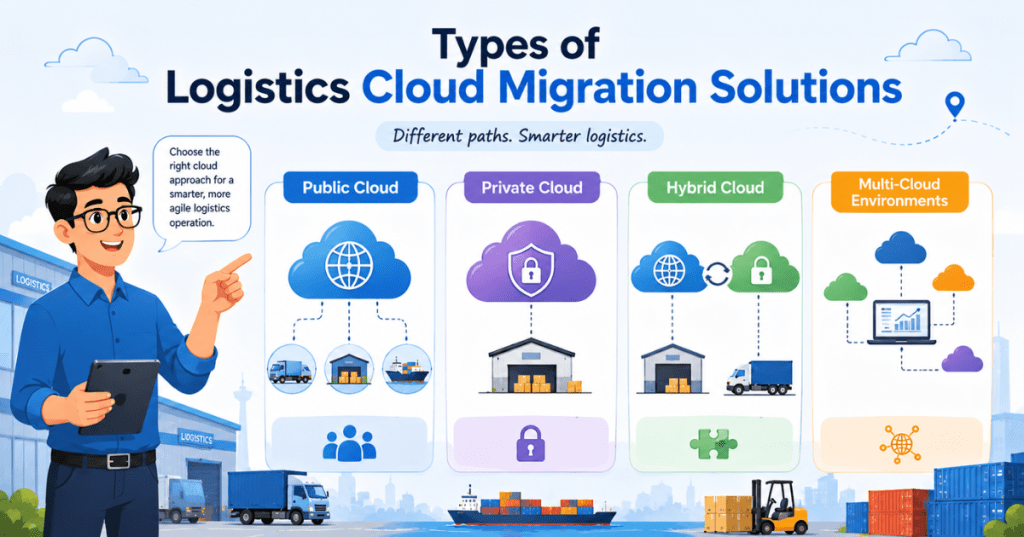
Types of Logistics Cloud Migration Solutions
Not all cloud environments are designed for the same operational requirements. Selecting the right Logistics Cloud Migration Solutions strategy depends on factors such as security requirements, regulatory obligations, scalability goals, and budget considerations. Understanding the available deployment models helps logistics companies choose the most suitable approach for their digital transformation journey.
Public Cloud
- Public cloud environments provide scalable computing resources through third-party cloud providers. This model offers rapid deployment, flexible resource allocation, and lower infrastructure costs, making it an attractive option for logistics companies seeking operational agility and faster innovation.
Private Cloud
- A private cloud is dedicated exclusively to a single organization, offering greater control, customization, and security. Logistics companies handling sensitive operational data or operating under strict compliance requirements often choose private cloud environments to strengthen governance and data protection.
Hybrid Cloud
- Hybrid cloud combines public and private cloud environments, allowing organizations to distribute workloads based on business and security requirements. This approach provides flexibility while enabling logistics companies to maintain critical systems in secure environments and leverage public cloud scalability when needed.
Multi-Cloud Environments
- Multi-cloud strategies involve using services from multiple cloud providers to improve redundancy, performance, and vendor flexibility. This approach helps logistics organizations reduce dependency on a single provider while optimizing workloads across different platforms for enhanced reliability and business continuity.
Why Traditional Logistics Infrastructure Is No Longer Enough
The logistics industry is evolving rapidly as businesses face increasing shipment volumes, rising customer expectations, and more complex supply chain operations. Traditional IT infrastructure, once sufficient for managing logistics workflows, is now struggling to support modern operational requirements. Legacy systems often lack the flexibility, scalability, and integration capabilities needed to handle real-time data, connected technologies, and growing business demands. As a result, many logistics organizations are turning to cloud-based solutions to modernize their infrastructure and remain competitive in an increasingly digital marketplace.
Challenges of Legacy Logistics Systems
Legacy infrastructure can create significant barriers to operational efficiency and business growth. Many logistics companies continue to rely on outdated systems that were not designed to support modern supply chain technologies, data-intensive processes, or rapidly changing market conditions.
Limited Scalability
- Traditional infrastructure often requires additional hardware investments whenever business demands increase. This makes it difficult for logistics companies to quickly adapt to seasonal fluctuations, expanding customer requirements, or new operational initiatives without significant delays and capital expenditures.
High Maintenance Costs
- Maintaining on-premises servers, storage systems, and network infrastructure requires continuous investments in hardware upgrades, software updates, and technical support. These ongoing expenses can consume valuable resources that could otherwise be directed toward innovation and business growth.
Poor System Integration
- Many legacy logistics platforms operate independently, making it difficult to connect transportation, warehouse, inventory, and customer management systems. This lack of integration creates inefficiencies, limits visibility, and slows decision-making across the supply chain.
Data Silos
- When critical business information is stored across disconnected systems, teams struggle to access accurate and consistent data. Data silos reduce operational transparency, increase reporting challenges, and make it harder to gain actionable insights for strategic planning.
Operational Risks Caused by Outdated Infrastructure
Outdated IT environments not only reduce efficiency but also expose logistics organizations to operational risks that can directly impact profitability, customer experience, and long-term business performance.
Downtime
- Aging infrastructure is more vulnerable to hardware failures, software issues, and unexpected disruptions. Even short periods of downtime can interrupt logistics operations, delay shipments, and create significant financial losses while damaging customer trust.
Delayed Deliveries
- Logistics companies depend on accurate, real-time information to coordinate transportation and distribution activities. Outdated systems often struggle to process data efficiently, increasing the likelihood of delays, scheduling errors, and disruptions across the supply chain.
Inefficient Warehouse Management
- Legacy warehouse systems may lack automation capabilities and real-time inventory visibility. This can lead to inventory inaccuracies, slower order processing, reduced productivity, and operational inefficiencies that affect overall supply chain performance.
Reduced Customer Satisfaction
- Customers expect accurate tracking information, reliable deliveries, and responsive service. Infrastructure limitations that cause delays, system outages, or communication gaps can negatively impact customer experiences and reduce long-term loyalty.
Growing Demand for Cloud Computing Services for Logistics Industry
The need for greater operational agility, real-time visibility, and technology-driven decision-making is accelerating cloud adoption throughout the logistics sector. Modern logistics organizations require infrastructure capable of supporting evolving business models and emerging technologies.
Increasing Shipment Volumes
- The growth of eCommerce, global trade, and customer demand for faster deliveries has significantly increased shipment volumes. Cloud-based infrastructure provides the scalability needed to process larger workloads without compromising performance or reliability.
Connected Supply Chains
- Modern supply chains rely on continuous communication between manufacturers, suppliers, logistics providers, and customers. Cloud platforms enable seamless information sharing and collaboration, improving visibility and coordination across the entire logistics ecosystem.
IoT Integration
- Logistics organizations increasingly use IoT devices to monitor vehicles, track shipments, manage assets, and optimize operations. Cloud environments provide the processing power and connectivity required to collect, analyze, and act on large volumes of real-time IoT data.
AI-Powered Logistics Operations
- Artificial intelligence is transforming logistics through predictive analytics, route optimization, demand forecasting, and automated decision-making. Cloud infrastructure supports these advanced technologies by providing scalable computing resources and access to centralized operational data.
Key Benefits of Cloud Migration Services for Logistics
Cloud Migration Services for Logistics provide more than infrastructure modernization. They create a foundation for greater operational efficiency, business agility, and long-term scalability. By moving critical systems and workloads to the cloud, logistics organizations can improve performance, strengthen resilience, and better support evolving customer expectations.
Enhanced Supply Chain Visibility
Cloud-based platforms centralize operational data from transportation, warehousing, inventory management, and customer-facing systems. This unified visibility enables logistics companies to track activities in real time, identify disruptions quickly, and make data-driven decisions that improve supply chain performance.
Faster Data Access Across Locations
- Cloud environments allow employees, partners, and stakeholders to securely access information from virtually any location. This improves collaboration across distributed logistics networks while ensuring teams can make timely decisions using accurate and up-to-date information.
Improved Business Continuity and Disaster Recovery
- Cloud platforms provide built-in redundancy, automated backups, and disaster recovery capabilities that help minimize operational disruptions. In the event of a system failure, cyberattack, or natural disaster, logistics companies can restore critical services more quickly and maintain business continuity.
Reduced IT Infrastructure Costs
- Cloud adoption eliminates many of the expenses associated with purchasing, maintaining, and upgrading physical hardware. Organizations can optimize technology spending through flexible pricing models that align infrastructure costs with actual business usage.
Better Scalability During Seasonal Demand Peaks
- Logistics businesses frequently experience demand fluctuations driven by holidays, promotional events, and market changes. Cloud infrastructure enables organizations to scale resources dynamically, ensuring consistent performance during peak periods without overinvesting in permanent capacity.
Improved Integration with Transportation and Warehouse Management Systems
- Modern cloud platforms simplify integration between transportation management systems, warehouse management software, inventory tools, analytics platforms, and third-party applications. This connected ecosystem improves operational efficiency and supports a more streamlined supply chain operation.
What Are Cloud Security Services for Logistics Companies?
As logistics companies increasingly adopt cloud technologies, securing digital infrastructure has become a critical business priority. Modern logistics operations rely on interconnected systems, real-time data sharing, and cloud-based applications to manage transportation, warehousing, inventory, and customer communications. While cloud adoption offers significant operational advantages, it also introduces new cybersecurity risks. Cloud Security Services for Logistics Companies help protect sensitive business data, prevent unauthorized access, maintain regulatory compliance, and ensure uninterrupted operations across the supply chain ecosystem.
Understanding Cloud Security in Logistics Operations
Cloud security refers to the technologies, policies, controls, and practices used to protect cloud-based applications, data, networks, and infrastructure from cyber threats. In logistics environments, cloud security plays a vital role in safeguarding shipment information, customer records, operational systems, and business-critical processes. Effective security strategies help organizations maintain visibility, resilience, and trust while supporting digital transformation initiatives.
Why Cloud Security Is Critical for Logistics Companies
The logistics industry handles large volumes of sensitive information, including customer data, shipment details, inventory records, and supplier communications. A successful cyberattack can disrupt operations, cause financial losses, and damage customer relationships. Implementing Cloud Security Solutions for Logistics Companies helps organizations strengthen cyber resilience, reduce operational risks, and maintain business continuity in an increasingly connected environment.
Common Threats Facing Logistics Organizations
Ransomware Attacks
- Ransomware remains one of the most disruptive cybersecurity threats facing logistics businesses. Attackers can encrypt operational systems and critical data, bringing transportation, warehousing, and distribution activities to a halt. Strong cloud security controls help minimize exposure and accelerate recovery efforts.
Data Breaches
- Logistics companies manage valuable operational and customer information that can become a target for cybercriminals. Data breaches may result in financial penalties, reputational damage, and compliance violations. Cloud security measures help protect sensitive information through encryption, access controls, and continuous monitoring.
Insider Threats
- Not all security risks originate from external attackers. Employees, contractors, or third-party users with excessive access privileges can unintentionally or deliberately expose critical information. Proper identity management and access governance reduce the likelihood of insider-related incidents.
Third-Party Vendor Vulnerabilities
- Logistics operations often depend on external technology providers, suppliers, and business partners. Weak security practices within third-party environments can create entry points for attackers. Effective cloud security strategies help monitor and manage risks across connected vendor ecosystems.
Supply Chain Cyberattacks
- Cybercriminals increasingly target supply chain networks because a single compromised system can affect multiple organizations. Cloud security frameworks help organizations strengthen defenses, improve visibility, and respond quickly to threats that could disrupt critical logistics operations.
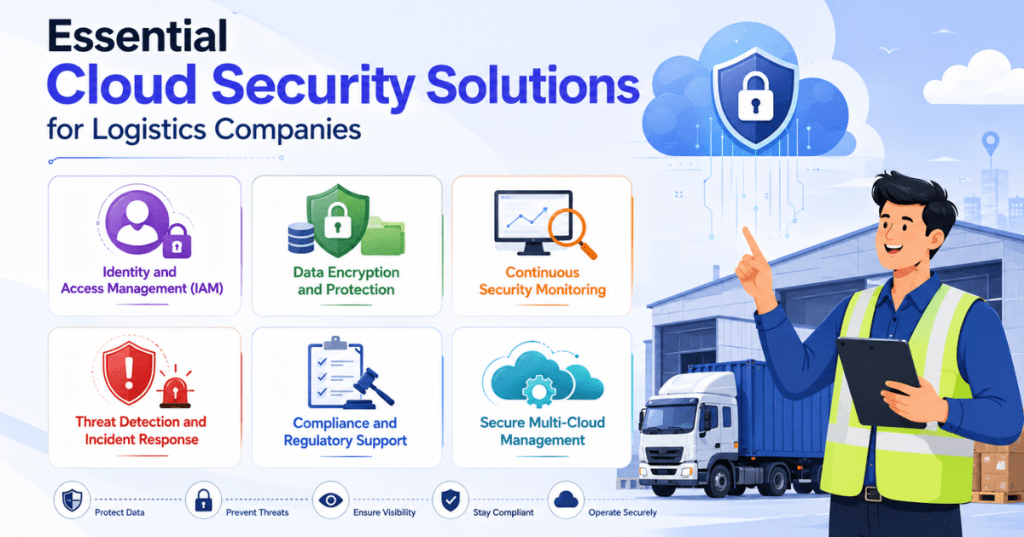
Essential Cloud Security Solutions for Logistics Companies
Protecting modern logistics infrastructure requires a comprehensive security strategy that addresses people, processes, and technology. The following security capabilities form the foundation of a resilient cloud environment.
Identity and Access Management (IAM)
Identity and Access Management solutions ensure that only authorized users can access specific systems, applications, and data. By implementing role-based access controls, multi-factor authentication, and user governance policies, logistics organizations can significantly reduce the risk of unauthorized access and credential-based attacks.
Data Encryption and Protection
Encryption protects sensitive information both during transmission and while stored within cloud environments. Strong encryption practices help safeguard shipment records, financial information, customer data, and operational intelligence from unauthorized access, ensuring greater confidentiality and regulatory compliance.
Continuous Security Monitoring
Modern cyber threats evolve rapidly, making continuous monitoring essential for cloud environments. Security monitoring solutions provide real-time visibility into network activity, user behavior, and system performance, enabling organizations to identify suspicious activities before they escalate into major incidents.
Threat Detection and Incident Response
Advanced threat detection technologies use automation, analytics, and artificial intelligence to identify potential security threats quickly. Combined with incident response planning, these capabilities help logistics companies contain attacks faster, minimize operational disruption, and reduce business impact.
Compliance and Regulatory Support
Logistics companies must often comply with industry regulations, data protection requirements, and customer security standards. Cloud security solutions help organizations implement governance frameworks, maintain audit readiness, and demonstrate compliance across cloud-based operations.
Secure Multi-Cloud Management
Many organizations operate across multiple cloud platforms to improve flexibility and resilience. Secure multi-cloud management ensures consistent security policies, centralized visibility, and effective governance across different cloud providers while reducing operational complexity and risk.
How Cloud Migration and Cloud Security Work Together
Cloud migration and cloud security should never be treated as separate initiatives. Successful digital transformation requires organizations to integrate security throughout every stage of the migration journey. A security-first approach helps logistics companies maximize cloud benefits while minimizing operational and cybersecurity risks.
Building a Secure Cloud Foundation
Security should be incorporated from the earliest stages of cloud planning and architecture design. Establishing strong governance policies, access controls, encryption standards, and security frameworks creates a reliable foundation that supports long-term operational growth and resilience.
Security Considerations During Migration
During migration, organizations must evaluate data sensitivity, application dependencies, access requirements, and compliance obligations. Addressing these security considerations early helps prevent vulnerabilities from being introduced into the new cloud environment while ensuring a smoother migration process.
Reducing Risk While Modernizing Infrastructure
Migrating to the cloud provides an opportunity to replace outdated security practices with modern protection mechanisms. By integrating advanced security technologies during migration, logistics companies can reduce cyber risks while improving operational efficiency and infrastructure performance.
Ensuring Business Continuity Throughout Migration
Business continuity is a critical concern for logistics organizations where even minor disruptions can impact supply chain performance. Combining cloud migration with proactive security planning helps minimize downtime, protect critical workloads, and ensure uninterrupted operations throughout the transition process.
How to Choose the Right Cloud Migration Strategy for Logistics Operations
A successful cloud transformation begins with selecting the right migration strategy that aligns with business objectives, operational requirements, and long-term scalability goals. Logistics companies should assess their existing infrastructure, application dependencies, data workflows, and security requirements before moving to the cloud. Partnering with an experienced cloud migration service provider can simplify this process by helping organizations develop a structured migration roadmap, reduce implementation risks, and ensure business continuity throughout the transition. A well-planned migration strategy enables logistics businesses to improve operational efficiency, optimize costs, enhance
Assessing Current Infrastructure
Before beginning any migration initiative, organizations should evaluate their existing IT environment, applications, databases, and operational workflows. Understanding current infrastructure limitations, performance challenges, and system dependencies helps identify migration priorities and potential risks. A thorough assessment also provides a clear roadmap for modernization efforts and future scalability requirements.
Defining Business Objectives
Cloud migration should support measurable business outcomes rather than serving solely as a technology upgrade. Logistics organizations should establish clear objectives such as improving operational efficiency, enhancing supply chain visibility, reducing infrastructure costs, strengthening security, or enabling future innovation. Well-defined goals help guide decision-making throughout the migration process.
Selecting the Right Cloud Environment
Choosing the appropriate cloud model depends on an organization’s security requirements, compliance obligations, workload characteristics, and operational priorities. Public, private, hybrid, and multi-cloud environments each offer unique advantages. Selecting the right environment ensures logistics companies achieve the ideal balance between flexibility, performance, security, and cost efficiency.
Planning Data Migration and Security Controls
Data is one of the most valuable assets within any logistics operation. Organizations must develop detailed migration plans that address data classification, transfer methods, access management, encryption requirements, and regulatory compliance. Integrating security controls into migration planning helps protect sensitive information while minimizing operational and cybersecurity risks.
Measuring Success and ROI
The success of a cloud migration initiative should be measured using predefined performance indicators. Metrics such as infrastructure cost savings, system availability, operational efficiency, application performance, scalability improvements, and security enhancements help organizations evaluate return on investment and identify opportunities for continuous optimization.
Best Practices for Successful Logistics Cloud Migration
Migrating logistics infrastructure to the cloud is a complex process that requires careful planning, execution, and governance. Following proven best practices helps organizations reduce risks, improve project outcomes, and maximize the benefits of their cloud transformation initiatives.
Conduct a Cloud Readiness Assessment
A cloud readiness assessment helps organizations evaluate their technical environment, operational processes, security posture, and migration preparedness. This assessment identifies potential challenges, uncovers infrastructure gaps, and provides valuable insights that support more informed planning and decision-making throughout the migration journey.
Prioritize Mission-Critical Applications
Not all applications require migration at the same time. Logistics companies should prioritize systems that have the greatest impact on business operations, customer service, and supply chain performance. A structured migration approach allows organizations to reduce complexity, minimize disruption, and validate success before expanding migration efforts.
Implement Security by Design
Security should be integrated into every phase of the migration process rather than added after deployment. A security-by-design approach incorporates identity management, encryption, access controls, monitoring capabilities, and compliance requirements from the outset, helping organizations build a stronger and more resilient cloud environment.
Create a Phased Migration Roadmap
Attempting to migrate all systems simultaneously can increase operational risk and complexity. A phased migration roadmap allows logistics organizations to transition workloads in manageable stages, monitor performance, address challenges proactively, and maintain business continuity throughout the transformation process.
Train Teams and Stakeholders
Technology adoption is most successful when employees understand how to use and manage new systems effectively. Providing training for IT teams, operational staff, and business stakeholders helps improve cloud adoption, reduce resistance to change, and ensure organizations maximize the value of their cloud investments.
Establish Ongoing Monitoring and Governance
Cloud migration is not a one-time project but an ongoing operational responsibility. Continuous monitoring, performance management, security oversight, and governance practices help organizations maintain efficiency, control costs, identify risks, and ensure cloud environments continue to align with evolving business objectives.
Emerging Trends Shaping the Future of Logistics Cloud Infrastructure
The logistics industry continues to evolve as organizations adopt new technologies to improve efficiency, visibility, and decision-making. Cloud infrastructure serves as the foundation for many of these innovations, enabling businesses to leverage advanced capabilities that support digital transformation and long-term competitiveness.
AI-Powered Logistics Operations
Artificial intelligence is helping logistics companies automate routine processes, optimize transportation routes, improve demand forecasting, and enhance operational decision-making. Cloud-based environments provide the computing power and scalability required to support AI-driven applications across complex logistics networks.
Predictive Analytics and Real-Time Intelligence
Modern logistics operations generate vast amounts of operational data every day. Cloud platforms enable organizations to analyze this information in real time, uncover trends, predict disruptions, and make proactive decisions that improve efficiency, reduce costs, and strengthen customer service performance.
Edge Computing for Logistics Networks
Edge computing brings data processing closer to operational environments such as warehouses, distribution centers, and transportation assets. When combined with cloud infrastructure, edge computing reduces latency, accelerates decision-making, and supports real-time operational visibility across geographically distributed logistics networks.
IoT-Enabled Supply Chain Visibility
Internet of Things (IoT) devices are transforming supply chain management by providing continuous visibility into asset locations, shipment conditions, vehicle performance, and inventory status. Cloud platforms collect and analyze IoT-generated data, enabling organizations to improve monitoring, efficiency, and operational responsiveness.
Autonomous and Data-Driven Logistics Ecosystems
The future of logistics is increasingly focused on automation, intelligent decision-making, and connected digital ecosystems. Cloud infrastructure supports autonomous technologies, advanced analytics, and integrated operational platforms that help logistics organizations improve agility, reduce manual processes, and create more resilient supply chain networks.
Why SISGAIN Is the Right Technology Partner for Logistics Cloud Transformation
Choosing the right technology partner is essential for maximizing the benefits of cloud transformation. SISGAIN combines deep logistics industry expertise with advanced cloud technologies to deliver secure, scalable, and high-performance solutions tailored to modern supply chain operations. As a trusted cloud security services company, SISGAIN helps organizations strengthen cybersecurity, protect sensitive logistics data, maintain compliance, and reduce operational risks through proactive security frameworks and continuous monitoring. Along with comprehensive cloud migration capabilities, SISGAIN enables logistics businesses to accelerate digital transformation, improve resilience, and create a secure foundation for long-term operational success and sustainable growth.
Logistics-Focused Industry Expertise
SISGAIN understands the unique challenges facing logistics organizations, including supply chain complexity, real-time visibility requirements, operational scalability, and cybersecurity risks. By combining industry knowledge with modern cloud technologies, SISGAIN delivers customized solutions that align with logistics workflows, regulatory requirements, and long-term business objectives.
End-to-End Cloud Migration Planning and Execution
From initial infrastructure assessments to migration planning, deployment, and post-migration optimization, SISGAIN provides comprehensive cloud migration support. This end-to-end approach helps logistics companies minimize disruptions, accelerate implementation timelines, and achieve a smooth transition to cloud-based environments.
Advanced Security-First Architecture
Security is integrated into every stage of SISGAIN’s cloud transformation strategy. Through robust access controls, encryption frameworks, continuous monitoring, and proactive risk management practices, SISGAIN helps organizations protect critical business data and strengthen their overall cybersecurity posture.
Scalable and Future-Ready Cloud Solutions
SISGAIN designs cloud environments that can evolve alongside changing business needs. Whether supporting growing shipment volumes, expanding operational networks, or adopting emerging technologies, these scalable solutions provide the flexibility needed to support sustainable business growth.
Continuous Monitoring, Optimization, and Support
Cloud success extends beyond migration. SISGAIN provides ongoing monitoring, performance optimization, and technical support to help logistics organizations maintain system reliability, improve efficiency, address emerging challenges, and maximize the long-term value of their cloud investments.
Proven Approach to Business Continuity and Risk Reduction
SISGAIN follows a structured methodology focused on minimizing operational risks and ensuring business continuity throughout cloud transformation initiatives. By implementing resilient architectures, disaster recovery strategies, and proactive security controls, organizations can maintain uninterrupted operations while navigating digital modernization efforts.
Conclusion
Cloud migration and cloud security have become essential for modern logistics companies aiming to improve efficiency, scalability, and resilience. By adopting Cloud Migration Services for Logistics along with robust security frameworks, businesses can enhance supply chain visibility, reduce operational costs, and protect critical data from evolving cyber threats. A well-planned strategy ensures smooth transformation, minimal disruption, and long-term business growth. Ultimately, combining cloud migration with strong security enables logistics organizations to stay competitive in a fast-changing, technology-driven industry.
Frequently Asked Questions
What are Cloud Migration Services for Logistics?
Cloud Migration Services for Logistics help businesses move applications, data, and operational systems from on-premises infrastructure to cloud environments. This improves scalability, operational efficiency, flexibility, and real-time visibility across logistics and supply chain operations.
Why do logistics companies need cloud security services?
Cloud security services help logistics companies protect sensitive shipment data, customer information, and business-critical systems from cyber threats. They also support compliance, reduce security risks, and ensure uninterrupted operations.
What are the benefits of logistics cloud migration solutions?
Logistics cloud migration solutions improve supply chain visibility, reduce infrastructure costs, enhance scalability, support remote access, strengthen disaster recovery capabilities, and enable faster integration with modern logistics technologies.
How long does a logistics cloud migration project typically take?
The timeline depends on infrastructure complexity, data volume, application requirements, and migration scope. Small projects may take a few weeks, while enterprise-scale cloud migrations can require several months for successful implementation.
What security measures should logistics companies implement in the cloud?
Logistics companies should implement identity and access management, multi-factor authentication, data encryption, continuous monitoring, threat detection, backup strategies, and compliance controls to secure cloud-based operations effectively.
 Software Services
Leave a comment