Artificial intelligence is no longer a futuristic concept in e-commerce—it has become a powerful competitive advantage that separates high-growth brands from businesses struggling to keep pace. While many companies still rely on traditional strategies, leading e-commerce brands are using AI and machine learning to deliver personalized experiences, optimize operations, predict customer behavior, and increase profitability.
This growing gap between AI-driven organizations and conventional online stores is reshaping the future of digital commerce. From intelligent product recommendations and dynamic pricing to demand forecasting and automated customer support, AI-powered technologies are enabling businesses to operate smarter and scale faster.
The most successful brands understand that AI is not simply about automation; it is about creating better customer experiences and making data-driven decisions. By learning from these industry leaders, businesses can unlock new growth opportunities and build a stronger competitive position in an increasingly intelligent and customer-centric marketplace.
Key Takeaways
High-growth e-commerce companies are no longer relying solely on traditional marketing and operational strategies. They are leveraging artificial intelligence and machine learning to create smarter, more personalized, and highly scalable businesses.
- AI in E-commerce has evolved from an emerging technology into a competitive necessity.
- Machine learning enables businesses to predict customer behavior and improve decision-making.
- Personalized recommendations and predictive analytics significantly increase revenue and customer loyalty.
- AI-powered automation helps reduce operational costs and improve efficiency.
- Demand forecasting and inventory optimization allow brands to minimize waste and maximize profitability.
- Large Language Models (LLMs) are changing how customers discover products and interact with businesses.
- Generative Engine Optimization (GEO) and Answer Engine Optimization (AEO) are becoming essential for visibility across AI-driven search experiences.
- Companies that delay AI adoption risk losing market share to more agile competitors.
- Successful AI implementation requires clear goals, quality data, and scalable technologies.
- Partnering with experienced providers like SISGAIN can accelerate digital transformation and maximize return on investment.
- AI-powered e-commerce will continue evolving through agentic AI, autonomous assistants, predictive commerce, and real-time personalization.
Why AI and Machine Learning Have Become Essential for E-commerce Growth
The Shift From Traditional E-commerce to Intelligent Commerce
Modern businesses across industries are embracing intelligent technologies to improve customer experiences and operational efficiency. While AI in e-commerce is transforming digital commerce, sectors such as AI and Machine Learning for healthcare are also demonstrating how predictive analytics and automation can deliver measurable outcomes. Organizations that invest in AI early gain stronger competitive advantages, improve decision-making, and build scalable systems that support long-term growth and innovation.
Rising Customer Expectations
Modern consumers expect seamless, personalized, and convenient shopping experiences across every touchpoint. They want relevant product recommendations, fast responses, and frictionless transactions. AI technologies help businesses understand customer preferences and deliver tailored experiences that improve satisfaction, strengthen loyalty, and increase conversion rates in an increasingly competitive digital marketplace.
Data-Driven Decision Making
Leading e-commerce brands no longer rely on assumptions when making business decisions. Machine learning models analyze customer behavior, sales patterns, and market trends to generate valuable insights. These data-driven strategies help companies improve forecasting, optimize inventory, refine marketing campaigns, and make informed decisions that contribute to sustainable growth.
Personalization as a Competitive Advantage
Personalization has become one of the strongest differentiators in modern commerce. AI-powered systems analyze browsing history, purchase behavior, and customer preferences to deliver customized recommendations and targeted experiences. Businesses that prioritize personalization can enhance customer engagement, increase average order value, and create stronger relationships that encourage repeat purchases.
Increasing Pressure on Margins and Customer Acquisition Costs
Rising advertising expenses and growing competition are making it increasingly difficult for businesses to maintain profitability. AI and machine learning help companies optimize marketing spending, improve customer retention, forecast demand, and automate repetitive processes. These capabilities reduce operational costs and enable brands to maximize revenue while maintaining healthy profit margins.
What High-Growth E-commerce Brands Understand That Others Overlook
AI Is Not Just Automation—It Is Business Intelligence
Many businesses still view artificial intelligence as a tool for automating repetitive tasks. However, high-growth companies understand that AI for E-commerce Businesses goes far beyond automation. Modern AI systems generate valuable insights, identify opportunities, predict trends, and support better decision-making. By leveraging Machine Learning Solutions for E-commerce, leading brands create intelligent ecosystems that improve efficiency, increase revenue, and deliver exceptional customer experiences.
AI Helps Predict Customer Behavior
Successful e-commerce brands use AI to understand how customers browse, shop, and interact with products. Predictive analytics allows businesses to anticipate future purchasing patterns, identify high-value customers, and recommend relevant products. These insights enable companies to improve engagement, increase conversions, and make proactive decisions that drive sustainable growth.
Machine Learning Improves Every Interaction
Machine learning continuously analyzes customer activities and refines digital experiences over time. From personalized emails and product suggestions to targeted advertisements and chatbots, intelligent systems ensure every interaction becomes more relevant. This continuous optimization helps businesses improve customer satisfaction and create stronger relationships with their audiences.
Data Creates Sustainable Competitive Advantages
Data has become one of the most valuable assets in modern commerce. High-growth brands use AI-driven insights to understand market trends, optimize inventory, and refine marketing strategies. Businesses that effectively utilize their data gain long-term advantages that competitors relying on traditional approaches often struggle to replicate.
Continuous Learning Enables Faster Growth
Unlike traditional software, machine learning models evolve with every new interaction and dataset. This ability to learn continuously allows businesses to adapt to changing customer preferences and market conditions. As a result, companies can innovate faster, improve operational efficiency, and maintain a strong competitive position in rapidly evolving markets.
How AI in E-commerce Improves Customer Experience
Creating Hyper-Personalized Shopping Journeys
Customer experience has become a defining factor for success in digital commerce. AI in E-commerce enables brands to create highly personalized shopping journeys that increase engagement and customer loyalty. Through intelligent recommendations, predictive analytics, and real-time personalization, AI-Powered E-commerce platforms provide seamless experiences that meet the expectations of today’s consumers while improving overall business performance.
Personalized Product Recommendations
AI algorithms analyze browsing history, purchase behavior, and customer preferences to suggest products that are most relevant to individual shoppers. Personalized recommendations improve product discovery, increase average order values, and enhance customer satisfaction. This capability has become one of the most effective E-commerce AI Solutions for driving revenue growth.
Dynamic Pricing Strategies
Modern AI systems can adjust pricing based on demand, competition, customer behavior, and market conditions. Dynamic pricing helps businesses maximize profitability while remaining competitive. By analyzing large volumes of data in real time, companies can make smarter pricing decisions that improve both sales performance and customer retention.
AI-Based Search and Navigation
Traditional search functions often struggle to understand customer intent. AI-powered search technologies provide more accurate results by interpreting natural language and user behavior. Intelligent navigation enhances product discovery, reduces friction, and enables customers to find desired products more quickly, resulting in higher conversion rates.
Voice Commerce and Conversational Shopping
The growing popularity of voice assistants and conversational AI is transforming online shopping experiences. Customers can search for products, ask questions, and complete purchases using natural language interactions. These technologies create more convenient and engaging experiences while opening new opportunities for businesses to connect with consumers.
AI-Powered Customer Support
AI chatbots and virtual assistants provide instant support and personalized assistance throughout the customer journey. They help answer questions, track orders, resolve issues, and offer recommendations around the clock. This level of responsiveness improves customer satisfaction while reducing operational costs and increasing service efficiency.
Machine Learning Applications That Are Driving Revenue Growth
Practical Use Cases Used by Fast-Growing Brands
Leading digital retailers are increasingly using Machine Learning in E-commerce to improve efficiency, enhance customer experiences, and increase profitability. Rather than relying on assumptions, successful brands leverage data-driven insights to optimize operations and make smarter decisions. These Machine Learning Solutions for E-commerce enable businesses to scale faster while creating sustainable competitive advantages in an increasingly demanding market.
Demand Forecasting
Machine learning models analyze historical sales data, customer trends, and seasonal patterns to accurately predict future demand. This enables businesses to prepare inventory levels, reduce waste, and avoid stock shortages. Better forecasting helps companies improve customer satisfaction and maximize revenue opportunities.
Inventory Optimization
Efficient inventory management is essential for profitability. Machine learning systems monitor stock levels and purchasing trends to ensure products are available when customers need them. This minimizes overstocking, reduces carrying costs, and helps businesses maintain healthy profit margins.
Customer Segmentation
Machine learning enables businesses to divide customers into meaningful groups based on behavior, preferences, and purchase history. These insights allow brands to create targeted campaigns and personalized experiences that improve engagement, increase conversions, and strengthen customer relationships.
Predictive Analytics
Predictive analytics helps businesses identify future trends and anticipate customer behavior. By analyzing large volumes of data, organizations can make proactive decisions regarding pricing, promotions, and product strategies. This approach improves operational efficiency and drives long-term growth.
Fraud Detection
Fraud prevention has become increasingly important in digital commerce. Machine learning algorithms can identify suspicious transactions and unusual patterns in real time. These intelligent systems reduce financial risks, protect customer information, and help maintain trust in online platforms.
Churn Prediction Models
Machine learning can identify customers who are likely to stop purchasing or switch to competitors. By recognizing early warning signs, businesses can implement retention strategies and personalized offers that improve loyalty and increase customer lifetime value.
Marketing Campaign Optimization
Machine learning helps businesses analyze campaign performance and customer responses across multiple channels. These insights allow marketers to optimize targeting, allocate budgets effectively, and improve return on investment while delivering more relevant experiences to customers.
The Hidden Costs of Ignoring AI and Machine Learning
Why Businesses That Delay Adoption Risk Falling Behind
As artificial intelligence becomes more deeply integrated into commerce, businesses that delay adoption face increasing challenges. Competitors using intelligent technologies are delivering better customer experiences and operating more efficiently. Companies that fail to embrace AI and machine learning may struggle to remain competitive in an evolving digital marketplace.
Higher Customer Acquisition Costs
Without AI-driven insights, businesses often rely on inefficient marketing strategies that increase advertising expenses. Intelligent systems optimize audience targeting and campaign performance, helping organizations acquire customers more efficiently and improve overall marketing returns.
Lower Conversion Rates
Traditional online experiences often fail to deliver the personalization modern consumers expect. AI-powered recommendations and behavioral analysis increase relevance and engagement, enabling businesses to convert more visitors into paying customers and maximize revenue opportunities.
Poor Inventory Management
Inaccurate forecasting and manual inventory processes can result in stock shortages or excess inventory. These issues negatively affect customer satisfaction and profitability. AI technologies help businesses maintain optimal inventory levels and improve operational efficiency.
Reduced Customer Retention
Customer loyalty is increasingly influenced by personalized experiences and timely interactions. Businesses that ignore AI may struggle to understand changing customer expectations, leading to lower retention rates and reduced lifetime value.
Inefficient Operations
Manual processes consume valuable resources and limit scalability. AI-driven automation streamlines workflows, reduces errors, and improves productivity. Companies that fail to modernize often experience slower growth and higher operational expenses.
Losing Market Share to AI-Enabled Competitors
High-growth brands are investing heavily in artificial intelligence to improve decision-making and customer experiences. Businesses that continue using outdated approaches risk losing customers and market share to competitors that are embracing digital innovation.
AI Technologies Powering Modern E-commerce Platforms
Read More :- What Are the Most Overlooked Benefits of AI and Machine Learning in Healthcare?
Core Technologies Behind Intelligent Commerce
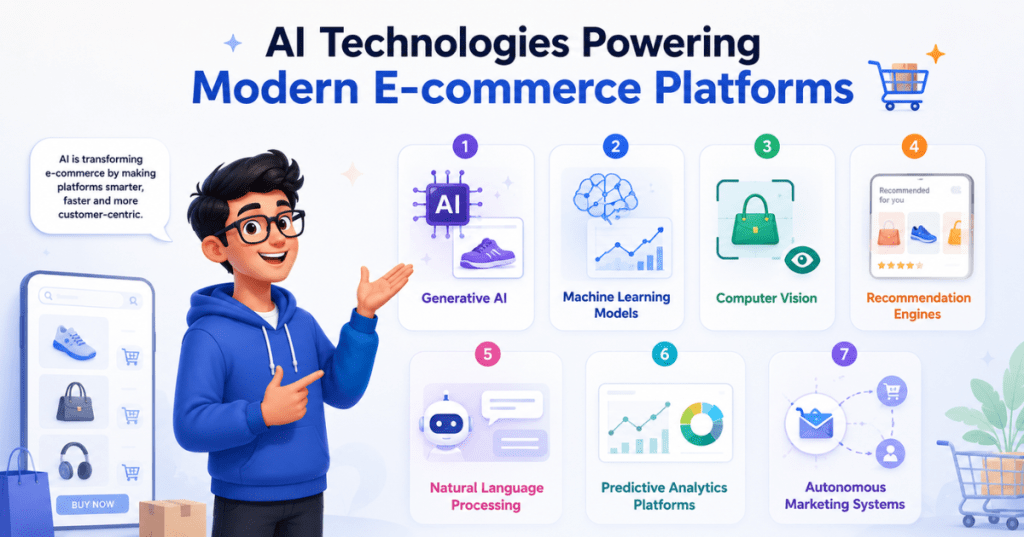
Modern online businesses rely on advanced technologies to deliver highly personalized and efficient shopping experiences. These E-commerce AI Solutions enable organizations to automate processes, understand customer behavior, and make data-driven decisions. As AI for E-commerce Businesses continues to evolve, these technologies are becoming essential for long-term growth and competitive differentiation.
Generative AI
Generative AI is transforming content creation, customer engagement, and personalization. Businesses use it to generate product descriptions, marketing campaigns, and conversational experiences. These capabilities improve efficiency while enabling brands to deliver more engaging customer interactions.
Machine Learning Models
Machine learning models continuously analyze customer behavior and operational data to uncover valuable insights. They support demand forecasting, recommendation engines, pricing optimization, and predictive decision-making, helping businesses improve performance and profitability.
Computer Vision
Computer vision technologies enable visual search, image recognition, and product identification. Customers can search for products using images, while businesses can automate quality control and enhance user experiences. These capabilities create more intuitive and convenient shopping journeys.
Recommendation Engines
Recommendation engines analyze browsing patterns and purchasing history to suggest relevant products to customers. Personalized recommendations increase average order values, improve engagement, and contribute significantly to revenue growth for modern e-commerce brands.
Natural Language Processing
Natural language processing enables AI systems to understand and respond to human language. This technology powers chatbots, virtual assistants, and intelligent search capabilities that improve customer interactions and provide faster support experiences.
Predictive Analytics Platforms
Predictive analytics platforms help businesses identify future trends and opportunities by analyzing large datasets. These systems improve strategic planning, optimize operations, and enable organizations to make proactive decisions that support sustainable growth.
Autonomous Marketing Systems
AI-driven marketing platforms automate campaign management, customer segmentation, and performance optimization. By continuously learning from user behavior, these systems improve targeting accuracy and help businesses maximize returns on their marketing investments.
Real-World AI Use Cases Across the E-commerce Customer Journey
Where AI Creates the Greatest Impact
Customer expectations continue to evolve, making seamless digital experiences more important than ever. AI-powered recommendations, intelligent search, and personalized engagement are helping brands increase conversions and customer loyalty. Businesses working with an experienced ECommerce App Development Company can build feature-rich and AI-enabled applications that deliver exceptional shopping experiences across web and mobile platforms while supporting long-term business growth.
Product Discovery
AI-powered search and recommendation systems make it easier for customers to discover products that match their interests and preferences. By analyzing browsing behavior and previous purchases, intelligent algorithms improve product visibility and help businesses increase conversions and customer engagement.
Personalized Recommendations
Personalized recommendations are among the most successful AI applications in digital commerce. By studying customer preferences and purchasing patterns, AI systems suggest relevant products that enhance the shopping experience, increase average order value, and encourage repeat purchases.
Smart Checkout Experiences
Artificial intelligence helps simplify checkout processes through intelligent payment methods, fraud prevention, and personalized offers. These capabilities reduce cart abandonment rates and create a faster, more convenient experience that contributes to higher conversion rates.
AI Chatbots and Customer Service
AI-driven chatbots and virtual assistants provide instant support and answer customer queries around the clock. These technologies improve response times, reduce operational costs, and ensure customers receive timely assistance throughout their shopping journey.
Inventory and Supply Chain Optimization
AI systems analyze demand patterns, supplier performance, and inventory levels to improve supply chain efficiency. These insights help businesses reduce stock shortages, minimize waste, and ensure products remain available when customers need them.
Post-Purchase Engagement
Customer relationships do not end after a transaction. AI enables businesses to deliver personalized follow-ups, loyalty rewards, and relevant recommendations that improve customer retention and increase lifetime value.
Customer Lifetime Value Prediction
Predictive AI models help businesses identify high-value customers and estimate future revenue potential. These insights enable organizations to create targeted retention strategies and maximize profitability over the long term.
AI Models and Technologies Businesses Should Understand
The AI Models Behind Intelligent E-commerce Systems
Understanding modern AI models is essential for businesses looking to create intelligent and scalable platforms. Large language models, predictive analytics, recommendation engines, and computer vision technologies are driving digital transformation across industries. Partnering with an experienced machine learning services company enables organizations to implement advanced solutions, optimize business processes, and leverage data-driven insights that improve customer experiences and support sustainable growth.
Large Language Models
Large Language Models have transformed how businesses interact with customers and optimize digital experiences. These models understand natural language, generate content, and provide intelligent responses that enhance customer engagement and support.
GPT Models
GPT models are widely used for conversational AI, content generation, product descriptions, and personalized customer interactions. They help businesses automate communication and improve user experiences across multiple channels.
Gemini
Gemini models offer advanced reasoning capabilities and multimodal understanding, enabling businesses to create intelligent search experiences, automate workflows, and deliver highly relevant customer interactions.
Claude
Claude models are designed to provide reliable and context-aware responses. Businesses use these systems to improve customer support, content generation, and knowledge management processes.
DeepSeek
DeepSeek models are gaining popularity for their cost efficiency and strong performance in coding, reasoning, and AI-assisted automation. These capabilities support intelligent business processes and scalable AI implementations.
Llama Models
Llama models provide flexible and open-source AI capabilities that enable organizations to develop customized applications while maintaining greater control over their technology ecosystems.
Recommendation Models
Recommendation engines analyze user behavior and purchasing patterns to deliver personalized product suggestions. These models enhance customer experiences and significantly increase engagement and revenue.
Predictive Machine Learning Models
Predictive models analyze historical data to forecast customer behavior, sales trends, and inventory requirements. Businesses use these insights to make proactive decisions and optimize operations.
Reinforcement Learning
Reinforcement learning enables AI systems to continuously improve through experience and feedback. This approach supports pricing optimization, recommendation engines, and intelligent automation strategies.
Computer Vision Models
Computer vision technologies enable image recognition, visual search, and product classification capabilities. These models create more interactive shopping experiences and improve operational efficiency.
Natural Language Processing Models
Natural language processing models enable AI systems to understand human language and intent. They power chatbots, intelligent search systems, and automated customer support solutions.
Generative AI Models
Generative AI models are transforming content creation and personalization. Businesses use these technologies to create product descriptions, advertisements, emails, and conversational experiences more efficiently.
Why These AI Models Matter for E-commerce Businesses
AI models enable organizations to deliver personalized experiences, automate repetitive processes, and make better decisions based on real-time insights. Businesses that invest in intelligent technologies gain competitive advantages, improve operational efficiency, and create scalable systems that support long-term growth.
Large Language Model Optimization: Preparing for AI Search
As AI-powered search platforms become increasingly popular, businesses must optimize their content for large language models and answer engines. This approach improves visibility across conversational search experiences and ensures brands remain discoverable in AI-generated responses.
How Brands Can Appear in AI-Generated Answers
Brands can improve their visibility by publishing authoritative content, answering user questions clearly, and creating structured information that AI systems can easily understand and reference.
Generative Engine Optimization
Generative Engine Optimization focuses on making content discoverable by AI platforms such as ChatGPT, Gemini, Claude, and Perplexity. GEO emphasizes context, expertise, and semantic relevance rather than traditional keyword density.
Answer Engine Optimization
Answer Engine Optimization helps businesses appear in featured snippets and AI-generated responses. Structured headings, FAQ sections, and concise explanations improve visibility across modern search experiences.
Conversational Search Optimization
Consumers increasingly interact with search engines using natural language. Businesses should create content that answers questions conversationally and addresses user intent to remain relevant in AI-driven ecosystems.
Structured Content for AI Visibility
Well-organized content with clear headings, schema markup, FAQs, and topic clusters enables AI models to understand information more effectively. Structured content improves discoverability and strengthens authority across search platforms.
Emerging Trends Shaping the Future of AI-Powered E-commerce
Innovations High-Growth Brands Are Already Exploring
Forward-thinking organizations are investing in emerging technologies that promise to redefine digital commerce. These innovations are enabling businesses to deliver smarter experiences, increase efficiency, and create new opportunities for growth.
Agentic AI
Agentic AI systems are capable of making autonomous decisions and performing complex tasks with minimal human intervention. These technologies represent the next stage in intelligent automation and business optimization.
Autonomous Shopping Assistants
AI-powered assistants are evolving into digital shopping companions that guide customers, recommend products, and simplify purchasing decisions. These experiences improve convenience and customer engagement.
Voice Commerce
Voice-enabled technologies are changing how consumers search for and purchase products. Voice commerce creates more natural interactions and offers businesses additional opportunities to engage with customers.
Visual Search
Visual search technologies allow users to discover products using images instead of text. These capabilities improve product discovery and enhance the overall shopping experience.
AI-Generated Product Descriptions
Generative AI enables businesses to create consistent and optimized product descriptions at scale. This improves efficiency while maintaining content quality across large catalogs.
Real-Time Personalization
AI systems continuously analyze customer behavior to deliver highly personalized experiences in real time. This capability strengthens customer relationships and increases conversion rates.
Predictive Commerce
Predictive commerce uses AI and machine learning to anticipate customer needs and buying behavior. Businesses can proactively recommend products and optimize marketing strategies based on future trends.
How to Successfully Implement AI in E-commerce
A Strategic Roadmap
Successful AI adoption requires a clear strategy, reliable data infrastructure, and technologies aligned with business goals. Rather than relying on generic platforms, organizations increasingly invest in custom ai software development solutions to create scalable systems tailored to their requirements. Customized AI implementations help businesses maximize ROI, improve operational efficiency, and build intelligent ecosystems capable of supporting future innovation and sustainable competitive advantages.
Identify High-Impact Areas
Organizations should begin by identifying business processes where AI can deliver the greatest value. Focusing on high-impact opportunities ensures faster results and stronger returns.
Build Data Infrastructure
Reliable data is the foundation of successful AI initiatives. Businesses should establish secure and scalable infrastructures capable of supporting advanced analytics and machine learning models.
Choose the Right AI Technologies
Selecting technologies aligned with business goals is essential for long-term success. Organizations should evaluate solutions based on scalability, flexibility, and expected outcomes.
Start With Pilot Projects
Pilot projects allow businesses to validate AI capabilities before large-scale implementation. These initiatives reduce risk and provide valuable insights for future expansion.
Measure ROI and Performance
Continuous measurement enables organizations to evaluate the effectiveness of AI initiatives. Performance metrics help businesses refine strategies and maximize returns on investment.
Scale Across Departments
After demonstrating success, businesses can expand AI capabilities across marketing, customer service, supply chain management, and other operational areas. Enterprise-wide adoption enables organizations to unlock the full potential of artificial intelligence.
Common Mistakes Businesses Make When Adopting AI
Challenges That Slow Down AI Success
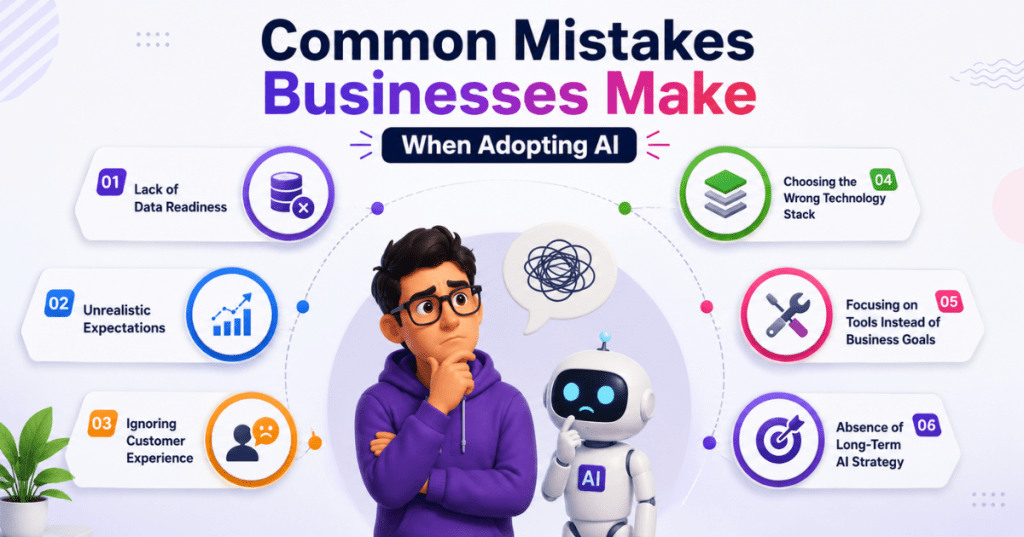
While artificial intelligence offers tremendous opportunities for growth and innovation, successful implementation requires more than simply investing in new technologies. Many businesses struggle to achieve meaningful results because they overlook fundamental requirements and strategic considerations. Understanding these common mistakes can help organizations maximize the value of AI investments, avoid costly setbacks, and build sustainable competitive advantages in an increasingly AI-driven marketplace.
Lack of Data Readiness
Artificial intelligence relies heavily on high-quality and well-structured data. Many businesses attempt to implement AI without establishing a reliable data foundation, resulting in inaccurate predictions and poor outcomes. Organizations should prioritize data quality, integration, and governance to ensure their AI systems can generate meaningful insights and support informed decision-making.
Unrealistic Expectations
Some organizations expect artificial intelligence to deliver immediate results or solve every business challenge overnight. In reality, successful AI adoption requires continuous improvement, experimentation, and long-term commitment. Setting realistic goals and focusing on measurable outcomes helps businesses achieve sustainable growth while maximizing the return on their AI investments.
Ignoring Customer Experience
Technology should enhance customer experiences rather than complicate them. Businesses that focus exclusively on automation without considering customer needs often create frustrating interactions and reduced engagement. AI initiatives should always prioritize personalization, convenience, and responsiveness to deliver experiences that strengthen customer relationships and increase loyalty.
Choosing the Wrong Technology Stack
Selecting inappropriate tools and platforms can limit scalability and increase implementation costs. Businesses should carefully evaluate AI technologies based on their objectives, infrastructure requirements, and long-term growth plans. Choosing the right technology stack enables organizations to build flexible and future-ready systems that support evolving business needs.
Focusing on Tools Instead of Business Goals
Many companies become overly focused on adopting the latest AI technologies without clearly defining the problems they want to solve. Successful organizations align AI initiatives with strategic objectives and measurable business outcomes. A goal-oriented approach ensures that investments deliver tangible value and contribute directly to growth and profitability.
Absence of Long-Term AI Strategy
Artificial intelligence should be viewed as an ongoing transformation rather than a one-time project. Businesses that lack a clear roadmap often struggle to scale their initiatives and maintain competitive advantages. Developing a long-term AI strategy enables organizations to adapt to changing market conditions, continuously innovate, and unlock the full potential of intelligent technologies.
Why SISGAIN Is the Right Technology Partner for AI and Machine Learning Solutions
Businesses looking to accelerate their AI-driven growth need a technology partner with proven expertise, scalability, and a strong focus on business outcomes. SISGAIN delivers comprehensive custom ai software development solutions tailored to specific business objectives, customer behavior, and long-term growth strategies. As an experienced machine learning services company, SISGAIN helps organizations leverage predictive analytics, recommendation engines, intelligent automation, and data-driven decision-making to improve efficiency and customer experiences. With extensive capabilities as an ECommerce Mobile App Development Company, the company enables brands to create seamless and intelligent shopping experiences across web and mobile platforms. SISGAIN’s expertise also extends to other domains, including AI and Machine Learning for healthcare, demonstrating its ability to deliver enterprise-grade solutions across industries. Supported by dedicated AI engineers and data scientists, the company focuses on secure, scalable, and customized development while ensuring measurable ROI, helping businesses build future-ready platforms that support sustainable growth and long-term competitive advantages.

Conclusion
The most successful e-commerce brands are not winning simply because they spend more on marketing—they are succeeding because they leverage artificial intelligence and machine learning to make smarter decisions, deliver highly personalized experiences, and operate more efficiently. What many businesses still consider a future investment has already become a competitive advantage for high-growth companies. From predictive analytics and intelligent automation to AI-powered customer engagement, these technologies are redefining the way digital commerce operates.
As AI models, machine learning systems, and large language models continue to evolve, businesses that embrace innovation early will be better positioned to increase revenue, improve customer loyalty, and build sustainable long-term growth. In an increasingly data-driven and AI-powered marketplace, organizations that invest in intelligent technologies today will be the ones leading the future of e-commerce tomorrow, while those that delay adoption risk falling behind more agile and digitally mature competitors.
Frequently Asked Questions ?
What is AI in E-commerce?
AI in E-commerce refers to the use of artificial intelligence technologies to improve customer experiences, automate operations, personalize recommendations, optimize pricing, and increase business efficiency.
How is machine learning used in e-commerce?
Machine learning in e-commerce helps businesses analyze customer behavior, forecast demand, optimize inventory, detect fraud, and deliver personalized shopping experiences.
What are the benefits of AI-powered e-commerce?
AI-powered e-commerce improves customer satisfaction, increases conversions, enhances personalization, automates repetitive tasks, and helps businesses make data-driven decisions.
Why are high-growth brands investing in AI?
High-growth brands use AI to gain competitive advantages, improve operational efficiency, increase customer retention, and generate higher revenue.
Which AI models are used in e-commerce?
Popular AI models used in e-commerce include GPT, Gemini, Claude, Llama, recommendation engines, predictive analytics models, natural language processing models, and computer vision systems.
What should businesses consider before implementing AI?
Businesses should evaluate their data quality, identify high-value use cases, select the right technologies, define KPIs, and work with experienced AI development partners.


Leave a Reply