If you run a business in Dubai or anywhere else in the UAE, you already know how mobile-obsessed your customers are. They browse on the metro, compare prices in-store, and expect a website to load instantly — or they bounce straight to a competitor. This is exactly why Progressive Web App development in Dubai has moved from “nice to have” to “must have” for companies that want to grow without burning through their budget on a separate native app for every platform.
A Progressive Web App, or PWA, sits in the sweet spot between a website and a mobile app. It loads through a browser like any webpage, but it behaves like an app — it can work offline, send push notifications, and even sit on a user’s home screen. For businesses across the UAE, this means Progressive Web Apps in UAE are quickly becoming the practical answer to a very real problem: how do you give customers an app-like experience without the cost and delay of building separate iOS and Android apps?
In this guide, we’ll break down exactly what PWAs are, how they work, where they fit into different industries, what they cost, and how they genuinely contribute to business growth with PWA in UAE — minus the marketing fluff you’ll find on most pages covering this topic.
Key Takeaways
Before we go deep into the details, here’s a quick map of what this guide covers and the core ideas you’ll walk away with:
- What a PWA actually is a hybrid between a website and a native app that runs through any modern browser.
- The real benefits of Progressive Web Apps in Dubai faster load speeds, offline access, lower development cost, and better customer retention.
- How PWAs technically work through service workers, app shells, and a web app manifest, explained in plain language.
- The features that make a PWA genuinely useful installability, push notifications, responsiveness, and automatic updates.
- Where PWAs are already creating impact retail, real estate, hospitality, government services, and logistics across the UAE.
- An honest look at the pros and cons because no technology is perfect for every business.
- The common roadblocks teams face including iOS limitations and discoverability — and practical ways around them.
- What it actually costs the real factors that influence app development cost in Dubai, including super app functionality.
- Best practices and what’s coming next from AI-driven personalization to the rising demand for super apps in the region.
- Why the right development partner matters and what to look for in a mobile application development company in Dubai.
What Is a Progressive Web App?
A Progressive Web App is a website built with modern web technologies that delivers an app-like experience — installable, fast, and capable of working offline — without requiring a download from an app store.
In simple terms, think of a PWA as a website that’s learned the best tricks from native apps. You open it once through a browser like Chrome or Safari, and from then on, it can behave almost exactly like an app you’d download from the App Store or Google Play. There’s no lengthy installation process, no waiting for app store approval, and no separate codebase for every operating system.
This is precisely why PWA development services in Dubai have become so popular among startups and enterprises alike — they solve a genuine business pain point: reaching customers quickly, on every device, without multiplying development costs.
Key Benefits of Progressive Web Apps for Business Growth
The reason PWAs keep coming up in growth conversations isn’t hype — it’s measurable impact. Here are the benefits of Progressive Web Apps in Dubai that actually move the needle for a business:
- Faster load times. PWAs use caching and a lightweight app shell, so pages load in a fraction of the time compared to traditional websites — and speed directly affects conversion rates.
- Works offline or on weak connections. This matters a lot in a market like the UAE, where users might be in basements, elevators, or areas with patchy connectivity. A PWA keeps functioning instead of showing a blank screen.
- Lower development and maintenance cost. Instead of building and maintaining separate apps for iOS and Android, you maintain one responsive codebase that works everywhere.
- No app store friction. Customers don’t need to search, download, and wait. They tap “Add to Home Screen” and they’re in — which removes a major drop-off point in the user journey.
- Better engagement through push notifications. PWAs support push notifications even though they’re technically websites, helping you re-engage users the same way a native app would.
- Improved SEO visibility. Because a PWA is still a website at its core, it can be indexed by search engines — something a native app simply cannot do on its own.
- Higher conversion and retention rates. Several global retailers have reported meaningfully higher conversion rates and session times after switching to a PWA, largely because the friction of installation and load time disappears.
Together, these advantages explain why business growth with PWA in UAE isn’t just a buzzword — it’s a practical strategy for companies trying to do more with a leaner budget.
How Progressive Web Apps Work
PWAs rely on a handful of web technologies that, together, create that app-like feel:
- Service Workers — These are background scripts that manage caching and offline functionality. They intercept network requests and decide whether to serve content from the cache or fetch it fresh, which is what allows the app to work without an internet connection.
- Web App Manifest — A simple JSON file that tells the browser how the app should behave when installed: its name, icon, theme color, and how it should launch (full-screen, like a native app, rather than inside browser tabs).
- App Shell Architecture — This is the minimal HTML, CSS, and JavaScript needed to power the user interface. It loads instantly because it’s cached locally, while the actual content loads dynamically.
- HTTPS Requirement — PWAs must be served over a secure connection. This isn’t just a technical checkbox; it builds the trust layer that’s essential for any business handling customer data or payments.
Put simply, a PWA “wraps” your existing web experience in a layer of modern technology that makes it faster, installable, and far more resilient.
Major Features of a Well-Built PWA
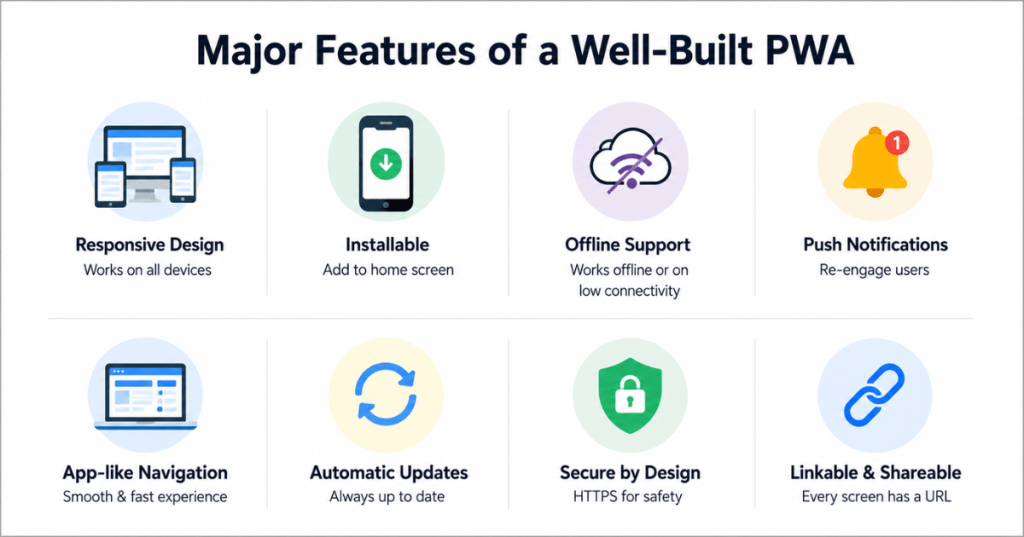
Not every website that calls itself a PWA actually delivers the full experience. Here’s what to look for — and what any credible PWA development services in Dubai provider should be building into your app:
- Responsive design that adapts seamlessly across mobile, tablet, and desktop screens.
- Installable on the home screen without going through an app store.
- Offline and low-connectivity support through smart caching strategies.
- Push notifications to bring users back without relying on email or SMS.
- App-like navigation with smooth transitions and minimal reliance on full page reloads.
- Automatic updates — users always get the latest version without manually updating anything.
- Secure by design, since HTTPS is a non-negotiable requirement.
- Linkable and shareable, meaning every screen has a URL that can be shared directly — something native apps can’t easily replicate.
Read More :- How to Choose the Best Mobile App Development Company UAE
Industry Applications: Where PWAs Are Making an Impact in the UAE
PWAs aren’t a one-size-fits-all solution, but their flexibility makes them relevant across a surprising number of sectors:
- Retail and e-commerce. Online stores use PWAs to reduce cart abandonment by speeding up checkout and keeping the shopping experience alive even on flaky mobile networks — a real concern during high-traffic sale events.
- Real estate. Property platforms benefit from instant-loading listings, offline browsing of saved properties, and push alerts for new listings matching a buyer’s criteria.
- Hospitality and travel. Hotels and travel platforms use PWAs to let guests check booking details, boarding passes, or itineraries even without a stable connection at the airport.
- Government and public services. As government bodies across the UAE push forward smart-city and digital-government initiatives, PWAs offer a low-friction way for citizens to access services without downloading a separate app for every department.
- Logistics and delivery. Drivers and field staff rely on PWAs that keep working in low-signal areas, syncing data automatically once connectivity returns.
- Healthcare. Clinics and healthcare platforms use PWAs for appointment booking and patient portals that load quickly even on older devices.
This breadth of use cases is exactly why many businesses now treat PWA development as a core part of their digital strategy, not just an experimental side project.
Advantages and Disadvantages of Progressive Web Apps
No technology decision should be made without weighing both sides. Here’s an honest comparison:
| Advantages | Disadvantages |
|---|---|
| Lower development cost than building separate native apps | Limited access to certain native device features (e.g., advanced Bluetooth, some camera APIs) |
| Faster time-to-market | iOS support, while improved, still lags behind Android in some PWA capabilities |
| Works across all devices and operating systems | Discoverability can be harder since PWAs aren’t always listed in app stores |
| Easier to maintain — one codebase instead of several | Push notification support on iOS Safari has historically been more limited |
| Better SEO performance since content is crawlable | Heavy offline-first apps still require careful architecture to avoid performance issues |
| No app store approval delays or fees | Users unfamiliar with “Add to Home Screen” may not realize an app-like option exists |
The takeaway here isn’t that PWAs are flawless — it’s that for most small and mid-sized businesses, the advantages significantly outweigh the limitations, especially when budget and speed-to-market matter.
Why Experienced Developers Make PWA Projects More Successful
Building a high-performing Progressive Web App requires more than technical knowledge—it demands strategic planning and extensive testing. Experienced app developers in UAE understand regional customer behavior, device preferences, browser compatibility, and local business requirements. They design scalable architectures, implement reliable offline functionality, optimize performance across multiple platforms, and address challenges such as iOS limitations before launch. By anticipating technical issues early, skilled developers reduce project risks, improve user experience, and ensure your PWA delivers consistent performance as your business expands across the UAE market.
Understanding the Cost of Building a Super App
If your long-term vision includes combining multiple services into one platform, understanding the cost of super app development UAE becomes essential. Unlike standard Progressive Web Apps, super apps integrate features such as payments, messaging, booking systems, loyalty programs, and real-time tracking within a single ecosystem. These advanced capabilities require stronger backend infrastructure, scalable architecture, API integrations, and ongoing maintenance. While the investment is significantly higher, businesses benefit from greater customer engagement, increased retention, and the flexibility to expand services without rebuilding their digital platform.
What Influences App Development Costs in Dubai?
Every business has unique requirements, which is why app development cost in Dubai varies based on project complexity, features, integrations, design quality, and scalability goals. A basic Progressive Web App typically requires a lower investment than enterprise-grade solutions with payment gateways, multilingual support, AI capabilities, or custom backend systems. Additional factors such as security requirements, cloud infrastructure, third-party APIs, and ongoing maintenance also influence the final budget. Understanding these variables helps businesses plan realistic investments while selecting features that deliver the highest long-term return.
Best Practices for Successful PWA Development
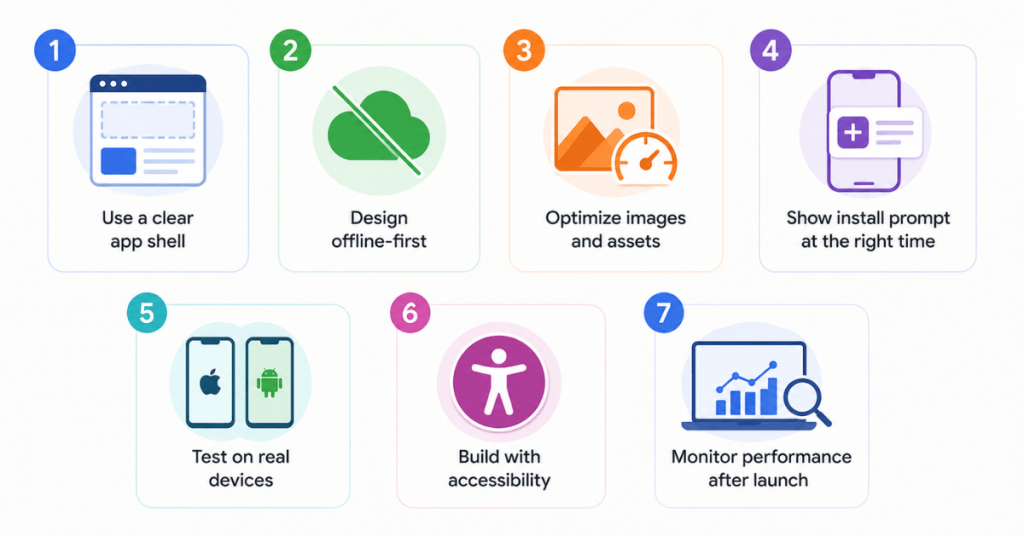
If you’re planning to invest in a PWA, these practices consistently separate the projects that succeed from the ones that quietly underperform:
- Start with a clear app shell strategy so your interface loads instantly, even before content arrives.
- Design offline-first, not offline-as-an-afterthought — plan what should still work without a connection from day one.
- Optimize images and assets aggressively, since speed is the entire value proposition of a PWA.
- Make the install prompt visible and well-timed, rather than burying the “Add to Home Screen” option.
- Test across real devices, not just emulators, especially across the iOS and Android split common in the UAE market.
- Build with accessibility in mind, ensuring the app works well for all users, including those using assistive technologies.
- Monitor performance post-launch using tools like Lighthouse to catch regressions early.
Future Trends: What’s Next for PWAs in the UAE
The PWA landscape is evolving quickly, and a few trends are worth watching closely:
- AI-driven personalization is becoming standard, with PWAs increasingly using behavioral data to tailor content and recommendations in real time.
- Rising demand for super apps. The UAE’s appetite for all-in-one platforms — combining payments, bookings, and services — is pushing more businesses to explore super app architecture built on a PWA foundation.
- Improved iOS support is gradually closing the gap with Android, making PWAs an even safer long-term bet.
- 5G adoption across the region is making even richer, more interactive PWA experiences viable without sacrificing speed.
- Voice and conversational interfaces are starting to integrate into PWAs, particularly in retail and customer service contexts.
Businesses that invest in PWA infrastructure now are positioning themselves to adopt these trends faster than competitors still tied to slower, native-only development cycles.
Why SISGAIN Is Essential for These Services
Technology alone doesn’t guarantee results — the right development partner does. As a mobile application development company in Dubai, SISGAIN brings together technical depth and regional market understanding, which matters when you’re building for UAE-based customers with specific connectivity patterns, payment preferences, and bilingual content needs.
Working with experienced app developers in UAE means your PWA is architected correctly from the start — covering offline strategy, security, and scalability — rather than retrofitted after performance issues surface. SISGAIN‘s approach typically includes:
- A discovery phase that maps your business goals to the right PWA features, instead of a one-size-fits-all template.
- Transparent guidance on app development cost based on your actual scope, not inflated estimates.
- Experience scaling from a focused PWA into broader super app development as your business grows.
- Ongoing support post-launch, since a PWA’s performance depends on continuous monitoring and updates.
Choosing a partner who understands both the technical and commercial side of PWA development is often the single biggest factor in whether a project delivers real business growth with PWA in UAE or just becomes another underused digital asset.
Conclusion
Progressive Web Apps have moved well past the experimental stage. For businesses across Dubai and the wider UAE, Progressive Web App development in Dubai offers a genuinely practical path to reaching customers faster, cutting development costs, and staying competitive without the overhead of maintaining multiple native apps. From faster load times and offline functionality to easier maintenance and stronger SEO performance, the benefits compound quickly once a PWA is built thoughtfully and maintained properly.
That said, a PWA is only as good as the strategy and team behind it. Understanding the real costs, the genuine challenges, and the best practices outlined in this guide puts you in a far stronger position to make a decision that actually serves your business goals — rather than just following a trend.
Frequently Asked Questions ?
1. What is the difference between a PWA and a native app?
A PWA runs through a browser and works across all devices with a single codebase, while a native app is built separately for iOS and Android and must be downloaded from an app store. PWAs are generally faster to build and cheaper to maintain, though native apps still offer deeper access to certain device hardware.
2. Do Progressive Web Apps work on iPhones?
Yes, PWAs work on iPhones through Safari, though some features — particularly certain push notification capabilities — have historically been more limited on iOS compared to Android. Apple has been steadily improving this support in recent updates.
3. How much does Progressive Web App development cost in Dubai?
Cost depends entirely on scope — a simple PWA costs considerably less than a feature-rich app with payment integration, multi-language support, or super app functionality. A detailed discovery conversation with a development team is the most reliable way to get an accurate estimate.
4. Can a PWA replace my mobile app completely?
For many businesses, yes — especially those prioritizing speed-to-market and lower maintenance costs. However, businesses needing deep hardware integration (like advanced camera or sensor access) may still benefit from a native app alongside their PWA.
5. Which industries in the UAE benefit most from PWAs?
Retail, real estate, hospitality, logistics, healthcare, and government services have all seen strong results, largely because these sectors depend heavily on fast, reliable mobile experiences for a wide range of users.


Leave a Reply